skip to main contentskip to main navigation
 
State of New Jersey Deapartment of Human Services title graphic  
Governor Chris Christie • Lt.Governor Kim Guadagno
 
Office for Prevention of Developmental Disabilities
New Jersey Helps
NJ 211 Community Resource Website
New Jersey Housing Resource Center
New Jersey Mental Health Cares Hotline
NJ Family Care

Lead remains the leading environmental threat to the health of New Jersey’s children. As the most densely populated state in the Union, and among those states with the oldest and most extensive industrial heritage, New Jersey contains a substantial amount of lead, subjecting our residents to the dangers of lead poisoning.

The legacy of lead in housing, soil and water often creates unacceptably high exposure levels to children, adults, pets and wildlife.  The Departments of Human Services, Health and Senior Services, and Community Affairs work together closely to address these issues and to protect our children from becoming poisoned.  This page provides links to resources and provides information on how lead harms children and what we all can do to prevent it.

But lead is not the only environmental health threat, especially for children...

Cadmium found in children's jewelry made in China, replacing dangerous lead...
children's jewelry containing cadmiumLOS ANGELES - Moving swiftly, U.S. product safety authorities say they are launching an investigation into the presence of the toxic metal cadmium in children's jewelry imported from China after disclosure of lab tests showing that some pieces consisted primarily of the dangerous substance.  Cadmium is ranked number seven on the CDC's priority list of 275 most hazardous substances in the environment!  Read more...
For more information about cadmium, go to the Agency for Toxic Substances & Disease Registry page.
 
 
Plastic toxins - new environmental threats...
Since OPDD is charged with educating the public, we have expanded our information to include newly emerging toxins, especially BPA and PVC. Below, you will find links to their pages.
 
 
Bisphenol A or BPA - found in water bottles and food storage containers...
baby bottles and pacifiers with bpa

Bisphenol A, better known as BPA
, is emerging as a possible toxin - especially during fetal development or for newborns - as studies over the past several years are connecting BPA levels to various health problems.


Polyvinyl chloride or PVC - toxins have been banned in toys... but not always in school supplies
plastic backpacksPolyvinyl chloride, or PVC, is a major source of phthalates – which are the same dangerous plastic softeners banned from children's toys in recent years.

The organization MomsRising.org has gathered information about PVC in school supplies, which are often made from materials that were banned in 2008 from children's toys, but not banned from many school supplies and other items for children. Check out our PVC page before you do your back-to-school shopping!
 
 
Lead is #1 preventable environmental health problem - Here are important resource links & materials...
Get the Lead Out – Teachers Manual: Lead poisoning is the nation’s #1 preventable environmental health problem facing children today.  This manual is for child care providers and teachers, with checklists and workbook materials.
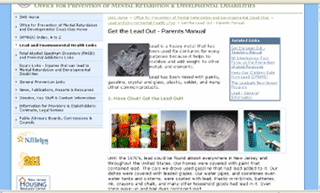
 

Get the Lead Out - Parents Manual (pictured above) - We have created this illustrated web page to show step by step measures for parents and families to use in safeguarding children from lead.  Lead can be found in the workplace, in homes, in hobby materials, and many unexpected places.  Check out this page to see examples.

Keep Our Children Safe from Lead - DHS's Division of Medical Assistance and Health Services (DMAHS) through the NJ FamilyCare program - also provides lead poisoning prevention materials.  There are English/Spanish manuals for teachers, caregivers, and parents, as well as Lead Poisoning Information Packets in six languages that you can download from this DMAHS page.
 
 
Toxins are everywhere...
Lead content in imported children’s toys and other common household products has emerged as a major source of risk of exposure to this toxic metal. Check the Consumer Action Guide to Toxic Chemicals in Toys, available to the public at www.healthytoys.org, to see how the commonly purchased children's products rank in terms of containing lead, cadmium, arsenic and other harmful chemicals.

While lead remains the greatest environmental threat to the development of children’s neurological systems, children are exposed to a myriad of other chemicals and toxins that may result in poor developmental outcomes.  Ironically, the purpose of many of these toxic-laden products is to make our lives easier and more comfortable.  Our homes, both inside and out, are built and furnished with materials that are treated with or have substances added to them to make them more durable and attractive. 

Necessities, including our food and clothing, are subjected to chemical exposures, both natural and synthetic, that may have harmful health effects.  Common appliances like washing machines and dishwashers, as well as service businesses such as dry cleaners, all use environmentally toxic substances.

These toxins accumulate in fat, blood, organs, hair and nails.  They pass easily through the body in amniotic fluid, breast milk, urine, feces, sweat and semen.  These exposures greatly threaten our health and that of future generations.

Additional publications dealing with Childhood Lead Poisoning Prevention

New Jersey Interagency Taskforce on the Prevention of Lead Poisoning 


Toxins found in everyday items...
The list of such substances is extension. Examples of chemicals, metals and toxins that are common in our daily lives include: cadmium; mercury; cotinine (a metabolite of nicotine); phtalates (a chemical used in nail polish, soaps and shampoos, as well as in soft plastic products like PVC pipes, flooring and iPods); pesticides; and wood preservatives.


Chemicals, metals & toxins:

Uses:

Cadmium - by-product in the production of zinc and lead
NiCd batteries 
        Cadmium red yellow pigmentschildren's jewelry containing cadmium children's necklace containing cadmium 

Ni-Cd batteries for cordless power tools, cellular telephones, camcorders, portable computers, portable household appliances and toys.

Bright yellow to deep red pigments in plastics, ceramics, glasses, enamels and artists colours.

Stabilizers to ensure long life of PVCs

Corrosion resistant coatings on steel, aluminium & non-ferrous metal fasteners and moving parts; electronic parts

As alloys in electrical & heat conductivity alloys, electrical contact alloys; in solar cells,

Mercury
fish thermometer
 mercury BP monitor Mercury Vapor Lamp

laptop automatic shutoff    thermostat 
mercury silent light shutoff      wash machine shutoff barometers mercury emissions 

Fish & seafoodraccoon eating mercury contaminated fish 


Medical uses: thermometers, BP monitors, feeding tubes, dental amalgam (within silver fillings), lab chemicals, medical batteries for blood analyzers, defibrillators, hearing aids, meters, monitors, pacemakers, pumps, scales, telemetry transmitters, blood gas analyzers, ultrasound & ventilators

Batteries, fluorescent & high-intensity lamps; non-electronic thermostats; pressure gauges; some electrical switches in air flow/fans, building security systems, fire alarm box switches, lap-top computer screen shut-off, silent light switches, washing machine power shut off

Float controls in septic tanks & sump pumps

Non-digital thermostats; thermostat probes in gas appliances

Pressure gauges: barometers, manometers & vacuum gauges

Personal computers that use a printed wire board

Cotinine – a nicotine metabolite that accumulates in the blood and urine following tobacco smoke inhalation
cigarette smoke    cigarette in ashtray with smoke 

ETS - Environmental Tobacco Smoke or “secondhand smoke” – Children with a greater exposure to tobacco smoke were significantly more likely to have more severe asthma, an increased number of respiratory illnesses, and lower lung function.

Phthalates – so-called plasticizers, give synthetics their elastic character. Used mainly in soft PVC (polyvinylchloride). Not permanently fixed within soft PVC, they evaporate or dissolve when exposed to liquids and fats. Consequently, they’re found throughout the environment.
nailpolish PVC pipe stool
yellow ducky  vs.yellow ducky 
iv feeding tubes with phthalates can be harmful to preemies   phthalate baby teething ring

Baby products such as shampoo, lotion or powder Nail polish, soaps, shampoos, soft plastic products like PVC pipes, flooring, iPods, fake leather, wallpapers, shower curtains.

Phthalate-leaching toys and baby products pose a particular threat to infants and young children. Phthalates can be ingested, inhaled and absorbed through the skin. Phthalates can also be found in plastics made with bisphenol A (BPA). 
Phthalates interfere with the production of  testosterone and have been associated with reproductive abnormalities.


In babies, could hurt their reproductive ability later on in life. It seems absorption of phthalates through the skin seems to be an important way many babies get their phthalates
Banned from children’s toys & baby articles in Europe.

Pesticides 

Pesticides are used to protect food from pests, such as insects, rodents, weeds, mold, and bacteria.

Pesticides used on food include:

  • insecticides to control insects
  • rodenticides to control rodents
  • herbicides to control weeds
  • fungicides to control mold and fungus
  • antimicrobials to control bacteria

various pesticides  spraying fields 
             lawn flag warning of pesticides
           don't put pesticides in food containers like milk cartons 

crop dustingAdverse effects of pesticide exposure range from mild symptoms of dizziness and nausea to serious, long-term neurological, developmental and reproductive disorders. 

crop dusting                    

Kids need Protection

Children are at a greater risk for some pesticides for a number of reasons.

Children's internal organs are still developing and maturing and their enzymatic, metabolic, and immune systems may provide less natural protection than those of an adult. There are "critical periods" in human development when exposure to a toxin can permanently alter the way an individual's biological system operates.

Children may be exposed more to certain pesticides because often they eat different foods than adults.

For instance, children typically consume larger quantities of milk, applesauce, and orange juice per pound of body weight than do adults.

pesticides in home can affect baby crawling Children's behaviors, such as playing on the floor or on the lawn where pesticides are commonly applied, or putting objects in their mouths, increase their chances of exposure to pesticides.

Americans use more than a billion pounds of pesticides each year to combat pests on farm crops, in homes, places of business, schools, parks, hospitals, and other public places.

Wood preservatives
deck wood is usually preserved                                
                                 deck wood is usually preserved 

Furniture, flooring, paneling, windowsills, doorsills

Outdoor decks, fences

deck wood is usually preserved 


Results of Exposure to Toxins...
Exposure to toxins results in poor developmental outcomes or illnesses, including asthma, in an equal-opportunity fashion.  However, different outcomes can be attributed to age, e.g., children’s developing systems are far more sensitive to these toxins than adults, and socioeconomic standing. 

Where people live and work effects their exposure to toxins.  Toxic exposure tends to be higher in lower socioeconomic neighborhoods which are near old industrial sites or full of older homes.  So children in lower socioeconomic households are often at far greater risk of being exposed to these harmful substances.

More information about environmental hazards are available at the American Association on Intellectual and Developmental Disabilities: www.aamr.org/ and  the Alliance for Healthy Homes: http://www.afhh.org/

Book cover of Slow Death by Rubber DuckProvocative and groundbreaking, Slow Death by Rubber Duck reveals how the living of daily life creates a toxic soup inside each of us.

Studies have shown that significant levels of toxic substances can leach out of commonplace items in our homes and workplaces. How do these toxins make their way inside us and what impact do they have on our health? And more importantly, what can we do about them?

Rick Smith and Bruce Lourie, two of Canada's leading environmental activists, tackle these questions head on by experimenting upon themselves. Over a four-day period, our intrepid (and perhaps foolhardy) authors ingest and inhale a host of things that surround us all every day, all of which are suspected of being toxic and posing long term health risks to humans. By revealing the pollution load in their bodies before and after the experiment - and the results in most cases are downright frightening - they tell the inside story of seven common substances.
More...


OPRA - Open Public Records Act NJ Home Logo
Department: DHS Home  |  DHS Services A to Z  |  Consumers & Clients - Individuals and Families  |  Important Resources  |  Divisions & Offices  |  Commissioner & Key Staff  |  Disaster & Emergency Help & Information  |  Press Releases, Public and Legislative Affairs, & Publications  |  Providers & Stakeholders: Contracts, Legal Notices, Licensing, MedComms  |  Get Involved with DHS!
Statewide: NJHome  |  Services A to Z  |  Departments/Agencies  |  FAQs
 
Copyright © State of New Jersey, 1996 - 2008
Contact Us Privacy Notice Legal Statement & Disclaimers Accessibility Statement NJ Home Page