Delaware • New Jersey • Pennsylvania
New York • United States of America

- Introduction
- Designated Uses & Assessment Protocol
- Data Sources
- 2026 Water Quality Assessment
- Report Archives: 1998 - 2024
 |
Every two years, the DRBC compiles a Delaware River and Bay Water Quality Assessment Report for the U.S. EPA, which provides an assessment of the mainstem Delaware River and Bay's support of its designated uses during previous years.
The Basin states use the DRBC mainstem assessment as part of their reports to U.S. EPA, which are also compiled every two years.
DRBC's Role in Water Quality Management
• Establish or revise water quality standards, water quality criteria and designated uses for the mainstem Delaware River. Each Basin state's water quality regulations refer to or defer to DRBC for the mainstem.
• Implement and enforce water quality criteria through DRBC docket approvals or administrative agreements.
• Conduct monitoring and assessments to ensure that criteria are being met.
• Lead impaired waters' recovery for the mainstem river and bay through the establishment of "pollution budgets" or waste allocations, which set interim and long term standards, goals and plans.
• Ensure that the Commission's Special Protection Waters Antidegradation Program for the non-tidal Delaware River is working.
Designated Uses
The designated uses, which are protected by the DRBC's Water Quality Regulations (PDF) or by the federal Clean Water Act of 1972, are:
- Maintenance of aquatic life
- Providing a raw water source for human consumption (public water supply)
- Swimming and recreation
- Fish consumption
- Shellfish consumption
Assessment Protocol
The assessment primarily involves comparing levels of key water quality indicators (pH, for example) with DRBC stream quality objectives in order to identify impaired waters that do not meet DRBC's water quality regulations.
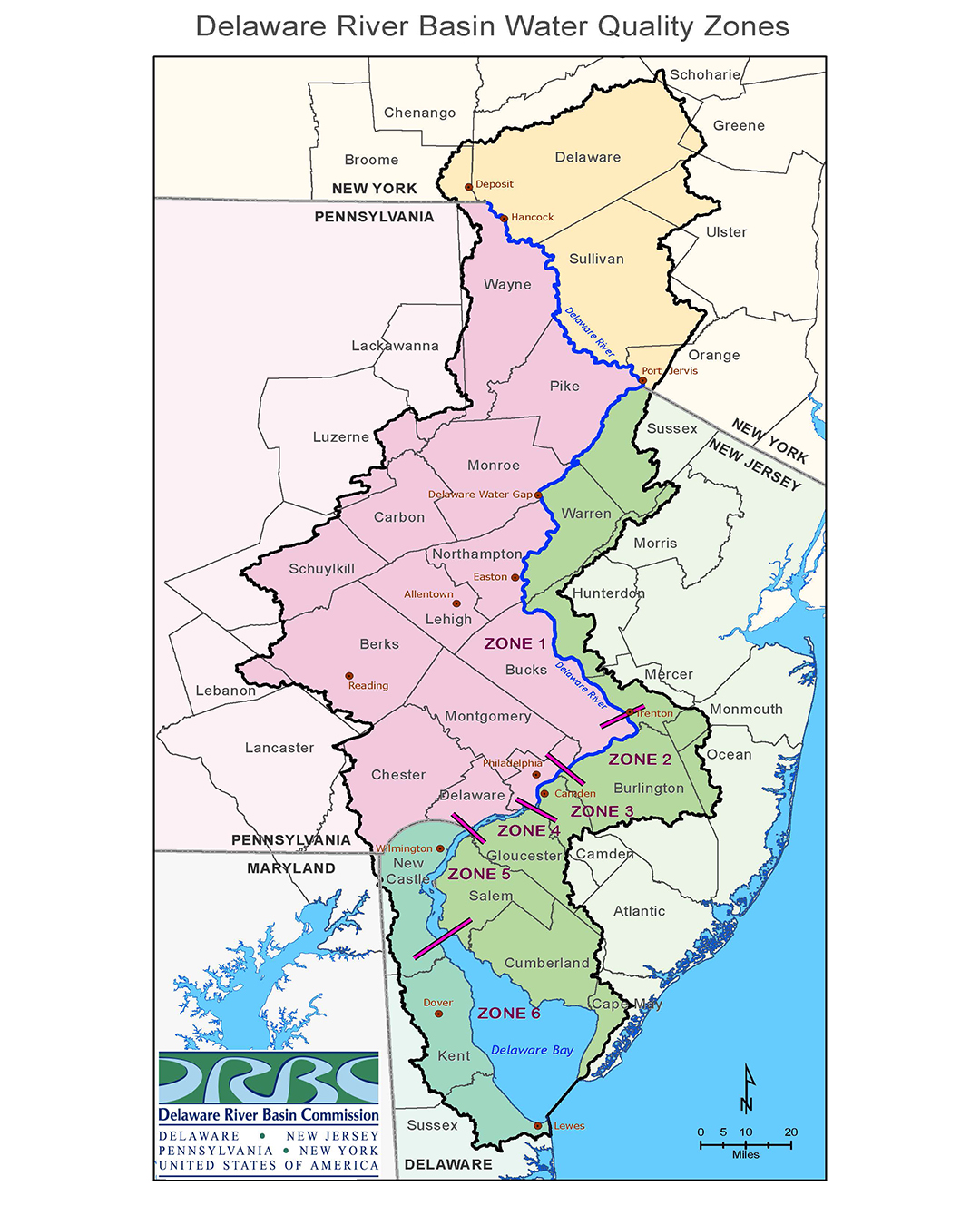
The regulations define "zones" in the Delaware River (see map above; click to view larger) to which the stream quality objectives are applied, and the report assesses water quality based in part upon those zones.
The biennial reporting of water quality assessments of the Delaware River and Bay is intended to provide the U.S. EPA and the public with an overview of water quality conditions and to provide a basis for further study.
Data Sources for the Assessment Report
→ DRBC monitoring programs provide the foundation for the assessment:
- Scenic Rivers Monitoring Program (upper, middle and lower non-tidal Delaware River)
- Delaware Estuary Boat Run Program (tidal Delaware River from Trenton, N.J. to the mouth of the Delaware Bay)
- DRBC Biological Monitoring Program
- DRBC Ambient Toxicity Monitoring
→ Data from other sources include:
-
DNREC Dioxins and Furans in Fish from the Delaware River Study
-
Pennsylvania Department of Environmental Protection (PADEP) Water Quality Network (WQN)
-
New Jersey Department of Environmental Protection (NJDEP) Ambient Surface Water Monitoring Network (from STORET)
-
New York State Department of Environmental Conservation (NYSDEC) Ambient Water Quality Monitoring Program (from STORET)
-
United States Geological Survey (USGS) National Water Information System (NWIS)
-
DRBC/USGS Cooperative Monitoring Program (continuous monitors)
-
National Oceanic Atmospheric Administration (NOAA) Physical Oceanographic Real‐Time System (PORTS) data
-
U.S. EPA National Coastal Assessment Programs
DRBC staff is preparing the 2026 Assessment report and collected comments through March 31, 2026, on the proposed assessment methodology.
For the 2026 assessment, DRBC will assess readily available data for a 5-year data window ending September 30, 2025. The proposed methodology is based on the methodology used in the 2024 report, with some revision to the assessment of bacteria data and total dissolved solids.
All are PDFs.
