

HIV, STD, and TB Reporting
Reporting Resources
Healthcare Professionals and Administrators
- Reporting Requirements
- Report to the Local Health Department
- How to Report
- Resources
- Frequently Asked Questions
Reporting Requirements
Healthcare professionals and administrators are legally required to report suspected and/or confirmed communicable diseases, outbreaks, and other public health emergencies to public health authorities in accordance with N.J.A.C. 8:57.
“Healthcare Professionals” include physicians and advanced practice nurses. "Administrator” includes persons with oversight over healthcare facilities, correctional facilities, state psychiatric hospitals, institutions of higher education, schools, childcare centers, youth camps, farm or migrant labor camps, insurers, and facilities under the jurisdiction of NJDCF, NJDHS, and NJLPS/YJC.
Download printable communicable disease reporting requirements for healthcare providers and administrators
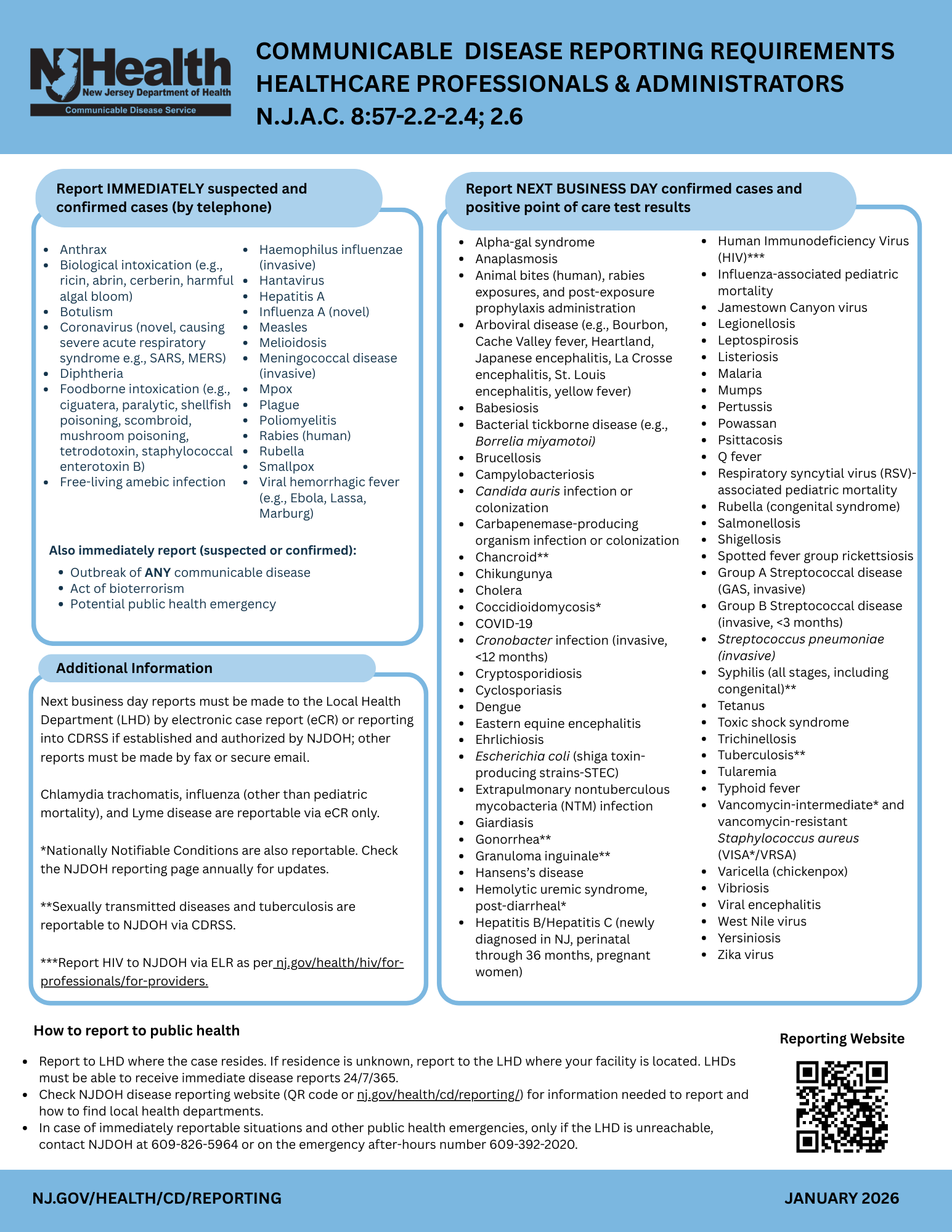
Reporting Timeframes
Certain communicable diseases, suspected outbreaks, and other public health emergencies must be reported immediately by telephone upon suspicion even if laboratory tests are still pending. Clinical judgement alone is enough to initiate a public health response to prevent the spread of diseases.
Non-immediately reportable diseases must be reported by the next business day.
Report to the Local Health Department
Reports must be made to the Local Health Department (LHD) where the patient resides, or if unknown, to the LHD where your facility is located.
-
Find your LHD: Use the Find Your Local Health Department locator or the PDF to locate your LHD
-
24/7 Availability: All New Jersey LHDs are required to maintain a mechanism to receive and respond to immediately reportable conditions 24 hours a day, 7 days a week, including weekends and holidays.
-
Emergency Backup: Only if an LHD cannot be reached for an immediately reportable situation or public health emergency, contact NJDOH at 609-826-5964 or on the emergency after-hours number 609-392-2020.
How to Report
-
Immediately reportable diseases and situations must be made to the LHD by telephone
-
Other reports must be made through electronic case report (eCR) or reporting into CDRSS if established and authorized by NJDOH; OR
-
If eCR or CDRSS access have not been authorized, by fax or secure email to the LHD
-
Point-of-care test results must be reported into CDRSS.
Required Information
-
Disease name
-
Patient demographics (name, age, DOB, sex assigned at birth, current gender identity, sexual orientation, race, ethnicity)
-
Patient home address, all known telephone numbers, and email address
-
Clinical presentation & diagnosis
-
Date of symptom onset
-
Clinical laboratory data that support the diagnosis, if available
-
A description of provided treatment
-
Hospitalization and mortality status
-
Reporting provider or administrator name, institution name, address, telephone number, and email address
-
Medical records upon request
Resources
List of Diseases Reportable by eCR
National Notifiable Condition List: Diseases added to the National Notifiable Condition List are reportable in New Jersey. Updates will be reflected annually on the Communicable Disease Reporting Requirements for Healthcare Professionals & Administrators disease list.
Frequently Asked Questions
Why must healthcare professionals report if the laboratory also reports?
Laboratory reports often lack essential clinical and exposure information needed for public health investigations. Information from healthcare professionals includes important information that public health authorities need to investigate and respond to illness and helps the health department analyze trends, identify risk factors, and track whether existing disease prevention activities are working.
Do both healthcare professionals and administrators need to report the same case?
Duplicate reporting of the same case by healthcare professionals and administrators is not necessary, but each is responsible for ensuring the case is reported.
What can healthcare professionals expect during an investigation?
Healthcare professionals may be contacted by the LHD and asked to provide clinical or diagnostic information regarding a patient. They also may be asked to collect additional clinical specimens to confirm the diagnosis of cases and to participate in prevention activities, including administering vaccines and prophylactic antibiotics.
Why is it important for healthcare professionals to report diseases in a timely manner?
The earlier illnesses are reported, the faster public health authorities can act. This allows public health officials to conduct timely investigations and enact prevention and control measures quickly.
How will I know if eCR has been authorized for my practice or organization for public health reporting?
Healthcare professionals should verify with their Healthcare Organization (HCO) or Electronic Health Records (EHR) vendor to determine if eCR is being received by NJDOH and for which communicable diseases.
How can I report a communicable disease if the patient lives outside of NJ?
Each state has information on how to report communicable diseases on their website. Search online for “<<STATE>> Department of Health Communicable Disease Reporting Procedures” to find information for that state.
Are healthcare professionals and administrators required to report point-of-care tests for COVID-19, influenza, and RSV?
All point-of-care tests are reportable for COVID-19. For RSV and seasonal influenza, point-of-care tests are reportable for cases associated with pediatric deaths or for cases associated with an outbreak.