Delaware • New Jersey • Pennsylvania
New York • United States of America

 |
PFAS Water Quality and Fish Tissue Assessment Study - Year 3
In May 2026, the DRBC published a technical report sharing the latest results of extensive field investigation and monitoring of per- and polyfluoroalkyl substances (PFAS).
This report marks the final report of a three-year grant-funded assessment of PFAS in surface water, sediment, fish tissue and blue crabs of the Delaware River mainstem and selected tributaries.
This multi-year assessment and complementary DRBC studies have found PFAS consistently detected in surface water, sediment, fish and blue crab tissues, underscoring the complexity and scope of PFAS pollution in the Basin.
View Report
• PFAS Water Quality and Fish Tissue Assessment Study - Year 3 (PDF; May 2026)
News Release
• New Research Details PFAS Prevalence in the Delaware River Basin (issued May 28, 2026)
Public Webinar: June 15, 2026
DRBC staff held a public webinar "PFAS in the Delaware River Basin: An Update from the DRBC" on June 15, 2026, to discuss notable trends and takeaways from this report and demonstrate a new interactive application that visualizes PFAS levels across the Basin.
Related Resources
Key Takeaways from the Study
- PFAS contamination is widespread, persistent and increasing downstream in the Delaware River Basin, particularly in tidal waters
- There are likely significant inputs between Chester, Pa. and Pea Patch Island from currently unidentified sources
- In surface waters, PFAS were detected at nearly every site
- Sediment results were variable across both sites and years, with more frequent and consistent detections at sites where sediment is more likely to accumulate (for example, side channels or embayments)
- PFAS were detected in every fish tissue and blue crab sample, and while concentrations varied by species and site. Specifically, PFOS is often the dominant PFAS in fish tissue.
- Passive samplers (POCIS) are a valuable complement to grab sampling, improving detection of low-level and less frequently observed PFAS
- Current analytical methods capture only a small fraction of known PFAS compounds, limiting ability to fully assess and respond to the threat of PFAS in the Delaware River Basin
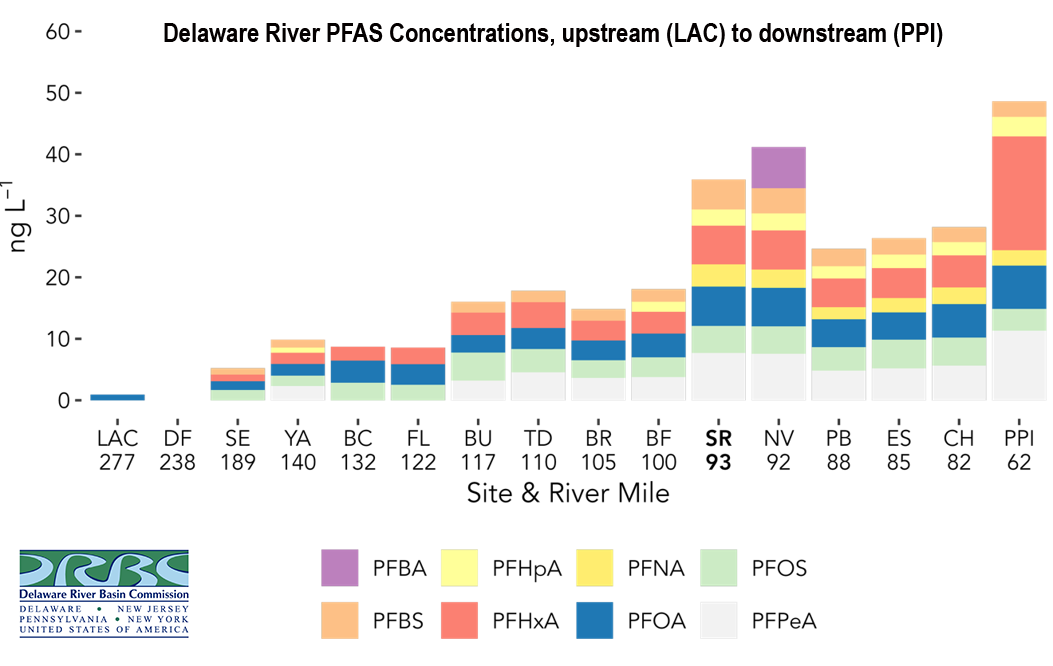
This graphic shows how PFAS concentrations (measured in nanograms per liter, ngL-1) increase from upstream (LAC = Lackawaxen) to downstream (PPI = Pea Patch Island) in the Delaware River; Schuylkill River (bolded) also included.
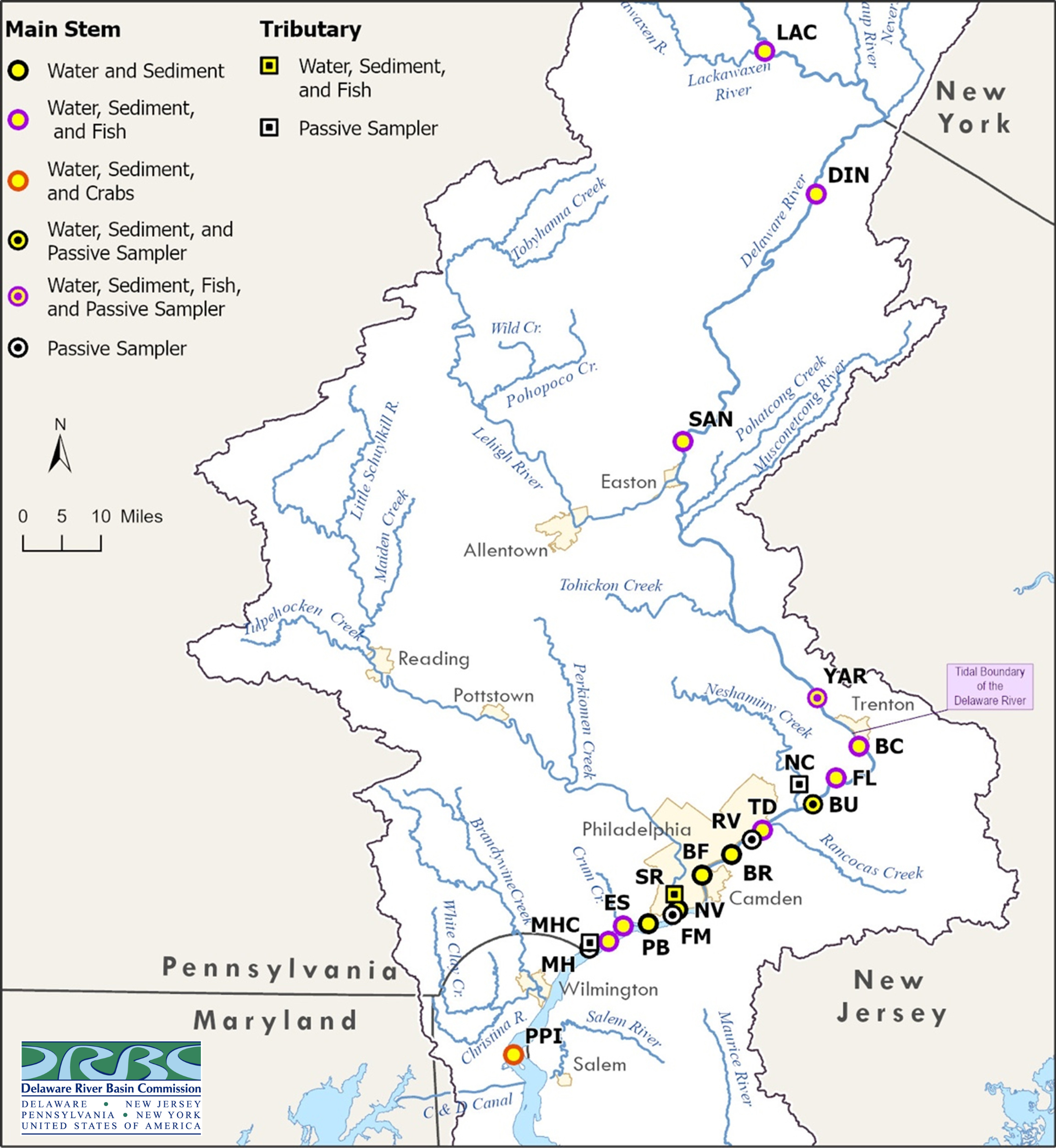
The different colors represent different PFAS compounds. See below for a complete listing of sites sampled.
Next Steps
- Continued monitoring, especially in portions of the tidal river and in tributaries highly impacted by urbanization/industrialization
- Targeted tracking and trend modeling to determine sources and reduce inputs
- Regular updates to the DRBC's PFAS interactive tool, sharing with the public all open-access PFAS data for the Basin to enhance understanding and awareness
- Continued coordination and communication with regional partners and stakeholders to support science-based management actions to protect aquatic life and wildlife and safeguard human health
 |
Background
PFAS are a diverse group of more than 14,000 chemical compounds with varying degrees of toxicity and bioaccumulation in the environment. The most produced and studied are Perfluorooctanoic acid (PFOA) and Perfluorooctanesulfonic acid (PFOS). Known as forever chemicals, they have unique properties to repel water and oil and are characterized by strong bonds making them indefinitely persistent in the environment.
This study builds on previous work by the DRBC to study contaminants of emerging concern, including PFAS, pharmaceuticals and personal care products (PPCPs), 1,4-dioxane, bromides, microplastics, and chlorides/freshwater salinization.
Study Design
• Samples Collected Summer 2023
• Four (4) non-tidal Delaware River sites sampled for water, sediment and fish tissue: smallmouth bass and white sucker
• 10 tidal Delaware River sites and the Schuylkill River sampled for water, sediment and fish tissue: white perch and channel catfish
• One (1) tidal Delaware River site sampled for water, sediment and blue crabs (PPI)
• Seven (7) sites had passive samplers (POCIS) deployed to capture time-weighted average PFAS concentrations over 28 days
All samples were analyzed for 40 PFAS compounds using EPA Method 1633.
→ Non-tidal Delaware River
• Lackawaxen (LAC)
• Dingmans Ferry (DIN)
• Sandts Eddy (SAN)
• Yardley (YAR)*
→ Tidal Delaware River
• Biles Channel (BC)
• Florence (FL)
• Burlington Bristol Bridge (BU)*
• Torresdale (TD)
• Riverton Yacht Club (RV)**
• Betsy Ross Bridge (BR)
• Ben Franklin Bridge (BF)
• Navy Yard (NV)
• Fort Mifflin (FM)**
• Philadelphia Airport (PB)
• Eddystone (ES)
• Chester (CH)
• Marcus Hook (MH)**
• Pea Patch Island (PPI)
→ Tidal Tributary
• Neshaminy Creek (NC)**
• Schuylkill River (SR)
• Marcus Hook Creek (MHC)**
*also had POCIS sampler
**POCIS sampler only
Please Note:
- All PFAS data, past and present, generated by DRBC on PFAS is publicly available in the US EPA's Water Quality Portal.
- This work was funded in part by grants from the U.S. Fish and Wildlife Service through the National Fish and Wildlife Foundation's Delaware Watershed Conservation Fund.
- Additional funding from the US EPA supported the development of the interactive web application.
