 Official Site of The State of New Jersey

An Investigation of Fraud, Waste, and Abuse in Two New Jersey Nursing Homes
- Posted on - 12/10/2025
Table of Contents
Executive Summary
The Office of the State Comptroller (OSC) has conducted an in-depth investigation into the operations of two nursing homes, Hammonton Center for Rehabilitation and Healthcare (Hammonton) and Deptford Center for Rehabilitation and Healthcare (Deptford), focused on a five-and-a-half-year period from 2019 to 2024. OSC found a troubling pattern of mismanagement, self-dealing, and profiteering by owners Daryl Hagler (Hagler) and Kenneth Rozenberg (Rozenberg), who own 46 nursing homes in four states. Through deceptive financial arrangements with related-party interests they owned, Hagler and Rozenberg inflated rent payments from the nursing homes to their property companies, intentionally understaffed both facilities, and diverted to themselves tens of millions of dollars in Medicaid funding intended to be used to care for vulnerable residents. They furthered their scheme by hiding these actions through false state and federal filings that failed to disclose the extent and profitability of their scams.
Hagler and Rozenberg maximized their profits in part by failing to pay for staff to care for residents. OSC reviewed 146 days from February 1, 2021 to May 31, 2024, and found that Hammonton and Deptford failed to meet the minimum required staff-to-resident ratios for almost all of the days that OSC reviewed. Hammonton was understaffed by an average of almost 52 percent daily, and Deptford was understaffed by an average of 54 percent daily, which means that residents in both facilities received less than half the minimum of direct care they were required by law to receive. The use of inadequately licensed and unqualified staff further imperiled the residents, with both facilities employing Licensed Practical Nurses (LPNs) in roles that should have been filled by Registered Nurses (RNs).
The chronic understaffing resulted in substandard care that stripped residents of their dignity. The nursing homes consistently received ratings of “much below average.” State surveys and inspections, frequent police reports, and witness accounts document the persistent state of misery at the nursing homes – missed medication doses, emergency calls due to inadequate staffing, and unsanitary conditions – leading to preventable suffering and at least one known tragic outcome for residents. Lack of direct care staff meant that call bells went unanswered, residents screamed out for help, residents sat in soiled diapers, and there was generally insufficient staff to feed, bathe, and care for residents in the facility. The poor quality of care they provided led the Centers for Medicare & Medicaid Services (CMS) to designate both nursing homes as “Special Focus Facilities” multiple times during the review period, a category reserved for the lowest performing nursing homes, the worst of the worst.
Hagler and Rozenberg were able to move money off the nursing homes’ books and into their bank accounts using a network of interrelated companies they owned and controlled, including:
· A Bronx, New York-based company called Centers for Care, LLC (Centers), owned by Hagler and Rozenberg;
· Two property companies that own the buildings and real estate for Hammonton and Deptford, owned by Rozenberg and M&J Klein Family Enterprises, LLC (KFE);
· A business consulting company owned by Hagler; Rozenberg; Rozenberg’s wife, Beth Rozenberg; Rozenberg’s daughter, Shoshana Rozenberg Areman; and Rozenberg’s son, Eli Rozenberg;
· An information technology company owned by Hagler and his son, Jonathan Hagler;
· A staffing company owned by Hagler; Rozenberg; Rozenberg’s daughter, Shoshona Rozenberg Areman; Hagler’s son, Jonathan Hagler; Amir Abramchik, Centers’ Chief Operating Officer; and Abramchik’s wife, Deborah Abramchik;
· Another staffing company owned by Rozenberg’s daughter, and Elisabeth Farkas, Rozenberg’s daughter-in-law;
· A building maintenance and construction company owned in part by Hagler; and
· Clinical laboratories owned by Rozenberg and his wife, Beth Rozenberg.
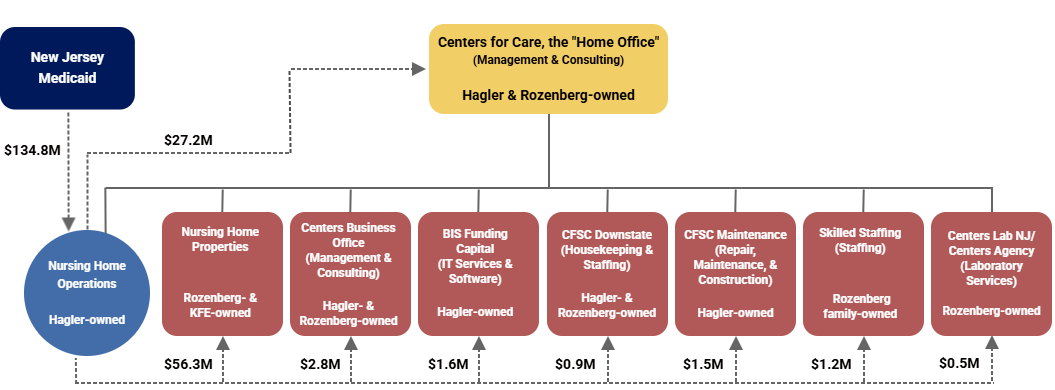
For the five-and-a-half-year period OSC reviewed, Hagler and Rozenberg moved $92 million through these companies, which is more than two-thirds of the $134.8 million they received in Medicaid funding from New Jersey. Because the risk of self-dealing is so great when related parties are involved, state and federal law limit how much related parties can be paid and requires disclosure of costs and profits. Hagler and Rozenberg were required by law to report how much they paid to companies they and their family members own. But they intentionally hid these transactions, reporting just $882,666 of the $92 million – less than 1 percent – to the state and federal governments. This was not a simple error; Hagler himself signed the false cost reports.
By hiding what they paid themselves through their related entities, Hagler and Rozenberg hid the outrageous deals they made with themselves from the government. The most lucrative scams stemmed from the mortgages and rent payments, and they were made possible by the legal separation of the nursing home operations from the nursing home properties. Hagler and Rozenberg bundled the purchase of both the operating companies and the properties into mortgages worth $63.2 million. The property companies then increased the rent charged to the operating companies to cover the mortgage payments. This scheme allowed Hagler and Rozenberg to purchase and own the nursing homes for nearly nothing, a mere 1.5 percent deposit. To avoid showing a profit, Hagler and Rozenberg on cost reports falsely labeled the mortgage payments as all rent, thus concealing the fact that $7.8 million paid toward the rent during the period OSC reviewed was for what should have been Hagler’s and Rozenberg’s private business loans.
They also used rent payments to move extraordinary amounts of money off the nursing homes’ books. Above and beyond the rent payments that paid for the mortgage principal, taxes, maintenance, and reserves, Hagler and Rozenberg paid Rozenberg’s property companies, in just five-and-a-half years, $27.8 million in duplicative and unnecessary “additional rent” payments. Those “additional rent” payments, according to the lease, were supposed to cover the property taxes, insurance, maintenance, and reserves—but those costs were already included in the base mortgage payments. So instead, $27.8 million in duplicative payments were distributed directly to Rozenberg and KFE, the other owner of the property companies.
Hagler and Rozenberg managed Hammonton and Deptford to reap grossly excessive profits for themselves while grievously harming the residents who lived in the facilities. They built a business that systematically redirected public funds intended for resident care to their own and their family members’ bank accounts.
OSC will therefore recover the funds Hagler, Rozenberg, and others wrongly took and impose penalties, where appropriate. OSC will pursue recovery of $86.3 million, an extrapolated overpayment amount, for the grievous lack of direct care staffing at the facilities. The Medicaid program, and taxpayers, paid for one thing—a quality nursing home that provides quality care and allows residents to live in dignity—but they got something else entirely—a nursing home where residents were forced to survive deplorable conditions. The state and federal government did not get what they paid for; taxpayers are entitled to get the money back.
In addition, or in the alternative, OSC is seeking a recovery of $35.5 million related to real estate scams and at least $2.1 million for wholly unsupported and undisclosed payments made to related parties. In total, OSC estimates that it will be seeking approximately $123.9 million in overpayments from Hagler and Rozenberg, their family members, KFE, and their related businesses. OSC will also seek penalties of $980,000 for failing to have RNs present in the facility in violation of state law plus additional penalties for filing false claims. OSC additionally will ensure the appropriate individuals and entities are barred from continuing to participate in Medicaid in New Jersey and advise other states of their misconduct here.
This investigation also revealed deficiencies in the State’s oversight of nursing homes that allowed their scams to continue for so long. It should not take a multi-year investigation to detect fraud of this magnitude. New Jersey must do more to recognize that nursing homes that consistently provide poor quality care, and receive so much money while doing so, provide an unmistakable signal that their owners may be committing fraud. OSC is thus again recommending changes to improve state regulation of nursing homes.
** Note: This report contains graphic images. **
Legal Background
A. State and Federal Legal Background
For nearly forty years, nursing homes have been highly regulated, both at state and federal levels, to ensure quality care for a vulnerable population. Congress enacted the Nursing Home Reform Act (NHRA) in 1987, which established specific standards of care for nursing homes receiving Medicaid or Medicare funds. The Act also established a nursing home resident Bill of Rights that recognizes residents are entitled to adequate care, privacy, participation in care planning, and freedom from retaliation if they complain about their living conditions.
Even prior to Congress acting, in 1976, New Jersey passed its own Nursing Home Responsibilities and Rights of Residents Act, N.J.S.A. 30:13-1 to -19, which included a resident Bill of Rights. Nursing homes are also subject to multiple state regulatory codes, including the Standards for Licensure of Long-Term Care Facilities, N.J.A.C. 8:39-1.1 to -47.5. In 2020, New Jersey codified minimum patient care ratio staffing requirements by shift. N.J.S.A. 30:13-18. The minimum staffing requirements are based on the number of residents living in a facility and differ depending on time of day.
Eligibility and terms of reimbursement for nursing facility services are detailed in N.J.A.C. 10:166-2.1 to -2.21. The primary goal of the state and federal regulations is to ensure that nursing homes deliver cost-prudent services that meet the residents’ medical, nursing, dietary, and psychosocial needs to attain and maintain their highest physical, mental, emotional, and functional status. 42 U.S.C. 1396r(b)(2); 42 U.S.C. 1395i-3; N.J.A.C. 10:166-2.1(a)(2). The New Jersey Department of Human Services (DHS) created the nursing facility reimbursement rate formula to “comply with Federal requirements that rates are reasonable and adequate to meet the cost that efficiently and economically operated facilities must incur to provide care.” N.J.A.C. 10:166-3.1(f)(1). Medicaid rules aim to prevent fraud, abuse, and unnecessary costs. N.J.A.C. 10:166-3.1(f)(3). Moreover, the Centers for Medicare & Medicaid Services’ (CMS) Provider Reimbursement Manual states that costs incurred by nursing homes should “not exceed what a prudent and cost-conscious buyer pays for a given item or service.” CMS Provider Manual – Part 1, Ch. 21 § 2102.1. See also 42 C.F.R. 413.9. Excess costs expended by a nursing home are not reimbursable by NJ Medicaid. N.J.A.C. 10:166-3.1(d) and N.J.A.C. 10:166-3.1(f).
In 2020, New Jersey enacted a law that directs the DHS Commissioner to establish a “direct care ratio reporting and rebate requirement.” N.J.S.A. 30:4D-7cc. This law and its implementing regulation require nursing homes to report their total revenues collected and to identify the portion of revenues spent on direct care staff wages, other staff wages, taxes, administrative costs, improvements to the facility’s equipment or building, and any other information required by DHS. N.J.A.C. 10:49A-2.2 to -2.6. If a nursing home spends less than 90 percent of Medicaid funds on direct resident care, the nursing home is required to return funds to the State. N.J.A.C. 10:49A-3.1.
B. Nursing Home Use of Related Parties
Caring for residents in long-term care facilities requires a spectrum of goods, services, and staff for nursing care, rehabilitative services, meals, building maintenance/cleaning, medical supplies, medication, operations management, and more. Often, nursing homes contract for all or some of these goods and services. In many instances, they contract with companies that share common ownership or control with the nursing home, which are known as related parties. 42 C.F.R. 413.17. Federal law recognizes that if a nursing home obtains goods or services from a business that is a separate legal entity, but that entity is owned or controlled by some or all of the nursing home owners, they are essentially obtaining these goods and services from themselves. 42 C.F.R. 413.17(c)(2).[1]
It is common for nursing homes to use related-party companies for staffing, management of the facility, and lease agreements with a property company for the building and the land. Conducting business with related parties is legal and commonplace, but the practice creates the potential for significant fraud, waste, and abuse if unchecked. The risks created by related-party businesses include conflicts of interest and self-dealing by the owner. Also, the quality of care will suffer if funds intended for resident care are diverted to provide excessive profit to those with ownership and control. Studies document that related-party management companies and property companies are frequently involved in siphoning funds from nursing homes.[2] According to a recent study by Andrew Olenski and Ashvin Gandhi, “[e]ssentially, owners are moving money from their left pocket to their right, and then showing they have no money in their left pocket.”[3]
Unscrupulous owners may cut back on hiring nurses and certified nurse aides/assistants (CNAs) to have more funds to divert toward related-party businesses. A recent report found that the use of related parties in nursing homes results in less staff, more health deficiencies, and lower quality ratings as determined by CMS’ Five-Star Quality Rating System.[4]
C. Transparency Requirements for Related-Party Transactions
To account for the expenditure of state and federal funds, limit excess profit-taking, and assist CMS in establishing appropriate reimbursement rates, nursing homes are required to submit to CMS and the State annual cost reports detailing their finances and expenditures. 42 C.F.R. 413.20; N.J.A.C. 10:166-3.2.
Pursuant to federal requirements, nursing homes must identify all related party vendors. 42 C.F.R. 413.17 and CMS Provider Manual – Part 2, Ch. 30 § 3024. In addition, for each of these vendors, they must describe the nature of the services and list the actual expenses incurred by these related parties. 42 C.F.R. 413.17(c)(2) and CMS Provider Manual – Part 2, Ch. 30 § 3024. These costs are only allowable if they do not exceed the price of comparable services, facilities, or supplies that could be purchased elsewhere. 42 C.F.R. 413.17(a). Goods and services must be delivered at cost or fair market value, whichever is less – as if the nursing home had engaged in a true arm’s-length negotiation with a third-party company. 42 C.F.R. 413.17(c). Any expense above that amount is considered unallowable and those costs must be adjusted on the cost reports. 42 C.F.R. 413.17(c)(2).
Like the federal requirements above, state regulations also provide that related-party costs must be less than, or equal to, the competitive price of comparable goods and services purchased elsewhere. N.J.A.C. 10:49A-2.1(e). This requires the nursing home to submit a substantive analysis for each related party demonstrating that the reported cost is equal to, or less than, fair market value. N.J.A.C. 10:49A-2.1(e). Nursing homes are required to maintain documentation and evidence to allow DHS to verify their compliance with nursing home patient care ratio requirements. N.J.A.C. 10:49A-3.4.
Methodology
The Office of the State Comptroller (OSC), Medicaid Fraud Division conducted this investigation in accordance with the Medicaid Program Integrity and Protection Act, N.J.S.A. 30:4D-53 to -64. Among other things, OSC is responsible for the prevention, detection, and investigation of fraud and abuse and the recovery of improperly expended Medicaid funds.
OSC began this investigation after learning that the New York Office of the Attorney General Medicaid Fraud Control Unit (MFCU) filed a Petition alleging that Daryl Hagler (Hagler), Kenneth Rozenberg (Rozenberg), Centers for Care, LLC (Centers), and others, had defrauded the New York Medicaid program of approximately $83 million through four of their Medicaid-funded nursing homes. Hagler, Rozenberg, and Centers are also the owners/operators of Deptford Center for Rehabilitation and Healthcare (Deptford) and Hammonton Center for Rehabilitation and Healthcare (Hammonton) in Gloucester and Atlantic Counties, respectively. OSC’s investigation, which remains ongoing, focuses on the period January 1, 2019 to June 16, 2024.[5]
In connection with this investigation, OSC reviewed thousands of pages of documents, including staff timesheets and timecards, staff licenses and certifications, bank account records, tax returns, cost reports, vendor contracts, general ledgers, invoices, incorporation documents, and other financial information. OSC also reviewed property records, appraisals, mortgages, loans, promissory notes, police call logs, and other government records. OSC analyzed data collected by CMS, the Division of Medical Assistance and Health Services (DMAHS), and the Department of Health (DOH), and interviewed an accountant and representative of Hagler and Rozenberg. OSC issued subpoenas for testimony to Hagler and Rozenberg, but they declined to be interviewed, citing the right against self-incrimination under the Fifth Amendment to the United States Constitution.
OSC also consulted with and interviewed various stakeholders and experts regarding aspects of this investigation, including representatives from the Office of the Long-Term Care Ombudsman, DOH, DHS, and others.
Factual Background
A. Daryl Hagler and Kenneth Rozenberg
Daryl Hagler and Kenneth Rozenberg are next door neighbors residing in Rockland County, New York. They have been friends for more than 30 years. They have collaborated on business deals for more than 25 years. They are heavily intertwined financially—bank records show Hagler transferred over $108 million to Rozenberg and Rozenberg transferred over $17 million to Hagler during the timeframe of this investigation. Together, they either own or are involved with at least 46 nursing homes nationwide, including in New Jersey, New York, Kansas, and Missouri. Their largest presence in the nursing home industry is in New York, where they are involved with over 31 nursing homes.
As detailed below, members of Hagler’s and Rozenberg’s families are involved in the related entities that provide services to their nursing homes. Those individuals include: Rozenberg’s wife, Beth Rozenberg; Rozenberg’s daughter, Shoshana Rozenberg Areman; Rozenberg’s son, Eli Rozenberg; Rozenberg’s daughter-in-law, Elisabeth Farkas; and Hagler’s son, Jonathan Hagler.
B. Hammonton Center
Located in Atlantic County, Innova Atlantic WH Operations LLC a/k/a Hammonton Center for Rehabilitation and Healthcare (Hammonton) is DOH-certified to provide 240 nursing home beds. During the review period, on average, approximately 178 residents resided at the facility on a daily basis. The facility is primarily funded by Medicaid; on average, approximately 88 percent of its residents are Medicaid beneficiaries.
As with many nursing homes, the ownership of the nursing home is split—an operating company handles operations and holds the nursing home license while a property company owns the property, land, and fixtures. Nursing home owners establish this arrangement to protect themselves from liability and, in some cases, to create related parties through which they can siphon funds. In this case, the operating company, Innova Atlantic WH Operations LLC, is majority-owned by Hagler (99 percent). The property company, Atlantic Health Land Holding Co. LLC, is owned by Rozenberg and M&J Klein Family Enterprises, LLC (KFE). Morris Klein, and now his son, Gedalia Klein, are the managing members of this family company. The other members are Rafael Klein, Elisheva Hacoen, Eliezer Klein, Joseph Klein, and Sarah Klein, all of whom hold a 10 percent share of M&J Klein Family Enterprises. The operating company pays rent to the property company monthly pursuant to a lease.
C. Deptford Center
Innova Gloucester Deptford Bridge Operations LLC, aka Deptford Center for Rehabilitation and Healthcare (Deptford) is located in Gloucester County. Deptford is DOH-certified to provide 240 nursing home beds. Between January 1, 2019 and mid-2024, according to the census, an average of slightly more than 199 residents resided at the facility on a daily basis. Eighty-four percent of Deptford’s residents are Medicaid beneficiaries, with Deptford receiving approximately $12.8 million annually.
Just as in Hammonton, the ownership of the operations and property are split. The operating company, Innova Gloucester Deptford Bridge Operations LLC, is majority-owned by Hagler. The property company, Gloucester Health Land Holding Co. LLC, is owned by Rozenberg and KFE. The operating company pays rent to the property company monthly pursuant to a lease.
In the facilities that Hagler and Rozenberg own and operate in New York, the ownership structure is flipped—Rozenberg owns the operating companies and Hagler owns the property companies.
D. Centers for Care, LLC d/b/a Centers for Specialty Care
Centers, which is jointly owned by Hagler and Rozenberg, is used to operate and control their many nursing homes and related-party businesses located in multiple states. Rozenberg is Centers’ Chief Executive Officer. Hagler was the Chief Financial Officer until at least 2022. According to Hagler, Rozenberg is his supervisor.
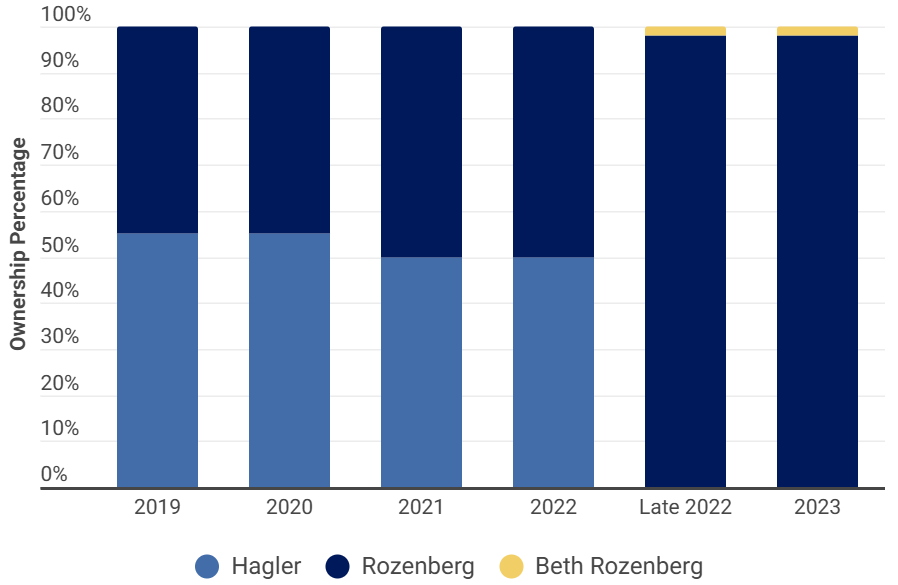
Hagler’s and Rozenberg’s individual shares of ownership in Centers have fluctuated. During the five-and-a-half-year period of OSC’s review, Centers was jointly owned by Hagler and Rozenberg until at least June 22, 2022, when Hagler was interviewed by the New York Attorney General’s office in connection with the investigation into four of his New York nursing homes. Tax returns suggest he divested his ownership of Centers at some point after that. Their shares of ownership of Centers during the period under investigation are shown below.
Figure 1: Changes in Centers’ Ownership Between 2019 and 2023
Centers is located at 4770 White Plains Road, Bronx, New York. It holds itself out as “a premier network of skilled nursing, rehabilitation, and senior care services with locations in New York and New Jersey.” Centers reports having 37,000 employees. Centers provides services to most, if not all, of the nursing homes that Hagler and Rozenberg own and control.
In New Jersey, Hammonton’s and Deptford’s agreements with Centers state that Centers will provide services related to financial management, accounting, cost reports, bookkeeping, payroll, accounts payable, billing, accounts receivable, coordinating vendors and suppliers, and marketing. The agreements also state that Centers will provide a licensed administrator to assist each nursing home’s licensed administrator, act as a liaison to Centers, and recruit necessary personnel. The agreements acknowledge common ownership between Centers and the nursing homes.
Together, Hammonton and Deptford paid Centers more than $27 million over the course of OSC’s review ($14 million and $13 million respectively). Based on invoices provided to OSC, Centers appeared to charge the nursing homes a lump sum amount for fiscal, administrative, clinical, and marketing expenses, totaling $176,300 per month. Centers received the second largest sum of money paid to any vendor of the nursing homes. And, because the majority of the revenue for both facilities comes from Medicaid funds, these payments were primarily funded with Medicaid dollars.
As shown below, the agreements state that Centers intends to charge Hammonton and Deptford for services at “actual cost,” as would be required for services provided by a related party, and state that it is not the intention of Centers to profit from the provision of services.
Figure 2: Snapshot of Agreement with Centers
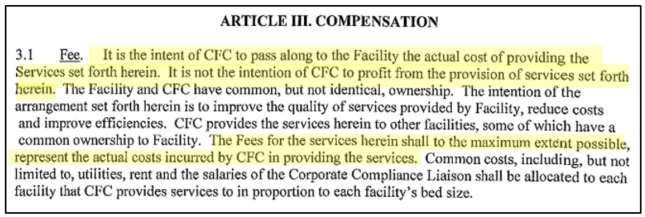
Despite the contractual language pledging to provide services “to the maximum extent possible” at “actual costs” and not to profit from its contracts with its related-party nursing homes, tax documents show that Centers had sizeable ordinary business income (profits) from its many nursing homes, including $15.1 million, $18.9 million, and $41.5 million in profits in 2019, 2020, and 2021 respectively. Hagler and Rozenberg kept a large portion of those profits for themselves. In 2019, Hagler received over $6 million and Rozenberg received over $4.9 million from Centers. Similarly, in 2020, Hagler received over $7.8 million and Rozenberg received over $6.4 million from Centers. And, in 2021, the owner distributions to Hagler and Rozenberg were even higher, with each receiving $8.4 million that year.
E. Hagler's and Rozenberg’s Other Business Interests / Related Parties
Hagler, Rozenberg, and their close relatives also have interests in numerous other businesses that provided goods or services to the nursing homes. OSC identified at least seven additional businesses owned by Hagler, Rozenberg, and family members or close associates that were paid to provide goods and services to Hammonton and Deptford. Centers handles the bookkeeping and accounting for most or all of these entities, while Hagler prepares the tax returns for many of the entities. These entities include:
· BIS Funding Capital LLC (BIS), which is owned by Hagler and his son, Jonathan Hagler. BIS is registered at Hagler’s personal residence. Hagler has described BIS as a “repository” for information technology (IT) leases with other vendors servicing Centers’ nursing homes. According to Hagler, BIS contracts with external vendors for software and allocates the services to Centers’ nursing homes.[6] Although Hagler denied that BIS provides computer hardware, invoices state payments are for “Major Moveable Equipment” and “Software Rental” or “Computer Rental” and provide no additional detail as to what equipment, software, or hardware was allegedly provided. Neither Hammonton nor Deptford has a written contract with BIS. BIS was not disclosed as a related party on cost reports submitted to the federal government from 2019 to 2022, except for 2022 (Deptford only). It was reported by both Hammonton and Deptford in 2023.
· Skilled Staffing, LLC, which is owned by Shoshana Rozenberg Areman, Rozenberg’s daughter, and Elisabeth Farkas, Rozenberg’s daughter-in-law. The company, registered in New York, holds itself out on social media as an agency that provides contract nursing personnel. The phone number listed on Skilled Staffing’s social media page is also associated with Regional Care Network (RCN), another staffing company, reportedly owned by Jared Dubin, a former Centers employee. Invoices indicate the company bills for direct care staff for the nursing homes, as well as “Quarterly Management / Consulting” from January 2020 to October 2021. Neither Hammonton nor Deptford has a written contract with Skilled Staffing. Skilled Staffing, LLC was not disclosed as a related party on cost reports submitted to the federal government from 2019 to 2023.
· CFSC Downstate, LLC, which is owned by Rozenberg; Hagler; Rozenberg’s daughter, Shoshona Rozenberg Areman; Hagler’s son, Jonathan Hagler; Amir Abramchik (Abramchik), Centers’ Chief Operating Officer; and Abramchik’s wife, Deborah Abramchik. Abramchik operates CFSC Downstate. It appears to be a staffing company, also registered in New York. Invoices show bills are primarily for housekeeping, health insurance, and patient activities but occasionally for a minimum data set (MDS) coordinator, Director of Nursing (DON), or hourly finance staff. Neither Hammonton nor Deptford has a written contract with CFSC Downstate. CFSC Downstate was not disclosed on cost reports submitted to the federal government from 2019 to 2023.
· CFSC Maintenance, which is a New York company doing business as One70 Group.[7] Hagler testified that One70 Group is owned by himself and Issac “Yitzy” Laniado. CFSC Maintenance reportedly does construction and repair work for Centers’ nursing homes, and Laniado operates the company. Invoices show payments for interior renovation work. Neither Hammonton nor Deptford has a written contract with CFSC Maintenance. CFSC Maintenance was not disclosed on cost reports submitted to the federal government from 2019 to 2023.
· Centers Lab NJ, LLC, d/b/a MedLabs Diagnostics, which is a wholly owned subsidiary of Centers Agency LLC, which was owned by Rozenberg and his wife, Beth Rozenberg, during the timeframe of this review. According to contracts with Hammonton and Deptford, Centers Lab NJ was contracted to provide medical diagnostic services to the nursing homes. Centers Lab was not disclosed on cost reports submitted to the federal government from 2019 to 2023.
· Centers Business Office NJ LLC, which is located at the same address as Centers. According to its website, it offers full-service consultancy services to help nursing homes maximize profitability and efficiency. During the period of investigation, the following individuals have, or had, an ownership interest in this entity: Hagler; Rozenberg; Rozenberg’s wife, Beth Rozenberg; Rozenberg’s daughter, Shoshana Rozenberg Areman; and Rozenberg’s son, Eli Rozenberg. Neither Hammonton nor Deptford has a written contract with Centers Business Office. Invoices provided by Centers Business Office indicate that this entity billed the nursing homes for worker compensation premiums, employee benefits, office contracted services, office supplies, rent and utilities, supplies, and services, wages, and benefits. Centers Business Office was not disclosed on cost reports submitted to the federal government from 2019 to 2023, except for Deptford’s in 2022.
OSC finds that all of these entities are “related parties” as defined by CMS. The test for related parties involves whether there is common ownership or control—where control includes “any kind of control, whether or not it is legally enforceable and however it is exercisable or exercised. It is the reality of the control which is decisive, not its form or the mode of its exercise.” The entities shared common ownership or control with Hagler and/or Rozenberg, either directly or through their ownership and control of Centers, or with the nursing homes themselves.[8] The exception is Skilled Staffing, reportedly owned by Rozenberg’s daughter and daughter-in-law. That entity is also a related party pursuant to the CMS Provider Manual, which states that existence of an immediate family relationship, including parent, child, and daughter-in-law, creates an irrebuttable presumption of related party status. Centers for Medicare & Medicaid Services. CMS Provider Manual – Part 1, Ch. 10 § 1004.
The chart below represents Centers’ relationship with its related parties and how much they received in Medicaid funding from New Jersey:[9]
Figure 3: Centers’ Payment of $92 Million of Medicaid Funds to Related-Party Entities
Findings
A. Hagler and Centers Chronically Understaffed the Nursing Homes.
This investigation of the Hammonton and Deptford nursing homes revealed a persistent failure to meet New Jersey's state-mandated staffing requirements, highlighting chronic understaffing issues that compromised resident care. Both facilities consistently fell short of the staffing ratios established by New Jersey’s minimum staffing law, effective February 2021, which outlines specific staff-to-resident ratios for different shifts to ensure adequate care and supervision. In violation of that statute, Hammonton and Deptford operated with significant staffing shortages, undermining resident safety and well-being. Moreover, OSC's investigation uncovered that the nursing homes used unlicensed and unqualified personnel, further exacerbating the harm caused by inadequate staffing and further jeopardizing the health and dignity of residents.
1. Requirements of New Jersey’s Staffing Laws
New Jersey’s minimum staffing law, N.J.S.A. 30:13-18 established the following minimum staffing ratios:
- Day shift (7:00 am to 3:00 pm): one CNA for every eight residents.
- Evening shift (3:00 pm to 11:00 pm): one direct care staff member for every ten residents. No fewer than half of all staff members must be CNAs and each registered nurse (RN)/ licensed practical nurse (LPN) must be signed in as a CNA and performing CNA duties such as feeding, turning, showering, etc.
- Night shift (11:00 pm to 7:00 am): one direct care staff member to every 14 residents provided that each direct care staff member shall sign in to work as a CNA and perform CNA duties.
Additionally, nursing homes must have a DON, who must be an RN licensed in New Jersey and have at least two years of supervisory experience in a nursing home before working as DON. N.J.A.C. 8:39-25.1. Facilities with more than 150 beds must have an RN on duty “at all times.” N.J.A.C. 8:39-25.2(e). Both Hammonton and Deptford are licensed for 240 beds, which means that they must always have an RN on duty at all times.
2. Hammonton Direct Care Staffing Analysis
OSC reviewed Hammonton’s direct care staffing based on a random sample of 82 days from February 1, 2021 to May 31, 2024. To complete this analysis, OSC issued a subpoena to Hammonton for, among other things, all timesheets during this timeframe for any and all direct care staff (full-time, part-time, and contracted).[10] Hammonton unreasonably delayed providing responsive documents.[11] In response to a preliminary draft of this report, and legal action by OSC, counsel produced hundreds of pages of additional documentation, including timecards for over 280 additional staff members that were not part of Hammonton’s initial response to the subpoena.
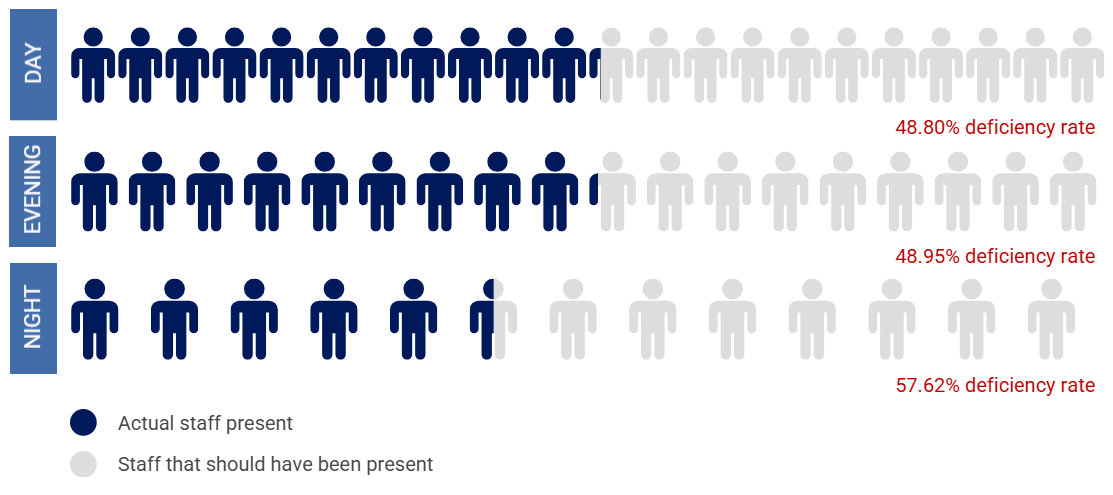
During the 2021 to 2024 staffing investigative period, Hammonton’s average census was 178, which means Hammonton was required to have a total of 53 direct care staff providing care to residents daily to comply with state law. On average, Hammonton should have had 22 CNAs during the day, 18 direct care staff during the evening shift, and 13 direct care staff on the overnight shift.
After taking into account the late-produced documentation, OSC found that Hammonton still failed to meet state minimum staffing requirements for every single day of the 82 sample days reviewed. On average, Hammonton should have had at least 53 direct care staff in total but had a shortage of nearly 28 direct care staff each day. This amounts to a daily deficiency rate of 52 percent. Also, for 46 days within the 82 sample days reviewed, Hammonton did not have an RN on duty, as required. According to CMS, there is substantial “evidence of a relationship between nursing home staffing levels and resident outcomes,” and “a clear association between nurse staffing ratios and nursing home quality of care.”[12] Hammonton did not have nearly enough staff, failing to meet even half the minimum staff required, and thus provided poor quality care, day after day, for years. See Appendix A for a summary of the staffing violations.
Figure 4: Hammonton’s Average Deficiency Rate per Shift
3. Deptford Direct Care Staffing Analysis
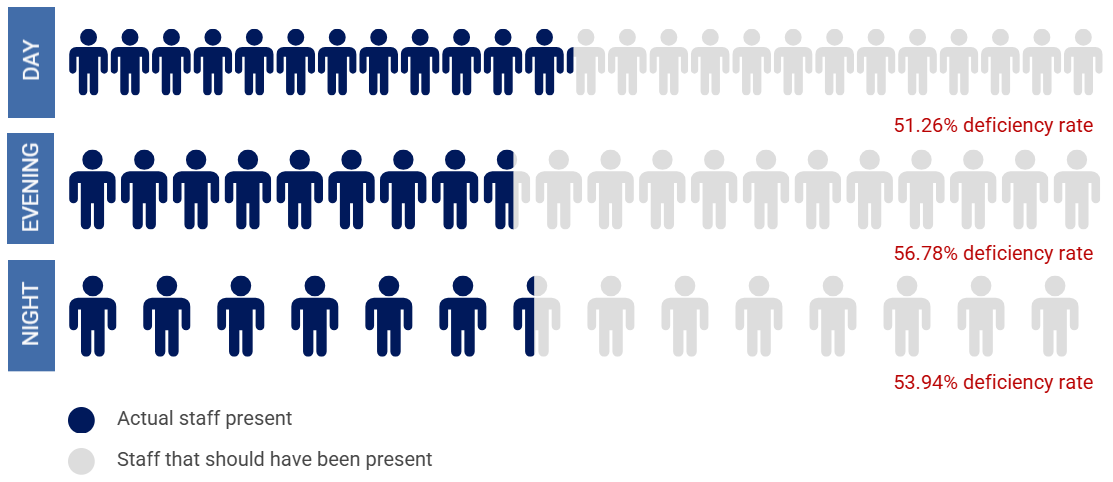
OSC also reviewed Deptford’s direct care staffing based on a random sample of 64 days.[13] Again, OSC issued subpoenas for all timesheets for any and all direct care staff (full-time, part-time, and contracted) and followed up numerous times with counsel but did not receive any additional documentation until court involvement. In response to the report, and legal action by OSC, counsel produced hundreds of pages of additional documentation, including timecards for over 300 additional staff members that were not part of Deptford’s initial response to the subpoena. During this period, Deptford’s average census was 199, which means Deptford was required to have had a total of at least 59 direct care staff providing care to residents daily to comply with state law. On average, Deptford should have had at least 25 CNAs during the day, 20 direct care staff during the evening shift, and 14 direct care staff on the overnight shift.
OSC found that Deptford failed to meet state minimum staffing requirements for 62 of 64 days it reviewed. On average, Deptford should have had at least 59 direct care staff in total but had a shortage of nearly 32 direct care staff each day. This amounts to a deficiency rate of 54 percent. And, for 52 days within the 64 sample days reviewed, Deptford did not have an RN on duty, as required. Deptford provided dangerously low staffing. See Appendix A for a summary of the staffing violations.
Figure 5: Deptford’s Average Deficiency Rate per Shift
4. Unlicensed/Unqualified Staff
OSC’s investigation not only found that Hagler and Centers chronically understaffed Hammonton and Deptford but also revealed that they utilized unlicensed and unqualified individuals to provide care to residents at both nursing homes.
As noted above, facilities with more than 150 beds must have an RN on duty “at all times.” N.J.A.C. 8:39-25.2(e). LPNs are not qualified to work as RNs and are prohibited from doing so by rules governing their scope of practice and by nursing home requirements. LPNs must work under the supervision of a physician or an RN, and tasks that must be performed by an RN cannot be delegated. N.J.A.C. 13:37-6.2 to -6.5; N.J.A.C. 8:39-25.1 to -25.2.
Nursing homes that participate in Medicaid are required to care for residents “in such a manner and in such an environment as will promote maintenance or enhancement of the quality of life of each resident.”[14] To do so, nursing homes must provide services and activities that will “attain or maintain the highest practicable physical, mental, and psychosocial well-being of each resident in accordance with a written plan of care.”[15] Hammonton’s and Deptford’s consistent short-staffing led to poor quality care, as described in more detail below. This systemic and egregious understaffing harmed the health and well-being of the residents for which these facilities were entrusted by the Medicaid program to care.
5. Staffing Violations Overpayment
Due to Hammonton’s and Deptford’s pervasive and egregious violations of staffing requirements intended to ensure a minimum standard of care for residents, N.J.S.A. 30:13-18, N.J.A.C. 10:49-9.8(a), and N.J.A.C. 10:49-5.5(a)(17), OSC found that Medicaid payments made to the facilities on days that did not meet these minimum standards were improper and must be recouped. Moreover, each facility falsely certified compliance with all laws and requirements to the Medicaid program, despite failing to adequately staff its operations for almost every day in OSC’s sample and receiving full Medicaid payment for those days.
OSC will seek to recover the extrapolated overpayment for the facilities' failure to meet staffing requirements. Because direct care staffing is so essential to the basic daily care that nursing home residents need, OSC will not provide partial credit for any other elements of care. Even if the facility did provide residents with food or beds on those days, without direct care to answer call bells or assist residents with eating, dressing, bathing, going to the bathroom, or getting out of bed—activities of daily living that direct care staff provide—the facility has so completely failed to provide the minimum standards of care and dignity that it must not receive Medicaid funds for those days. The nursing homes were required to provide one thing—a quality home that provides basic standards of care and dignity—and they were paid for that accordingly, but instead, they provided something entirely different, enriching themselves in the process. Thus, using extrapolation, a statistical method to estimate overpayments based on sampled data, OSC calculated that during the timeframe of this analysis, Hammonton was overpaid at least $42,089,243[16] in Medicaid funds that it must return to the Medicaid program, and Deptford was overpaid at least $44,163,302[17] in Medicaid funds that it must return to the Medicaid program.
Additionally, due to Hammonton’s and Deptford’s serious violations of N.J.A.C. 8:39-25.2(e), in which each facility failed to have an RN on duty for more than half of the days sampled, OSC determined, in accordance with N.J.S.A. 30:4D-7(h), N.J.S.A. 30:4D-17(e), N.J.S.A. 30:4D-57(d)(2), and N.J.A.C. 19:70-4.4, that Hammonton should be subject to a civil penalty of $460,000 calculated at $10,000 per day for 46 days. Similarly, OSC is imposing a civil penalty of $520,000 on Deptford for the same violation, calculated at $10,000 per day for 52 days.
In total, including the overpayment and penalty, OSC is seeking to recover $42,089,243 for staffing deficiencies at Hammonton and $44,163,302 for staffing deficiencies at Deptford, as well as a $980,000 penalty. In total, OSC finds that Hammonton and Deptford must repay $87,232,545 for their pervasive and egregious staffing violations.
6. Response to OSC Findings
In their response to a draft of this report detailing OSC’s preliminary findings, counsel argued that OSC’s sampling was not random. Counsel contended that MFD’s selected days were “not a random, representative sample and thus are not a proper basis for extrapolation.” They speculated “whether different days . . . tell a different story.” OSC stands by its statistically valid random sample. Specifically, OSC selected two statistical samples, one for each facility. When a proper statistical sample is selected, as it was in this case, those samples will be representative of their respective universes. OSC further ensures its statistical samples are representative for purposes of the target variable by performing t-tests on the means, f-tests on the standard deviations, and calculating confidence intervals. Although OSC provided the sampling and extrapolation information to counsel for verification, counsel has not provided OSC with a challenge by any competent or qualified personnel (i.e., a statistician).
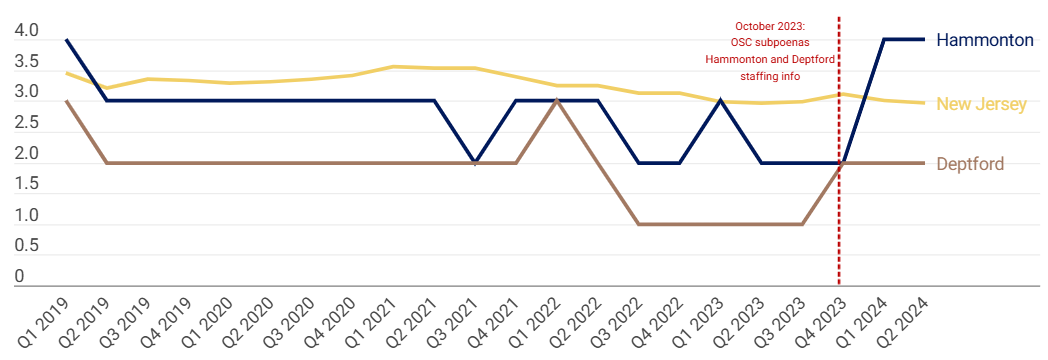
In response to the report, counsel also argued that the minimum staffing statute is unconstitutional and was impossible to comply with due to the lack of available direct care staff. The Legislature was aware of the impact of short-staffing on resident care in nursing homes; it established these requirements so that residents would not continue to be subject to the harms caused by inadequate staffing. The statute is presumed constitutional unless and until a court holds otherwise. In their response, counsel fails to cite to any steps the nursing homes took to increase staffing levels by addressing poor wages and benefits or staff burnout and exhaustion. They argue that the staffing levels in Hammonton and Deptford were the same or similar to the rest of the nursing homes in New Jersey. But that is not true. As shown in the chart below, based on self-reported staffing data that CMS uses to derive staffing-specific star ratings, both facilities self-reported that they were below the New Jersey average for almost the entire review period.
Figure 6: Staffing Star Rating by Year
Additionally, in their response to OSC’s staffing analysis, counsel claimed that OSC miscalculated the number of days that the nursing homes did not have an RN. Between 2021 and 2023, Hammonton and Deptford improperly used LPNs, a lower-level qualification than an RN, to work out of scope as RNs. Hammonton improperly used LPNs to work as RNs on 66 days out of the 82-day sample. Deptford used LPNs to work as RNs on 60 days out of the 64-day sample. The nursing homes failed to provide an RN for between 1 to 18 hours a day, not mere minutes as counsel claimed.
B. Hagler, Rozenberg, and Centers Provided Poor-Quality Care that Caused Resident Suffering in Hammonton and Deptford.
Alarming quality of care issues at Hammonton and Deptford are directly linked to the chronic staffing deficiencies at the nursing homes. The lack of adequate staff resulted in widespread neglect, preventable suffering, and tragic outcomes for residents, who experienced delays in care, improper administration of medications, and unsanitary living conditions, severely impacting their health and overall well-being.
To assess the quality of care, OSC reviewed various quality trackers such as CMS Star ratings, health and complaint inspections by DOH, and facility-maintained staffing information. The investigation also uncovered distressing patterns of neglect through analyses of 911 calls, volunteer reports, and news articles, highlighting a pervasive failure to meet basic care, safety, and resident dignity standards. These findings vividly illustrate how insufficient staffing directly contributed to the unacceptable conditions and outcomes experienced by residents, which underscores why it is so important for facilities to meet the state’s minimum staffing requirements.
1. CMS Star Ratings
Between January 2019 and June 2024, Deptford had an average overall star rating of 1.5. During this same period, Hammonton averaged an overall star rating of 1.8. The state average was 3.4 stars.
One star is the worst rating that a nursing home can receive based on CMS’s five-star rating system. Nursing homes that consistently receive one-star ratings mean they regularly and systematically have more widespread, serious, and uncorrected deficiencies than nursing homes with higher star ratings. According to CMS, “nursing homes with 1 star are considered to have quality much below average.”
2. Special Focus Facility
In addition to consistently receiving 1 and 2 stars in their CMS ratings, both Hammonton and Deptford were selected as Special Focus Facility (SFF) candidates multiple times during the review period. CMS launched the SFF Program in 1998 to identify and decrease the number of “persistently poorly performing nursing homes.” Each month, CMS identifies nursing homes in every state that are considered the most troubled and problematic and designates them as “SFF candidates.” Nursing homes that are selected as SFFs are subject to increased scrutiny and attention, including more frequent health inspections (every 6 months instead of every 12 to 15 months) and progressive enforcement actions until the nursing home either graduates or is terminated from the Medicaid/Medicare Programs.
During the review period, both Hammonton and Deptford were selected as SFF candidates more than once. Deptford was an SFF candidate from July 2022 through the end of September 2022, and then again from January 2023 through the end of September 2023. Hammonton was designated as an SFF candidate in May 2023, again from September 2023 through the end of June 2024, and then again in October 2024. OSC found that Hammonton and Deptford provided substandard quality of care to their residents not just during the months the nursing homes spent as SFF candidates but during OSC’s entire review period.
3. Surveys and Inspections
As part of this investigation, OSC reviewed DOH health inspection surveys of Hammonton and Deptford. The surveys revealed troubling and persistent findings, including lack of staff, lack of appropriate documentation, and failure to administer appropriate medications and treatment. These failures violated legal requirements and severely jeopardized the health and well-being of the residents, in some instances leading to fatalities. Examples of some of the most egregious DOH survey findings are included below.
Hammonton Surveys
- A September 2020 Survey found that a resident with serious health issues, including Type 1 Diabetes, schizoaffective disorder, and hypertension, likely went without 15 essential medications for at least nine days in April 2020 – including insulin and psychiatric medications. The survey also found that the resident’s insulin administration was consistently delayed, for as many as three hours, further endangering the resident’s health.
- The same survey found extensive water damage, walls with gaping holes, and damaged doors in nearly 40 percent of the resident rooms, with the Maintenance Director citing "manpower" shortages as the reason for the outstanding repairs.
- A June 2021 survey found Hammonton failed to prevent the sexual assault of two residents by another resident despite prior reports that the accused had committed offenses of a similar nature.
- The same survey included a review of a 911 call report documenting that police were called to the facility in March 2021, after a resident contacted police, alleging that she was sitting in her own excrement for over 24 hours. The resident received assistance as local law enforcement arrived at the facility, and police were informed that there were only two nurses available to care for more than 100 residents. The survey determined there was a failure to provide timely incontinence care and that all residents had the potential of being affected by this deficient practice.
- In an early June 2023 survey, the DOH surveyor noted that the plastic covering holding an identification card around the resident’s neck was “full of urine and mildew.” This same resident, who had yet to receive incontinence care, smelled heavily of urine, and their sheets were soaked and covered in “a yellow substance.” The survey found that the deficiency was caused by a lack of staff, which led DOH to curtail admissions at Hammonton due to “significant deficiencies in nurse staffing and in medication administration posing an immediate and serious threat of harm to residents.”[18]
- Another June 2023 survey found Hammonton failed to timely deliver, or deliver at all, insulin injections and various other medications to residents. Over a two-day period, staff failed to timely administer insulin to 18 diabetic patients, putting them at risk for “hyperglycemic reaction, hospitalization, and possible death.” Medication delays were as long three hours and twenty minutes. The survey identified 28 instances when staff failed to document that any medication was administered to residents at all.
Deptford Surveys
- An October 2021 survey found that Deptford discharged a resident without proper discharge planning. The resident was a wheelchair-bound amputee with diabetes who needed extensive assistance with transfers, hygiene, bed mobility, and dressing. He was discharged to a motel on September 28, 2021 but returned to the facility the same day because the hotel could not accommodate a wheelchair and Deptford discharged him without the prescribed commode chair. Deptford discharged him again the following day by leaving him in front of a county social services office before business hours. According to DOH, no one at the social services office had spoken to Deptford about the resident before he was discovered on their doorstep.
- A February 2022 survey found that over the course of two evenings, Deptford failed to follow resident care plans, evaluate them for pain, or administer pain medications as directed by physician order. The survey noted the residents experienced unmanaged and excruciating pain for a prolonged period. Two residents experiencing severe pain called 911 because nursing home staff did not respond to them.
- A November 2022 survey documented the death of a resident 13 days prior, due to egregious negligence by staff. The resident was limited to a pureed diet for medical reasons but was given a sandwich and cookie for an after-dinner snack. As a result, the resident apparently asphyxiated. The resident’s death was not noticed by staff for many hours. When DOH Surveyors were onsite, staff could not recall if the resident’s family or physician were notified that provision of solid food was the reason for the resident’s death. A CNA reported to DOH that during cardiopulmonary resuscitation (CPR) on the patient, the DON stated, “what happens in this room stays in this room.”
In their response, counsel alleges that OSC’s presentation of the information documented in DOH’s surveys is “inappropriate, misleading, and should be removed.” OSC stands by the summary of DOH findings contained in this report.
4. 911 Calls from the Nursing Homes
OSC also reviewed police call logs and found that Hammonton and Deptford residents and their loved ones made an alarming number of calls for assistance to local law enforcement.[19] During OSC’s review period, records show there were more than 2,400 calls placed to Deptford Police relating to the Deptford facility. Call after call documented pleas of assistance from residents experiencing severe neglect. Examples include a resident left sitting in their own urine and feces for hours, call bells disregarded, and pleas for assistance from nurses and staff that were ignored. One resident reported they had a broken catheter that had fallen out a few days prior, but there was no nurse on staff to fix the issue. Another incident report, presumably from the facility itself, noted that a “resident is missing” and “hasn’t been there all day.” The report was made at 1:39 PM, despite the resident not having been at the facility “all day.” The resident was not reported as returned until 8:03 PM.
For Hammonton, the police logs also portray a facility in distress. During the review period, there were approximately 1,000 calls made to Hammonton Police. Just as with Deptford, these calls document instances of neglect, non-responsive staff, and unanswered calls for help. In September 2019, a resident repeatedly called 911 for an ambulance due to a swollen tongue, but facility staff continually canceled the resident’s ambulance requests. A police officer drove to the facility to check on the resident and personally called an ambulance. In February 2020, after numerous calls from a resident complaining that no staff had changed them for hours, police intervened, finding the resident still lying in feces. A third party called 911 on behalf of one resident with dementia, who was left immobile with a broken back and received no response from staff when they requested assistance. Another resident reported “being fed dog food or not being fed at all.” In June 2023, police responded to the facility after a family member called to report their loved one had chest pains and nursing home staff were not addressing it after 40 minutes. Police found there were only 4 nurses and 12 CNAs for all of the 260 residents, with a police officer noting that “while in the building, I was unable to locate a nurse and could hear screaming from more than one patient requesting” assistance.
5. Deptford Volunteer Report and Hammonton News Report
OSC also interviewed a volunteer at Deptford who started visiting the nursing home on a weekly basis beginning prior to the COVID-19 pandemic. The volunteer, who was not affiliated with the State, reported to OSC that residents at Deptford were not receiving the respect and attention that they deserved. The volunteer conveyed that the nursing home was disgusting, with dirty floors and bathrooms, uncomfortable room temperatures (too hot and too cold), and an overall lack of sanitation. The volunteer also observed that the staff does not check on the residents’ basic needs, noting that residents are often left hungry and thirsty, not cared for, hygiene not maintained, and staff response is slow.
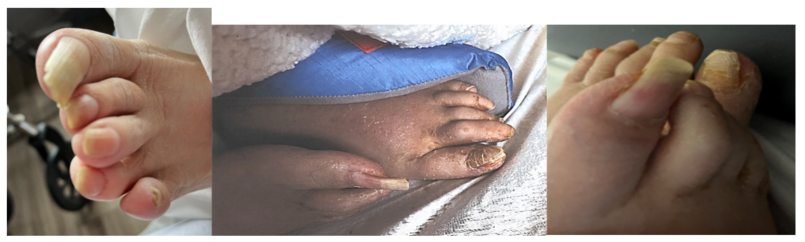
The volunteer observed abuse and neglect of Deptford’s residents, and provided OSC with the following pictures to corroborate these observations:
· The toenails of two residents were left so overgrown that the volunteer confronted staff to have this addressed. Staff advised that a podiatrist comes only once a month to service all of the facility’s residents.
Figure 7: Photographs of Residents’ Overgrown Toenails
- On November 21, 2023, the volunteer observed one resident’s call bell cord had been severed, rendering the resident unable to reach staff when needed.
Figure 8: Photograph of Severed Call Bell Cord

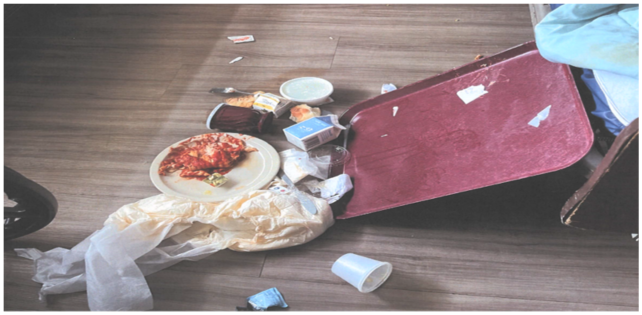
- The volunteer described one resident’s room as smelling terribly of urine and feces. On several occasions, the volunteer photographed the scene of this resident’s room upon arrival. On May 10, 2024, the volunteer observed the resident’s meal tray all over the floor, also mixed with dirty diapers.
Figure 9: Photograph of Resident’s Fallen Meal Tray and Dirty Diapers
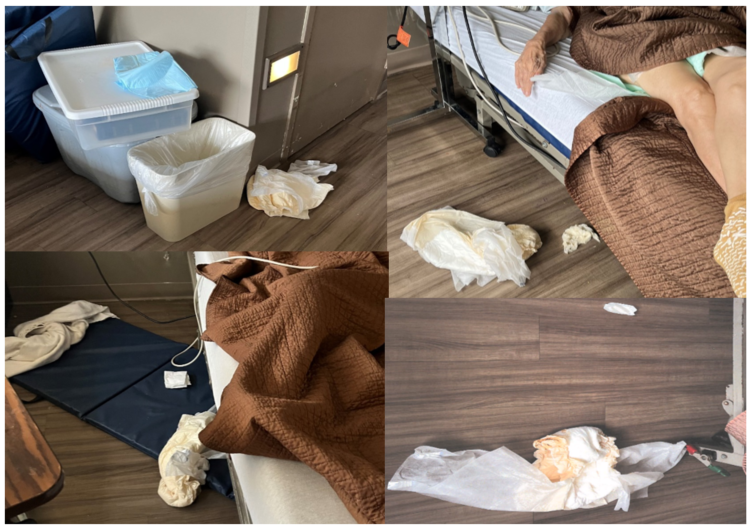
- The volunteer frequently observed dirty, used diapers disposed of on the floor of the resident’s room.
Figure 10: Photographs of Dirty, Used Diapers on the Ground in Resident’s Room
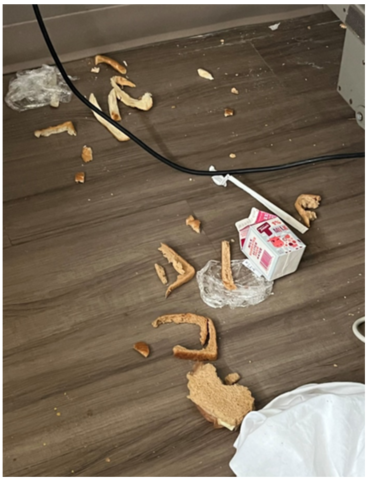
- On January 16, 2024, the volunteer observed a meal tossed on a resident’s floor and left there for a prolonged period of time.
Figure 11: Photograph of Meal Tossed on Resident’s Floor
- On February 1, 2024, the volunteer observed flies on the resident’s food and tray.
Figure 12: Photograph of Flies

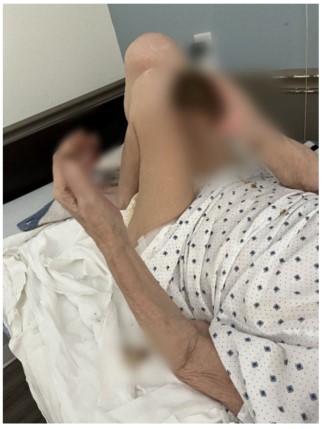
- On September 19, 2023, the volunteer observed that a resident was sitting in her own excrement in the middle of the day, with dried feces in her hand. When the volunteer reported this to staff, staff claimed that that the resident had just recently been washed, which the volunteer thought was inconsistent with their evaluation of the scene.
Figure 13: Photograph of Feces in Resident’s Hand
In addition to the volunteer’s report to OSC about Deptford, an in-depth May 2024 news article described similar findings and circumstances in Hammonton.[20] An excerpt from the article is below, in which a daughter describes what she encountered when visiting her 72-year-old mother at the Hammonton facility:
Her stay at the Hammonton Center was marked with red flags, according to her family: An improperly placed catheter. The wrong antibiotics. Long spells where she couldn’t reach her water cup or food, resulting in dehydration. Ignored lab results. Empty hallways devoid of staff members. A burst pipe spraying water onto another patient.
‘You could see her decline every time we visited her,’ said her daughter… recalling her mom’s time at Hammonton. ‘Understaffed is an understatement. I’d watch her sit in the hallway with no one attending to her. It was shocking the condition she was in after being in their care such a short period of time. She never came back to the way she was the day she walked in that place.’
The last straw, [she] said, was a six-hour delay in sending [her mother], who had acute kidney failure, to the emergency room.
The article also describes other harrowing conditions experienced by residents at Hammonton, including patients left unattended for extended periods, severe understaffing that led to inadequate care, critical medications administered incorrectly or not at all, and unsanitary conditions such as residents sitting in their own bodily fluids for hours.
The facts contained in the volunteer’s report and news article were not independently verified by OSC, but the reporting and pictures are consistent with OSC’s findings from its review of survey reports, quality metrics, staffing records, and police reports for both Hammonton and Deptford – these facilities provided such consistently substandard quality care to their residents that they harmed their health and overall well-being and deprived them of dignity. Despite legal mandates designed to ensure the highest practicable physical, mental, and psychosocial well-being of nursing home residents, both facilities consistently failed to meet these standards. The documented deficiencies in staffing, medication administration, and basic resident care, led to severe neglect, preventable suffering, and tragic fatalities.
C. Inflated Rent Payments and Related Party Siphoning Were Drivers of Insufficient Staffing and Poor Quality Care.
This investigation also revealed that Hagler, Rozenberg, and KFE prioritized their own financial gain over the welfare of residents. They redirected funds meant for staffing and resident care into overleveraged and inflated real estate transactions and related-party expenses, which significantly increased costs and left the facilities severely understaffed and unable to provide adequate care. Hagler, Rozenberg, and KFE, the related-party property owners, personally profited from these practices by diverting funds to themselves that were then taken as distributions. This diversion of Medicaid funds toward property company profits (and other unreasonable related-party profits) deprived the facilities of funds and left both Hammonton and Deptford unable to meet the minimum staffing requirements or standards of care, which harmed their residents.
1. Excessive $58.2 Million Mortgage in 2014 Bundled Three Nursing Homes Together and Drove Up Costs
As discussed above, ownership of the operations and the property for the Hammonton and Deptford nursing homes was split between different companies—Hagler owned the operations, while Rozenberg and KFE owned the properties.
The 2014 Mortgage
In 2014, Hagler and Rozenberg purchased Hammonton and Deptford, along with Mount Laurel Center for Rehabilitation and Healthcare (Mount Laurel). Hagler and Rozenberg agreed to pay $48.2 million for the operations of the three nursing homes and $20.6 million for the three property companies. The total price for the three nursing home operations and properties combined was $68.8 million (30 percent attributable to the acquisition of the properties, 70 percent attributable to the acquisition of the operating companies). Under the parties’ agreement, the purchase required only a 1.5 percent deposit of the purchase price.
Figure 14: 2014 Purchase Price Breakdown for Three Nursing Homes
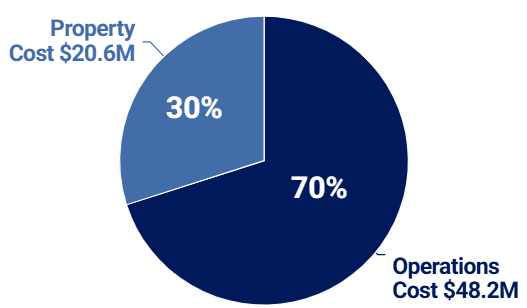
They financed these purchases with a $58.2 million mortgage from M&T Bank and a $10 million seller-financed promissory note.[21] Rozenberg also obtained a separate $8 million construction loan for all three properties. Both Hagler and Rozenberg personally guaranteed the $58.2 million mortgage, which was secured by the three properties, as well as the operations for the three nursing homes.
By bundling the acquisition of the operations and properties into a single mortgage, Rozenberg obtained a much higher mortgage of $58.2 million, far exceeding the $20.6 million purchase price for the three properties alone. Rozenberg used the mortgage to finance his and Hagler’s significant acquisition costs for the three nursing home operations ($48.2 million)—and then passed on these costs to the nursing homes and the Medicaid program as “rent” for the properties.
The 2014 Promissory Notes
Around the same time, in November 2014, Hagler and Rozenberg also caused the nursing homes to enter into two $15 million promissory notes, further burdening the operating companies with excessive and unnecessary related-party debt. The promissory notes state that they were issued to finance the purchase of the operating companies. There is no evidence that the $15 million principal ever changed hands, though the notes required the operating companies to pay the property companies annual interest of $451,000 each, with a balloon payment of the principal due at the end of the 20-year term, totaling $24 million per note, or $48 million in total. These promissory notes were duplicative and unnecessary because Rozenberg, through the property companies, had already secured a loan from M&T Bank for the full value of the operating and property companies, and as described more fully below, the costs of those loans were already being passed through to the nursing homes as “rent.” One document stated that the notes were merely created for “accounting purposes when the borrower acquired the property,” and yet, the nursing homes were charged interest on the notes for years, and the $15 million balloon payment for each nursing home, a total of $30 million, is still due at the end of the term.
The 2014 Triple Net Leases
In connection with the $58.2 million mortgage, Hagler then entered the operating companies into triple net lease agreements[22] with Rozenberg’s property companies, with each nursing home paying the property companies base rent of $1.1 million annually.[23] The base rent as reflected in the lease agreements did not include any other costs or expenses associated with the property; the operating companies were responsible for paying all expenses associated with the property separately, including insurance, maintenance, and taxes as “additional rent.”
But the $1.1 million base rent was already inflated because it was based on a mortgage that included the acquisition costs of the properties and operating companies. See Figure 14 above. And on top of this, the property companies also charged the nursing homes the interest from the unnecessary promissory notes, as well as millions more in “additional rent” annually per facility, driving rent costs as high as $5.9 million per year.
Cost reports submitted by the facilities from 2014 to 2017, show that these “additional rent” payments vastly exceeded base rent, adding millions more to the cost. Hammonton’s and Deptford’s “Building and Fixtures” costs were reported as shown below.
Figure 15: Excessive and Duplicative “Additional Rent” Charges (2014 - 2017)
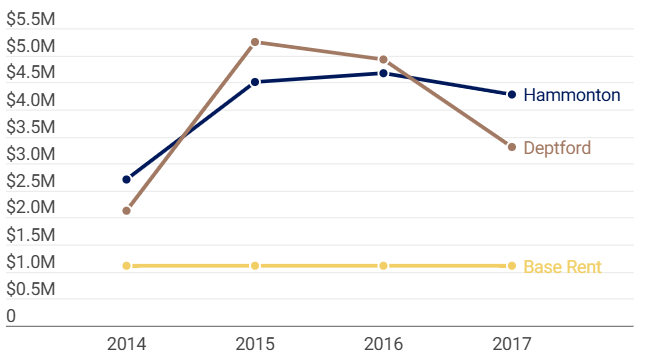
This excessive and unnecessary debt led to exorbitant and wasteful “rent” payments paid primarily with Medicaid funds, diverting millions of dollars that could have been used to hire additional staff, pay existing staff higher wages, upgrade the facilities, or offer additional therapies or activities to residents.
2. HUD Re-Financing in 2017 Drives Up Costs Even More, While Gaining Federal Protection against Default
The 2017 HUD-Backed Mortgages
Just a few years later, in 2017, Rozenberg and KFE refinanced the bundled mortgage for three nursing homes, this time entering into individual loans for Hammonton and Deptford, each one backed by the Federal Housing Administration of the United States Department of Housing and Urban Development (HUD) through its Section 232 program, which focuses on healthcare facilities. This was done at or around the same time that CMS terminated the provider agreement for the Mount Laurel nursing home in June 2017 due to poor conditions and failure to improve after multiple inspections.[24]
By refinancing with a HUD-backed loan, Rozenberg and KFE gained federal protection from default.[25] Rozenberg obtained a $31.4 million mortgage for Deptford and a $31.8 million mortgage for Hammonton, for a combined $63.2 million in mortgage debt. (The 2014 purchase price, when they purchased all three facilities (real estate and operations), was approximately $68.8 million, and when they refinanced in 2017, just two of the nursing homes (real estate and operations) were valued at over $63 million.) The value of the operating companies was again wrapped into the mortgages, as were an $8 million construction loan and $10 million seller-financed promissory note, loading the properties up with millions and millions of dollars in additional debt.[26], [27] The $15 million promissory notes that were entered into in 2014 for the purchase of the operating companies also remained in effect, requiring Hammonton and Deptford to each pay $451,000 a year in interest, on top of the rent.
The appraisals conducted in connection with the 2017 refinancing did not separately value the costs of the operations and property—but the additional costs associated with the refinancing (e.g., the construction loan and seller-financed note) appear to be primarily related to the properties. Thus, with the refinancing, it appears that the ratio of property- to operations-related costs was split as follows:
Figure 16: Breakdown of Property- and Operations-Related Mortgage Costs
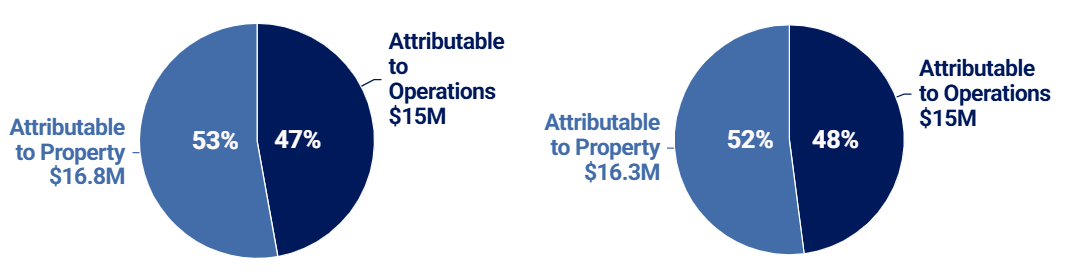
Note: Operations costs are evidenced by the 2014 promissory note, and property costs include half of the remaining balance on the seller finance note and construction loan.
The 2017 Triple Net Leases
As a result of the refinancing, the two facilities entered new triple net leases with their related-party property companies in which they agreed to double their base rent payments from $1.1 million each to $2.2 million for Hammonton and $2.3 million for Deptford per year.[28] HUD specifically required that “[t]he minimum annual lease payment must be at least 1.05 times the sum of the annual principal, interest, mortgage insurance premium, reserve for replacement deposit, property insurance, and property taxes.” Based on this requirement, the underwriter estimated that the minimum annual lease payment should therefore be $2,230,271 for Hammonton and $2,308,145 for Deptford. Those were the amounts that would satisfy the amount needed to repay the HUD-backed loan.
In addition to the now-doubled base rent obligation for each facility, both facilities were again required to pay to the related-party property companies the costs for insurance, taxes, and reserves for each facility. Based on the underwriter’s estimate, those amounts should have been included within the approximately $2.2 million and $2.3 million base rent obligations. Indeed, that is roughly what the property companies paid the bank each year to cover the mortgage principal, interest, insurance, taxes, and reserves. But bank records show that in addition to this, the property companies also tacked on $575,000 to $10.4 million in duplicative “additional rent” charges per year. Those additional payments totaled more than $31.4 million over the review period, only a portion of which was used to pay insurance, taxes, or reserves. They were used primarily as a vehicle to divert approximately $27.8 million in profits to Rozenberg and KFE.
The table below sets forth rent payments from January 1, 2019, through June 16, 2024, the day before a Receiver was appointed.[29] The base rent in the lease agreements was set at an amount high enough to cover most, if not all, of the debt service,[30] including not only the principal and interest but also the cost of taxes and insurance. Appendix B includes additional detail related to these costs.
Figure 17: Over $31.6M in “Additional Rent” Payments on Top of Mortgage Costs* (January 1, 2019 – June 16, 2024)
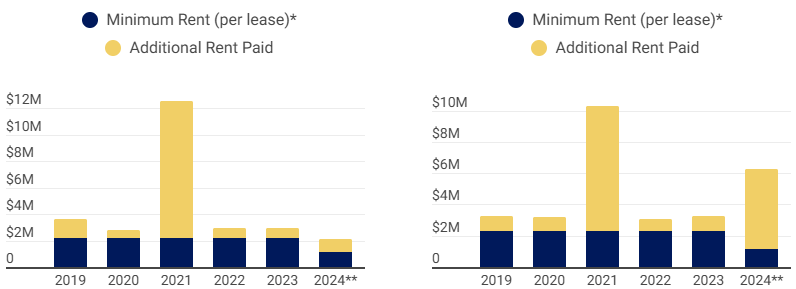
* According to underwriter’s estimates, minimum rent would have been enough to cover mortgage principal, interest, insurance, taxes, and reserves.
** For 2024, the total rent paid includes only six months of payments, so the base rent amounts have been prorated.
3. Improper Reporting of Approximately $7.8 Million of Operating Company Acquisition Costs as Property-Related Expenses
Between January 1, 2019, and June 16, 2024, OSC identified significant financial discrepancies in the reporting practices of Hammonton and Deptford concerning buildings and fixtures costs. Specifically, as shown in Figure 17 above, the nursing homes paid “rent” to cover the costs of a mortgage that included the owners’ acquisition of the operating companies. By reporting this as a “building and fixture” cost, they misrepresented these operating company expenses as though they were legitimate property-related costs.
During the timeframe of this investigation, Deptford’s property company paid a total of $8.1 million in principal and interest (P&I) to M&T Bank against the $31.4 million mortgage. As noted above, this mortgage covered the acquisition costs of both the operating and property companies. However, only a portion of these payments related to actual property expenses. The operating company, valued at $15 million per the 2014 promissory note, accounted for approximately 48 percent of the total mortgage, equating to roughly $3.9 million of the principal and interest payments made during this timeframe ($8.1M × 48% = $3.9M).[31]
Hammonton similarly misreported operating company expenses as property company expenses. With a $31.8 million mortgage, 47 percent was attributable to the purchase of Hammonton’s operating company (also valued at $15 million per the 2014 promissory note). See Figure 16. During the timeframe, Hammonton paid $8.2 million to M&T Bank for P&I, with $3.9 million of these payments attributable to the operating company acquisition ($8.2M * 47% = $3.9M).
This misuse of Medicaid funds—totaling $7.8 million—constitutes fraud and abuse that was made possible when related-party owners misrepresented their business acquisition costs as legitimate property expenses on federal cost reports. N.J.S.A. 30:4D-57d(2) and (3). The cost of acquiring a nursing homes’ operations company (e.g., the company holding its license, contracts, or receivables) is not a property-related cost, nor is it an allowable cost. According to CMS, reimbursable costs must be reasonable and directly related to resident care.[32] Costs should reflect what a prudent, cost-conscious buyer would pay, and “in the absence of clear evidence that the higher costs were unavoidable, the excess costs are not reimbursable under the program.” CMS Provider Manual – Part I, Ch. 21, § 2102.1. Here, the nursing homes (and, by extension, the Medicaid program) were required by Hagler and Rozenberg to pay costs that vastly exceeded what a reasonable prudent purchaser would pay. A landlord, particularly a related party one, should not be permitted to load up a property with unnecessary and unrelated debt and pass it off to the government as “rent” or an allowable property expense.
The misclassification of these payments as “buildings and fixtures” in federal cost reports undermines the integrity of the Medicaid program and Medicaid funding. It is imperative that nursing homes accurately report expenses, ensuring that they are both reasonable and directly related to resident care. By disguising operating company acquisition costs as allowable property expenses, Hammonton and Deptford improperly obtained and utilized Medicaid funds, thereby violating federal “reasonable cost” guidelines, cost reporting requirements, and state Medicaid documentation requirements that obligate providers to fully and accurately document services provided.
In their response, Hagler and Rozenberg, through counsel, argue that obtaining a loan and mortgage that covers operating and property costs is common in the nursing home industry. They contend that HUD approved the mortgage and was aware that the mortgage was in part used to pay to acquire the business. Their argument is in essence that they can take out a business loan of nearly any amount, secure it through a mortgage on a nursing home property, call all mortgage payments “rent,” and thereby avoid paying anything for the nursing home company. These practices are a wasteful and abusive use of public funds. No state or federal law authorizes business loans to be disguised as rent. The actual cost related to the acquisition of the property is far below the full cost of the mortgage. That HUD approved the mortgage under a program that funds more than Medicaid-funded nursing homes, does not mean that all payments under the mortgage are permissible under Medicaid.
Accordingly, during the timeframe of this review, approximately $7.8 million of Medicaid funds paid toward business acquisition costs was improperly spent and should be repaid.
4. Rozenberg and KFE Diverted Over $27 Million to Themselves through Illegitimate “Additional Rent” Payments
This investigation also found Hammonton’s and Deptford’s property companies diverted approximately $27.8 million in inflated “additional rent” payments to Rozenberg and KFE, exploiting related-party transactions to establish unauthorized profit centers and compromising funds meant for resident care. As noted above, bank records show that during the review period, Hammonton paid its property company approximately $26.9 million in total rent payments. See Figure 17. In that same period, the property company paid approximately $12.7 million to M&T Bank and $13.4 million to Rozenberg and KFE ($5.8 million and $7.6 million, respectively). Similarly, Deptford paid its property company approximately $29.3 million in total rent and the property company paid approximately $14.1 million to M&T Bank and $14.4 million to Rozenberg and KFE ($6 million and $8.4 million, respectively). Combined, Rozenberg and KFE received approximately $27.8 million from the property companies.
Figure 18: “Additional Rent” Diverted to Rozenberg and KFE
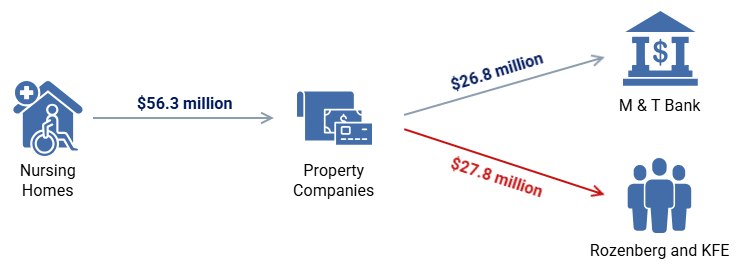
This shows that the “additional rent” payments charged to the nursing home were not used to pay for taxes, impositions, maintenance, or the like—those amounts were already covered by the base rent payments. Most of the additional rent was actually used to pay profits to the property companies’ owners, Rozenberg and KFE. These exponentially inflated payments to the related-party property companies were the primary means through which Rozenberg and KFE fraudulently and wastefully extracted millions for themselves, improperly diverting funds away from resident care. CMS has specifically stated that related-party transactions are not intended to be used as a means to create additional profit centers for owners. Here, not only were the costs charged to the nursing home well in excess of the property companies’ actual costs, but the operating companies fraudulently reported these “profits” as though they were allowable property related costs. OSC will seek to recover this $27.8 million in improperly spent Medicaid funds.
D. Hagler, Rozenberg, and Centers Knowingly Falsified Cost Reports to the State and Federal Government by Omitting Related-Party Transactions.
State and federal law require nursing home owners to submit annual “cost reports” that detail the nursing home’s costs in various areas, including property costs, staffing, and management services. As part of these cost reports, nursing homes are required to disclose all payments to related parties. CMS has explained that the rationale for this requirement is twofold: “(1) to avoid the payment of a profit factor to the provider through the related organization (whether related by common ownership or control), and (2) to avoid payment of artificially inflated costs which may be generated from less than arm’s-length bargaining.”[33] That is, these disclosures are meant to prevent such owners, who are both demanding the payment and writing the check to themselves, from inflating their costs and using public funds for their own personal profit, at the expense of resident care.
For cost report purposes, nursing homes are required to disclose “allowable” related-party costs. Allowable related-party payments are those that are for goods/services provided at documented cost or the documented fair market value of such good/service.[34]
State cost reports include a certification that the report is true and correct that must be signed by an authorized representative of the facility. Federal cost reports similarly require nursing homes to certify that the information on the report is correct and that they have complied with all applicable rules and regulations. The federal cost report signature page includes the certification, which must be signed by a nursing home officer, warning that any misrepresentation on the cost reports is punishable by fine and/or imprisonment. The person signing the cost report on behalf of the nursing home must certify that the signer has read the certification, has examined the report, and to the best of his or her knowledge, the cost report is true, correct, complete, and that it was prepared from the nursing home’s books and records. 42 C.F.R. 413.24(f)(4)(iv)(B). OSC reviewed all federal cost reports for 2019 to 2023, and all state cost reports for 2022 to 2023.
Figure 19: Excerpt from 2022 Deptford Cost Report Preparer Page, Signed by Daryl Hagler
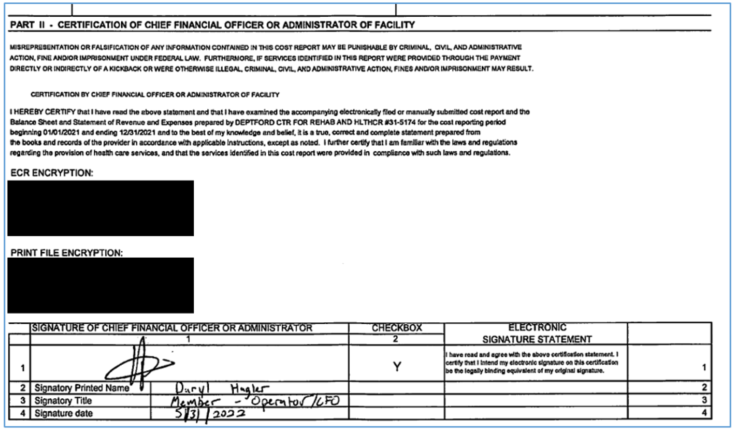
Despite the disclosure and accuracy requirements above, OSC found that Hammonton and Deptford failed to identify at least eight related-party companies they used to provide staffing, management, administrative, property rental, and other services on their state and federal cost reports.[35] They inconsistently disclosed two related parties, BIS Funding Capital LLC and Centers Business Office LLC. The related parties that Hagler and Rozenberg failed to disclose were: Centers for Care; Atlantic Health Land Holding, LLC; Gloucester Land Holding Co., LLC; CFSC Downstate LLC; CFSC Maintenance LLC[36]; Skilled Staffing LLC; Centers Agency; and Centers Lab NJ LLC. Moreover, by failing to disclose these related parties in their cost reports, Hagler and Rozenberg also circumvented the requirement that they report only the allowable costs attributable to these parties; instead, they reported the full amounts Hammonton and Deptford paid to these related parties. Bank records from the nursing homes show that Hammonton paid these related parties a total of $45 million over the timeframe of this review and Deptford paid related parties a total of $47 million over the review period. Only $882,666 of the $92 million was disclosed to the federal government.
Figure 20: Failure to Disclose Over $91 Million in Related-Party Transactions
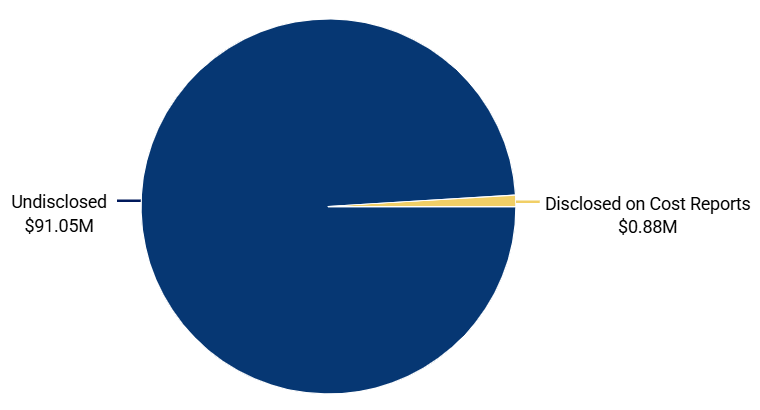
Centers retained the services of an accounting firm to prepare Hammonton’s and Deptford’s cost reports. Centers provided the accounting firm with the data needed for the firm to fill out and submit the forms to CMS and the State. Centers was always owned by Rozenberg and for many years, until at least 2022, by Hagler. Hagler signed and certified the cost reports as accurate. Their repeated failure to disclose their related parties and their repeated failure to reflect the allowable costs paid to these parties was not a mere one-time oversight. On multiple questions, on multiple pages, in multiple years, they omitted material cost information while Hagler certified that the report was accurate. OSC found that between 2018 and 2023, Hagler submitted cost reports in which he signed and certified that Hammonton and Deptford did not have business transactions with any related-party companies, except for the two parties that Hammonton and Deptford inconsistently disclosed (BIS Funding Capital LLC and Centers Business Office LLC).
Hagler is a licensed tax preparer who is responsible for Centers’ financial operations, including accounts receivable, billing, payroll, reporting, accounts payable, and billing. Centers performs the bookkeeping and accounting for many of its related parties, overseen by Hagler. Hagler himself prepares the tax returns for many of the related parties. The consistent failure to disclose the vast majority of their related parties is part of a larger scheme to evade government scrutiny of their related parties and thereby circumvent government requirements limiting allowable costs to fair market value or costs of the related party.
Centers also concealed most of its related parties from the accountant preparing the cost reports. OSC interviewed the accountant who prepared Hammonton’s and Deptford’s cost reports and he testified under oath that Centers was asked about related parties and denied having any, other than BIS and Centers Business Office.
Hagler and Rozenberg, through Centers, also omitted material information in cost reports submitted in New York and several other states. In a Settlement Agreement that Centers entered with the federal government on June 17, 2025, Centers admitted that it had made false statements, including material omissions on its cost reports, by failing to list related parties for 44 of its nursing homes located in New York, Rhode Island, Kansas, and Missouri.[37] Hagler and Rozenberg agreed that they made false statements when they denied business transactions with related parties, omitted calculations and disclosures regarding the related parties’ allowable costs, and falsely claimed that related-party transactions were not associated with a home office (Centers). This is the same scheme that OSC identified in Hammonton and Deptford.
The following table includes all of the undisclosed related parties in Hammonton’s and Deptford’s cost reports identified by OSC.[38]
Figure 21: Undisclosed Related Parties Identified by OSC
|
Name of Related Party |
Type of Service |
Ownership |
Disclosed on Federal Cost Report 2019 to 2023 |
Disclosed on State Cost Report 2022 to 2023 |
|
Gloucester Land Holding Co, LLC (Deptford PropCo) |
Land and Building |
Kenneth Rozenberg and Klein Family Enterprises LLC |
No |
No |
|
Atlantic Health Land Holding LLC (Hammonton PropCo) |
Land and Building |
Kenneth Rozenberg and Klein Family Enterprises LLC |
No |
No |
|
Centers for Care LLC |
Management and Consulting |
Daryl Hagler, Kenneth Rozenberg, and Beth Rozenberg |
No |
No |
|
Centers Business Office LLC |
Management and Consulting |
Kenneth Rozenberg, Beth Rozenberg, Shoshana Rozenberg, Daryl Hagler, and Eli Rozenberg |
2022 for Deptford only |
No |
|
CFSC Downstate LLC |
Housekeeping/Staffing |
Amir Abramchik (Centers’ Chief Operating Officer), Deborah Abramchik, Shoshana Rozenberg, Daryl Hagler, Jonathan Hagler, and Kenneth Rozenberg |
No |
No |
|
CFSC Maintenance LLC (dba One70 Group) |
Repair, Construction, Maintenance |
Daryl Hagler, Jonathan Hagler, and Isaac “Yitzy” Laniado |
No |
No |
|
Skilled Staffing LLC |
Staffing |
Shoshanah (Rozenberg) Areman and Elizabeth Farkas |
No |
No |
|
Centers Lab NJ LLC/ Centers Agency LLC |
Laboratory Services |
Kenneth Rozenberg and Beth Rozenberg |
No |
No |
|
BIS Funding Capital LLC |
IT Services and Software |
Daryl Hagler and Jonathan Hagler |
2022 for Deptford only; 2023 for Deptford and Hammonton |
Yes |
|
One70 Group LLC[39] |
Unknown |
Daryl Hagler, Isaac “Yitzy” Laniado, Tzvi Miller, and Benjamin Diamond. |
No |
No |
Hagler made at least 107 material misrepresentations or omissions on federal cost reports submitted to the federal government for Hammonton. Hammonton also made at least 37 material misrepresentations or omissions on reports submitted to the State.
Hagler made at least 93 material misrepresentations or omissions on federal cost reports submitted to the federal government for Deptford. OSC also identified at least 32 material misrepresentations or omissions on reports submitted to the State.
The extensive misrepresentations on cost reports evidence Hagler and Rozenberg’s longstanding pattern of trying to evade government scrutiny, using related-party transactions to inflate costs that they then siphon for their own gain. The rules on cost reporting exist to prevent inflated costs caused by non-arm’s length transactions and to ensure that transactions reflect true market value. By intentionally omitting material information on state and federal cost reports, they undermined protections meant to provide transparency and ensure that government funds are used for resident care, not excessive and unjustifiable profit-taking.
OSC will seek to recover penalties, including false claims act penalties as appropriate, for the extensive, material, false statements to the state and federal government.
E. Payments to Related Parties Lacked Documentation.
In addition to failing to report related-party transactions on cost reports and siphoning money from the nursing homes through related-party property companies, Hammonton and Deptford also failed to provide or maintain adequate documentation to support a portion of the goods and services allegedly provided by their related parties thereby failing to document that those goods or services were provided at a reasonable cost or were provided at all.
As with all Medicaid providers, state and federal regulations require nursing homes to maintain records to support their claims for Medicaid payment. N.J.S.A. 30:4D-12; N.J.A.C. 10:49-9.8(b)(1); CMS Provider Manual – Part 1, Ch. 10, § 1005. This requirement is especially significant when related parties are involved. When the entities paying for services and receiving those payments are the same, there is an increased risk of improper self-dealing or siphoning of public funds.[40] As such, when a nursing home does business with a related party, allowable costs are limited to the lower of the related party’s costs or fair market value of the good or service. N.J.A.C. 10:49A-2.1(e)(5) and N.J.A.C. 10:49A-3.4.
1. Hammonton and Deptford Do Not Have Documentation Supporting $2.1 Million in Related-Party Transactions
OSC’s investigation found that Hammonton and Deptford paid approximately $35.7 million to related parties during the review period (excluding the property companies). The investigation further revealed that the nursing homes paid for these goods and services without any evidence that the nursing homes were being charged at cost or documented fair value, as required.
As part of the investigation, OSC subpoenaed documentation from the nursing homes to determine whether they maintained adequate support to justify the costs paid for the goods/services purportedly provided by related parties. Hammonton and Deptford did not provide written contracts for at least five of the related parties. Without contracts, there was no documentation to support the nature of the goods or services these related parties purportedly provided to the nursing homes or the agreed upon costs for such goods or services.
During the review period, Hammonton paid approximately $18 million to related parties, excluding the property company, which was discussed above. The original documentation provided in response to OSC’s subpoena accounted for only $9.4 million of the $18 million paid by Hammonton, leaving $8.6 million in unaccounted goods or services allegedly provided by related parties. Similarly, Deptford paid a total of $17.6 million to related parties, excluding the property company, during the review period. The original documentation, however, accounted for just $7.2 million paid by Deptford, meaning at least $10.4 million worth of related party goods or services was unsupported.
After receiving OSC’s original finding that Hammonton and Deptford could not account over $19 million in goods and services, in October 2025, counsel provided OSC with additional invoices for almost $16.9 million worth of goods and services. For purposes of this report, OSC acknowledges that these invoices were provided but notes that the late production of documents, lack of timely cooperation with OSC’s investigation, and other red flags call some of these invoices into question.
Even taking into account the late-produced invoices, $174,012 of payments made to Hammonton’s related parties were completely unsupported and $1,954,837 of payments made to Deptford’s related parties were likewise unsupported.
In total, Hammonton and Deptford paid related parties at least $2.1 million for goods or services that are not supported by any documentation. OSC will seek to recoup these funds. The last-minute production of documents, absence of evidence of cost and fair market value, and missing documentation together raise concerns about the legitimacy of almost all of the related-party transactions. In totality, the evidence reveals that Hagler and Rozenberg paid their related parties inflated amounts to increase their own personal profits and purposefully shielded the transactions from scrutiny so they could continue this scheme. See Appendix C for additional details on the related-party payments and documentation, or lack thereof, to support them.
2. Skilled Staffing Was Used to Divert Funds to Rozenberg and Centers Employees
Section C above shows how Hagler, Rozenberg, and KFE inflated rent payments to related-party property companies to divert over $27.8 million for Rozenberg and KFE. Skilled Staffing was similarly used to divert funds to Rozenberg and various Centers employees.
On paper, Skilled Staffing was owned by Rozenberg’s daughter and daughter-in-law. Tax documents filed by Hagler on behalf of Skilled Staffing show that Rozenberg’s daughter and daughter-in-law reported receiving combined distributions from the entity between 2019 and 2021 totaling $5.5 million. But bank records disprove this, showing that the payments instead went to Rozenberg and the Centers Chief Operating Officer, Abramchik. In 2019, Rozenberg’s daughter and daughter-in-law reported combined distributions of almost $2 million. Instead, bank records show that a check for $1,980,000 from Skilled Staffing was deposited to a joint personal bank account held by Rozenberg and his wife. Similarly, in 2020, Rozenberg’s daughter and daughter-in-law reported combined distributions of $2,341,000; but bank records show the funds were deposited to the account of Rozenberg and his wife ($2,341,000). Again, in 2021, Rozenberg’s daughter and daughter-in-law claimed to have received $1.2 million in distributions, but bank records revealed that $750,000 was deposited into Rozenberg’s bank account and the remaining $450,000 was wire transferred to a bank account held by Abramchik. Additionally, bank records show that Skilled Staffing, which was never reported as a related party, also made significant payments totaling over $2.4 million to eight other members of Centers’ leadership.
Skilled Staffing was paid approximately $1.2 million by Hammonton and Deptford. It did not have a written contract with either nursing home detailing what it had agreed to provide. OSC originally found that more than $600,000 paid to this entity by the nursing homes was unsupported. However, the recent production of newly found documents, support almost all of the payments – less than $450 is unsupported. Unlike every other related party, the new documents appear to completely match all monies paid to Rozenberg’s daughter and daughter-in-law. The absence of a contract, the questionable manner in which the new documents were provided, and the large sums of money that Skilled Staffing paid to Rozenberg and other Centers employees suggest that that these payments were not legitimate costs for services provided to the nursing home and that Skilled Staffing was used as a vehicle to funnel money to Rozenberg and others in the Centers’ leadership.
Recommendations
The extreme fraud, waste, and abuse identified in this report came at a great cost to New Jersey taxpayers and nursing home staff. Sadly, an even greater cost was paid by the residents of Hammonton and Deptford and their families. The facts here again cry out for state government to treat the state of nursing homes in New Jersey as the crisis that it is.
OSC made three recommendations in its December 2024 report, An Investigation of Fraud, Waste, and Abuse in New Jersey’s Lowest-Rated Nursing Home, which addressed extensive fraud and siphoning that occurred at South Jersey Extended Care (SJEC) in Bridgeton:
1. State policies and practices should be adjusted to address and mitigate the risks that accompany the corporate structures used by for-profit nursing homes.
2. The Legislature should enact reforms to guard against fraud, waste, and abuse in nursing homes.
3. The patient care ratio law and regulations should be evaluated and amended as needed to better identify excessive profits, including by applying a stricter standard to higher risk nursing homes.
There has been no meaningful progress implementing any of those recommendations. This report again shows that the changes OSC recommended are desperately needed. OSC stands by the recommendations as fully discussed in the December 2024 report.
OSC further recommends as follows:
4. The Legislature should pass Senate Bill 1948, which would require nursing homes to submit audited financial statements for related entities. This legislation, if properly implemented, would guard against and help detect the abuses OSC has identified in this report and in its prior investigation of SJEC.
5. All state agencies should use existing statutory powers to detect and prevent fraud, waste, and abuse through rental and mortgage scams. Nursing home owners involved in rent and mortgage and other related-party scams should not be permitted to own or operate additional nursing homes in New Jersey.
6. The Legislature should pass legislation regulating rent and mortgages in nursing homes to prevent the types of deceptive and wasteful practices that OSC has identified in this report.
[1] The regulation defines a related party as: (1) Related to the provider. Related to the provider means that the provider to a significant extent is associated or affiliated with or has control of or is controlled by the organization furnishing the services, facilities, or supplies. (2) Common ownership. Common ownership exists if an individual or individuals possess significant ownership or equity in the provider and the institution or organization serving the provider. (3) Control. Control exists if an individual or an organization has the power, directly or indirectly, significantly to influence or direct the actions or policies of an organization or institution. 42 C.F.R. 413.17(b); see also CMS Provider Manual – Part 1, Ch. 10, § 1004.4 (Examples of Control No. 3). “A construction company builds a facility and leases it to an operating company which becomes a provider. Mr. A owns a 100% interest in the construction company and a 35% interest in the operating company. Mr. B, a key employee of the construction company, owns a 20% interest in the operating company. Under the circumstances described, it will be presumed that Mr. A, as the employer of Mr. B in the construction company, can influence Mr. B’s decisions relative to the operation of the provider and that the construction company and the provider are related by common control. (Mr. B would probably not jeopardize his position in the construction company by opposing Mr. A's wishes in the management of the provider).” Ibid.
[2] Ashvin Gandhi & Andrew Olenski, Tunneling and Hidden Profits in Healthcare, National Bureau of Economic Research, Revised September 2025, https://www.nber.org/system/files/ working_papers/w32258/w32258.pdf.
[3] Dan Armstrong, Nursing Home Industry May Obscure Some of its Profits, Lehigh Researcher Finds, Lehigh News, May 21 2024, https://news.lehigh.edu/nursing-home-industry-may-obscure-some-of-its-profits-lehigh-researcher-finds.
[4] The National Consumer Voice for Quality Long-Term Care, Where do the Billions of Dollars Go? A Look at Nursing Home Related Party Transactions (2023), https://theconsumervoice.org/wp-content/uploads/2024/05/2023-Related-Party-Report.pdf.
[5] On January 25, 2024, OSC issued a Notice of Intent to suspend Hagler, Rozenberg, the nursing homes, and various related entities from the Medicaid program. As a result, to protect residents and Medicaid funds, and with the consent of the facilities on June 17, 2024, the Superior Court of New Jersey, Chancery Division, ordered the appointment of a Receiver to take control of Hammonton’s and Deptford’s daily operations, including finances. The Receiver was appointed on June 17, 2024 and remains in place as of the release of this report.
[6] Although BIS is purportedly a software company, OSC’s review of bank accounts indicates that BIS has made significant payments to Valmar Surgical, a home medical equipment and support company. These payments from a software company to a medical equipment company suggest that Hagler and Rozenberg may use some of their related-party companies to simply move funds around.
[7] Although One70 Group is the “doing business as” name for CFSC Maintenance, LLC, OSC identified another entity named “One70 Group” with a different EIN number. In their response, counsel stated that all payments were made to CFSC Maintenance, LLC.
[8] Ownership information for these entities varied during OSC’s investigation period. The individuals identified include any person named as having an ownership interest at any point during that period.
[9] The amounts reflected in this chart are based on claims data run in February 2025; current numbers likely differ. The chart is presented for illustrative purposes only.
[10] For purposes of this discussion, “direct care staff” means nurses and CNAs who are signed in as CNAs who are performing CNA duties.
[11] OSC followed up with counsel for Hammonton and Deptford no less than five times after issuing subpoenas to confirm that they had provided all responsive documentation. Based on OSC’s good faith belief that Hammonton and Deptford had failed to provide all responsive documents, and their inaccurate claim that they had fully complied with the subpoenas, OSC filed a motion to enforce these subpoenas. OSC advised Hammonton and Deptford of OSC’s preliminary staffing findings and again asked whether the facilities possessed information that might change those findings. In response, counsel for Hammonton and Deptford advised that “our position is that we have complied with the subpoenas.” Through the Attorney General, OSC filed an order to show cause and motion to enforce the subpoenas seeking staffing documentation. The parties appeared for a settlement conference in the Superior Court of New Jersey, Mercer County, and, notwithstanding their prior assertions that they had fully complied with OSC’s subpoenas, counsel agreed that the facilities would provide complete daily staffing information by September 23, 2025—almost 9 months after the original subpoena was served. Hammonton’s and Deptford’s October 2025 production included hundreds of new pages of documentation, including timecards for more than 540 staff members who had never before been disclosed. OSC notes this history because it may be relevant to efforts to recover funds from the nursing homes.
[12] CMS Centers for Medicare & Medicaid Services, Design for Care Compare Nursing Home Five-Star Quality Rating System: Technical User’s Guide (July 2025), https://www.cms.gov/medicare/provider-enrollment-and-certification/certificationandcomplianc/downloads/usersguide.pdf.
[13] For purposes of this discussion, “direct care staff” means nurses and CNAs who are signed in as CNAs who are performing CNA duties.
[14] 42 U.S.C. 1396r(b)(1)(A).
[15] 42 U.S.C. 1396r(b)(2).
[16] MFD can reasonably assert, with 90 percent confidence, that the total overpayment in the universe is at least $42,033,479.77 (3.03 percent precision) with the error point estimate as $43,348,392.77. Adding the overpayment from the take-all stratum ($55,763.04) to the lower limit ($42,033,479.77), the total recovery amount is $42,089,242.81.
[17] MFD can reasonably assert, with 90 percent confidence, that the total overpayment in the universe is at least $44,043,649.96 (3.89 percent precision) with the error point estimate as $45,825,817.38. Adding the overpayment from the take-all stratum ($119,652.24) to the lower limit ($44,043,649.96), the total recovery amount is $44,163,302.19.
[18] A Curtailment Order stops all new admissions or readmissions of residents and patients to a nursing home when violations are found that pose an immediate and serious threat of harm to the residents. N.J.A.C. 8:43E-3.6.
[19] OSC did not independently corroborate the allegations made in the calls and reports. OSC is conveying what was reported to police by residents and family members.
[20] Hayleigh Colombo, Patients paid the price as public money flowed to embattled AC-area nursing home owners, The Press of Atlantic City, May 17, 2024, https://pressofatlanticcity.com/news/local/business/health-care/article_cf963dd8-12c6-11ef-87c9-b7558e751087.html.
[21] Bank documents do not indicate how the buyers financed the approximately $600,000 that was not covered by the mortgage or the seller-finance note.
[22] Triple net leases are typically commercial property leases where the tenant agrees to pay the rent, utilities, and property expenses such as insurance, maintenance, and taxes.
[23] Base rent is the fixed amount due monthly for the right to use the property. Base rent typically does not include expenses like utilities, taxes, insurance, or maintenance. Base rent is calculated based on the amount the property owner must pay the mortgage company to cover the monthly mortgage.
[24] Multiple health inspections at Mount Laurel revealed various safety issues, including failure to report physical altercations between residents; unclean and unsanitary living environments; inadequate intervention for a suicidal resident; insufficient training for staff; and failure to investigate and report sexual abuse and harassment between residents. D. DeSisto, Mount Laurel nursing, rehabilitation center closes; residents relocated, Burlington County Times, June 16, 2017. Harold Brubaker, Troubled Mount Laurel nursing home closing next month, The Philadelphia Inquirer, June 16, 2017, https://www.inquirer.com/philly/business/troubled-mount-laurel-nursing-home-closing-next-month-20170616.html. After CMS determined Mount Laurel no longer met the standards required to service Medicare and Medicaid recipients, the facility was about to close when a third-party buyer promptly purchased the nursing home and continued operating the facility under a new name, with new nursing home management.
[25] HUD offers mortgage insurance for refinancing home and certain commercial mortgages. It entails getting a loan from a private bank or lender that, if approved, is insured by HUD. If a mortgage holder defaults, HUD pays a portion of the unpaid principal balance to the bank. HUD insurance is meant to give nursing home buyers access to more favorable financing and to make loans less risky for lenders.
[26] Documents submitted to HUD in connection with this refinancing clearly disclosed that the mortgage encompassed the purchase of both the real estate and operating companies. Both the Hammonton and Deptford documents state: “The subject property was purchased in September 2014 as part of a three-property portfolio which included Mount Laurel Center for Rehabilitation and Healthcare, Hammonton Center for Rehabilitation and Healthcare, and Deptford Center for Rehabilitation and Healthcare. The three properties were acquired for $68,750,000, or $101,103 per bed including the real estate and operating companies. The portion of the purchase price allocated to the subject property was $21,386,113, of which included $6,173,475 was allocated to the Real Estate, and $15,212,628 was allocated to operations.”
[27] It is noteworthy that the tax assessed value of the land and improvements in 2016 was approximately $9.3 million for Deptford and approximately $8.3 million for Hammonton.
[28] OSC’s investigation did not identify any significant capital improvements to the nursing homes to enhance the value of the properties during the review period sufficient to justify the steep increase in base rent.
[29] After New York determined that Rozenberg and Hagler misappropriated more than $83 million in government funds and OSC issued a notice to Rozenberg and Hagler that they would be suspended from New Jersey Medicaid, the Superior Court of New Jersey, Chancery Division, ordered the appointment of a Receiver to take control of Hammonton’s and Deptford’s daily operations, including finances. The Receiver was appointed on June 17, 2024 and remains in place.
[30] The debt service for a mortgage is the amount needed to cover principal and interest payments, along with other debt obligations.
[31] This ratio was calculated by dividing the cost of the purchase of the operating company, $15 million, by the total cost of the mortgage. That ratio was then applied to the total P&I payments made during the timeframe to determine how much was attributable to the operating company purchase.
[32] CMS Provider Manual – Part I, Ch. 21 §§ 2102-2103.
[33] CMS Provider Manual – Part 1, Ch. 10 § 1000.
[34] Allowable costs must be reported at the related party’s actual costs or fair market value, whichever is less. 42 C.F.R. 413.17. To minimize the risk inherent with self-dealing, the costs cannot exceed the price of comparable services obtained through an arm’s length transaction. Cost reports must include both the amount paid, and the allowable amount.
[35] OSC’s investigation only focuses on some of the nursing homes’ related-party companies. The investigation may not have identified all the related-party companies owned by Hagler, Rozenberg, and their families, that are doing business with Hammonton and Deptford.
[36] They also failed to disclose One70 Group. Although One70 Group is the “doing business as” name for CFSC Maintenance, LLC, OSC identified a second entity named “One70 Group” with a different EIN number.
[37] U.S. Department of Justice, U.S. v. Centers Healthcare Settlement Agreement (June 23, 2025), https://www.justice.gov/criminal/media/1405141/dl?inline.
[38] Ownership information for these entities varied during OSC’s investigation period. The individuals identified include any person named as having an ownership interest at any point during that period.
[39] OSC identified two entities named “One70 Group,” one is the “doing business as” name for CFSC Maintenance LLC and the other is a vendor with a different EIN number.
[40] A study published by the National Bureau of Economic Research showed the critical nature of documentation requirements. It estimated that in 2019, 68 percent of nursing home profits were hidden by owners by using related parties. Ashvin Gandhi & Andrew Olenski, Tunneling and Hidden Profits in Healthcare, National Bureau of Economic Research, Revised September 2025, https://www.nber.org/system/files/working_papers/w32258/w32258.pdf. A 2023 article estimated that inflated costs paid by nursing homes resulted in $2.76B in ill-gotten gains diverted by owners. Ted Sherman, Susan K. Livio, & Matthew Miller, Inside the ‘multibillion-dollar game’ to funnel cash from nursing homes to sister companies, NJ.com, Revised July 29, 2025, https://www.nj.com/news/2025/04/inside-the-multibillion-dollar-game-to-funnel-cash-from-nursing-homes-to-sister-companies.html.
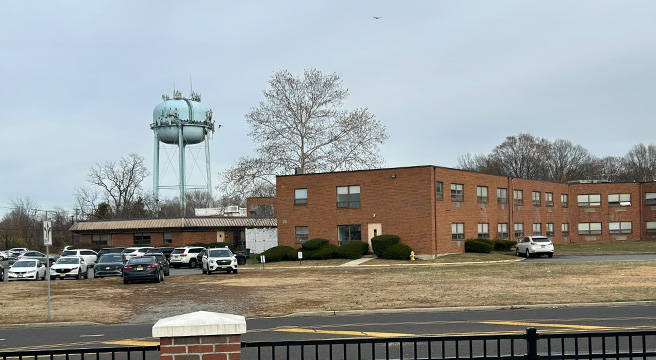
Waste or Abuse
Report Fraud
Waste or Abuse