 Official Site of The State of New Jersey
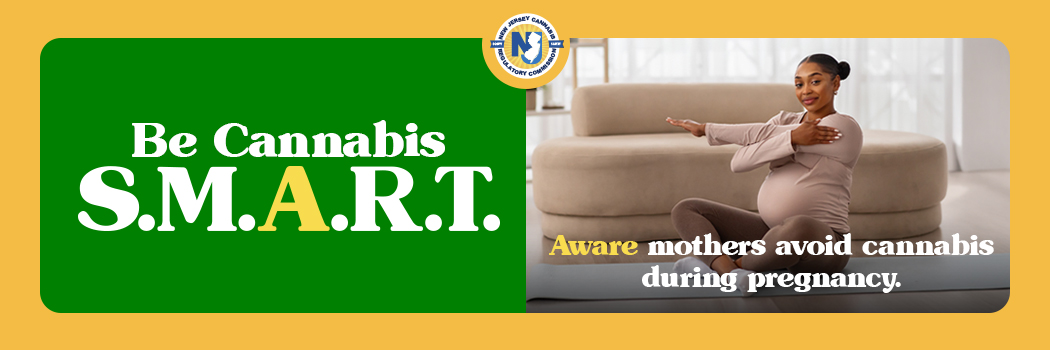
Know for your baby. Pause for your baby.
For the health and wellness of your baby, stopping cannabis use is the safest choice. Whether you are pregnant, breastfeeding, or planning a pregnancy, cannabis use in any form (smoked, vaped, eaten as an edible, taken as a gummy, transdermal patches or consumed in a beverage) may pose risks to your baby. The American College of Obstetricians and Gynecologists (ACOG) states there is no medical indication for cannabis use during pregnancy or in the postpartum period (ACOG, 2025)
Your baby and cannabis
Cannabis use during pregnancy may affect your baby’s development and increase the risk of pregnancy complications. Tetrahydrocannabinol (THC), the main psychoactive compound in cannabis, crosses the placenta and reaches the
developing fetus; cannabinoid receptors are present in the fetus as early as about five weeks of gestation (ACOG, 2025; CDC, 2025a).
Cannabis carries risk regardless of how it is used. Edibles are not a safer alternative. When THC is eaten rather than smoked, the body absorbs and processes it more slowly, so the effects are delayed, which can lead people to consume more than intended before feeling anything (NIDA, 2020).
Across the research literature, cannabis use during pregnancy has been associated with an increased risk of:
- Preterm birth (spontaneous preterm delivery)
- Low birth weight
- Small for gestational age / fetal growth restriction
- Reduced head circumference and birth length
- NICU admission
- Perinatal mortality (including stillbirth)
- Major congenital anomalies
- Impaired neurodevelopment (see below)
(ACOG, 2025; CDC, 2025a; 2024 meta-analysis, 2025; AAFP, 2024)
Today's cannabis is significantly more potent than it was in previous decades. Data from the University of Mississippi's Potency Monitoring Program, which operates under a contract with the National Institute on Drug Abuse, indicates that the average THC concentration in cannabis seized in the United States rose from below 4% in the early to mid-1990s to over 15% by the years 2018 to 2022. This represents an increase of approximately three to four times (NIDA, 2024; NIDA, 2020). Higher potency could lead to greater exposure for a developing brain and body.
A note on causation
Much of the evidence available is observational and is complicated by the concurrent use of tobacco, alcohol, and other substances, as well as social and economic factors. While studies show associations, they do not always demonstrate that cannabis alone causes specific outcomes. This uncertainty serves as a reason for caution rather than reassurance. Every major medical organization advises against cannabis use during pregnancy (ACOG, 2025; NASEM, 2017).
SIDS is most strongly and consistently linked to exposure to tobacco and nicotine smoke both before and after birth. The independent impact of cannabis on SIDS is unclear; a comprehensive review by the National Academies concluded that there is insufficient evidence to confirm or deny a link. Additionally, existing studies are complicated by the co-use of tobacco (NASEM, 2017). Since secondhand smoke of any kind is harmful, maintaining smoke-free environments is crucial.
Effects on child's developing brain
- Decreased attention and concentration
- Reduced performance on memory and learning tasks
- Lower scores on problem-solving and reasoning measures
- Hyperactivity and impulsivity
- Behavioral problems
- ADHD and ADHD-like symptoms
- Memory challenges and intellectual disability
Morning sickness and cannabis
Some people use cannabis to manage pregnancy-related nausea, anxiety, pain, or sleep problems. However, there is insufficient evidence that cannabis is a safe or effective treatment for nausea and vomiting during pregnancy, and ACOG states there is no medical indication for its use during pregnancy (ACOG, 2025; Galvin & Coulson, 2023).
Importantly, chronic cannabis use can cause or worsen severe, cyclic nausea and vomiting through cannabinoid hyperemesis syndrome (CHS). This condition can be mistaken for ordinary morning sickness or hyperemesis gravidarum and that improves only with cannabis cessation (Galvin & Coulson, 2023). In other words, cannabis used to relieve nausea may sometimes be the source of it.
Talk to your healthcare provider about safe, evidence-based options for managing morning sickness.
Breastfeeding and cannabis
THC is highly fat-soluble. It is stored in body fat and released slowly over time, so your baby may continue to be exposed even after you stop using cannabis (CDC, 2025a; LactMed, 2025).
THC can transfer into breast milk. A study by Bertrand et al. (2018) found that THC was detectable in breast milk for up to approximately six days after the last use. Another longitudinal study estimated the half-life of THC in milk to be around 17 days, with THC remaining detectable for more than six weeks (Wymore et al., 2021). Reports of detection windows in various studies range from about six days to over six weeks (LactMed, 2025).
THC is stored in body fat and is released gradually, so the practice of "pumping and dumping" will not eliminate it from your breast milk. Discarding milk only removes what has already been produced; it does not eliminate the THC stored in your body, which continues to enter newly produced milk (CDC, 2025a; LactMed, 2025).
If you are using cannabis to manage pain, anxiety, nausea, or other conditions while breastfeeding, it's important to discuss safer alternatives with your healthcare provider. The American College of Obstetricians and Gynecologists (ACOG), the American Academy of Pediatrics, and the Academy of Breastfeeding Medicine recommend abstaining from cannabis during breastfeeding. However, continuing to use cannabis is not a reason to avoid breastfeeding. The benefits of breastfeeding still apply, and parents who wish to breastfeed should receive support in doing so (ACOG, 2025; Wymore et al., 2021).
Secondhand cannabis smoke also poses risks to infants and young children; its smoke contains many of the same toxic and cancer-causing chemicals found in tobacco smoke. Never smoke near a baby or in spaces where a baby spends time (CDC, 2025a).
For Healthcare Providers
In its clinical consensus Cannabis Use During Pregnancy and Lactation, published in the October 2025 issue of Obstetrics & Gynecology, ACOG issued significantly updated guidance recommending universal screening for cannabis use at every stage of reproductive care (ACOG, 2025). Key recommendations include:
- Screen universally (before, during, and after pregnancy): Ask all patients about cannabis use at pre-pregnancy, prenatal, and postpartum visits as a routine, non-judgmental part of care.
- Use interview-based screening, not biologic testing: Self-report, structured interviews, or validated screening tools are preferred. Urine and other biologic testing can be inaccurate for assessing use and has contributed to racial and ethnic disparities in reporting and reporting to authorities.
- Obtain informed consent before any drug testing and be aware of local policies that may trigger involvement of child protective services (CPS).
- Advise cessation with individualized counseling: Communicate risks clearly while acknowledging the patient’s values, priorities, and barriers. Motivational interviewing and tailored cessation strategies are recommended.
- Address underlying needs: Help patients find evidence-based alternatives for pain, anxiety, nausea, insomnia, or other conditions driving cannabis use.
- Support breastfeeding while encouraging cessation: Continued cannabis use is not a contraindication to breastfeeding; patients who want to breastfeed should be encouraged and supported.
Providers should ensure patients understand that cannabis use in pregnancy and the postpartum period has been associated with spontaneous preterm birth, low birth weight, small for gestational age, NICU admission, perinatal mortality, and long-term neurocognitive and behavioral dysfunction (including ADHD, memory challenges, and intellectual disability) (ACOG, 2025).
What everyone should understand
With cannabis now legal in many states, many people assume it is safe to use during pregnancy. Legal does not mean safe for everyone. Legality reflects policy, not a determination that a substance is safe for a developing fetus (ACOG, 2025).
Cannabis use among pregnant people has been rising alongside legalization and growing social acceptance. In the U.S., self-reported use during pregnancy more than doubled between 2002 and 2017 and so has the misperception that it is harmless (ACOG, 2025; CDC, 2025a).
Cannabis use in pregnancy frequently occurs alongside tobacco, alcohol, or other substances, each of which independently carries risk. All substance use should be discussed openly with a healthcare provider (CDC, 2025c; ACOG, 2025).
Research into the long-term effects of prenatal cannabis exposure is still evolving. The absence of complete certainty is not a reason to assume safety; the existing evidence is significant enough that all major medical organizations advise against cannabis use during pregnancy and while breastfeeding (ACOG, 2025; NASEM, 2017).
It is never too late to stop. Reducing or stopping cannabis use at any point during pregnancy can help lower your baby’s exposure and potential harm (ACOG, 2025).
Information and Resources
- ReachNJ is a central call-in line for New Jersey residents who are looking for help with a substance use disorder (SUD). Serves all New Jersey residents. Call 1-844-ReachNJ or 1-844-732-2465. Learn more by visiting reachnj.gov
- Substance Abuse and Mental Health Services Administration (SAMHSA) National Helpline: Free, confidential treatment referral and information service, available 24/7. Call: 1-800-662-HELP (4357) | findtreatment.gov
- New Jersey Poison Control Center: If you have concerns about accidental exposure: call 1-800-222-1222 or chat at https://njpies.org .
- Centers for Disease Control and Prevention. (2025c). Substance use during pregnancy. https://www.cdc.gov/maternal-infant-health/pregnancy-substance-abuse/index.html
- American Academy of Family Physicians. (2024). Cannabis use during pregnancy. FPM. https://www.aafp.org/pubs/fpm/issues/2024/0700/cannabis-during-pregnancy.html
- National Institute on Drug Abuse. (2020). Myth or fact? “Marijuana is stronger these days.” https://archives.drugabuse.gov/blog/post/myth-or-fact-marijuana-stronger-these-days
- Bertrand, K. A., Hanan, N. J., Honerkamp-Smith, G., Best, B. M., & Chambers, C. D. (2018). Marijuana use by breastfeeding mothers and cannabinoid concentrations in breast milk. Pediatrics, 142 (3), e20181076. https://publications.aap.org/pediatrics/article-abstract/142/3/e20181076/81671/Marijuana-Use-by-Breastfeeding-Mothers-and
- Wymore, E. M., Palmer, C., Wang, G. S., Metz, T. D., Bourne, D. W. A., Sempio, C., & Bunik, M. (2021). Persistence of Δ-9-tetrahydrocannabinol in human breast milk. JAMA Pediatrics, 175*(6), 632–634. https://jamanetwork.com/journals/jamapediatrics/fullarticle/2776975
- Drugs and Lactation Database (LactMed). (2025). Cannabis. National Library of Medicine. https://www.ncbi.nlm.nih.gov/books/NBK501587/
- Centers for Disease Control and Prevention. (2025a). Cannabis and pregnancy. https://www.cdc.gov/cannabis/health-effects/pregnancy.html
- Centers for Disease Control and Prevention. (2025b). Polysubstance use during pregnancy. https://www.cdc.gov/pregnancy/during/polysubstance-use.html
- Meta-analysis of maternal and neonatal outcomes of cannabis use in pregnancy current to March 2024. (2025). [Peer-reviewed systematic review and meta-analysis]. PMC12315265. https://www.ncbi.nlm.nih.gov/pmc/articles/PMC12315265/
- National Academies of Sciences, Engineering, and Medicine. (2017). The health effects of cannabis and cannabinoids: The current state of evidence and recommendations for research. National Academies Press. https://www.ncbi.nlm.nih.gov/books/NBK425751/
- American College of Obstetricians and Gynecologists. (2025). Cannabis use during pregnancy and lactation [Clinical Consensus]. Obstetrics & Gynecology, 146(4). https://www.acog.org/clinical/clinical-guidance/clinical-consensus/articles/2025/10/cannabis-use-during-pregnancy-and-lactation
- Galvin, S. L., & Coulson, C. C. (2023). Addressing cannabis consumption among patients with hyperemesis gravidarum. AJOG Global Reports, 3(2), 100180. https://www.sciencedirect.com/science/article/pii/S2666577823000217
- National Institute on Drug Abuse. (2024). Cannabis potency data. https://nida.nih.gov/research/research-data-measures-resources/cannabis-potency-data