
Since its ratification in 1788, the United States Constitution has been amended twenty-seven times. New Jersey was the first state to ratify the first ten amendments, known as the Bill of Rights. In all, our state has ratified 26 of the 27 proposed amendments that have passed the required three-fourths of the states. New Jersey never ratified the 11th Amendment, giving states immunity from personal lawsuits in federal court.
In five instances, New Jersey ratified amendments after they were approved by the requisite number of states. These include the 13th (Abolition of Slavery), 15th (Right to Vote), 16th (Federal Income Tax), 18th (Prohibition of Alcohol), and 27th (Regulation of Congressional Salaries). New Jersey has the distinction of being the last state to ratify Prohibition in 1922, while being one of the first to ratify its repeal in 1933.
Congress shall make no law respecting an establishment of religion, or prohibiting the free exercise thereof; or abridging the freedom of speech, or of the press; or the right of the people peaceably to assemble, and to petition the Government for a redress of grievances.
A well regulated Militia, being necessary to the security of a free State, the right of the people to keep and bear Arms, shall not be infringed.
No Soldier shall, in time of peace be quartered in any house, without the consent of the Owner, nor in time of war, but in a manner to be prescribed by law.
The right of the people to be secure in their persons, houses, papers, and effects, against unreasonable searches and seizures, shall not be violated, and no Warrants shall issue, but upon probable cause, supported by Oath or affirmation, and particularly describing the place to be searched, and the persons or things to be seized.
No person shall be held to answer for a capital, or otherwise infamous crime, unless on a presentment or indictment of a Grand Jury, except in cases arising in the land or naval forces, or in the Militia, when in actual service in time of War or public danger; nor shall any person be subject for the same offence to be twice put in jeopardy of life or limb; nor shall be compelled in any criminal case to be a witness against himself, nor be deprived of life, liberty, or property, without due process of law; nor shall private property be taken for public use, without just compensation.
In all criminal prosecutions, the accused shall enjoy the right to a speedy and public trial, by an impartial jury of the State and district wherein the crime shall have been committed, which district shall have been previously ascertained by law, and to be informed of the nature and cause of the accusation; to be confronted with the witnesses against him; to have compulsory process for obtaining witnesses in his favor and to have the Assistance of Counsel for his defence.
In Suits at common law, where the value in controversy shall exceed twenty dollars, the right of trial by jury shall be preserved, and no fact tried by a jury, shall be otherwise re-examined in any Court of the United States, than according to the rules of the common law.
Excessive bail shall not be required, nor excessive fines imposed, nor cruel and unusual punishments inflicted.
The enumeration in the Constitution, of certain rights, shall not be construed to deny or disparage others retained by the people.
The powers not delegated to the United States by the Constitution, nor prohibited by it to the States, are reserved to the States respectively, or to the people.
Ratified by Required Number of States, December 15, 1791.
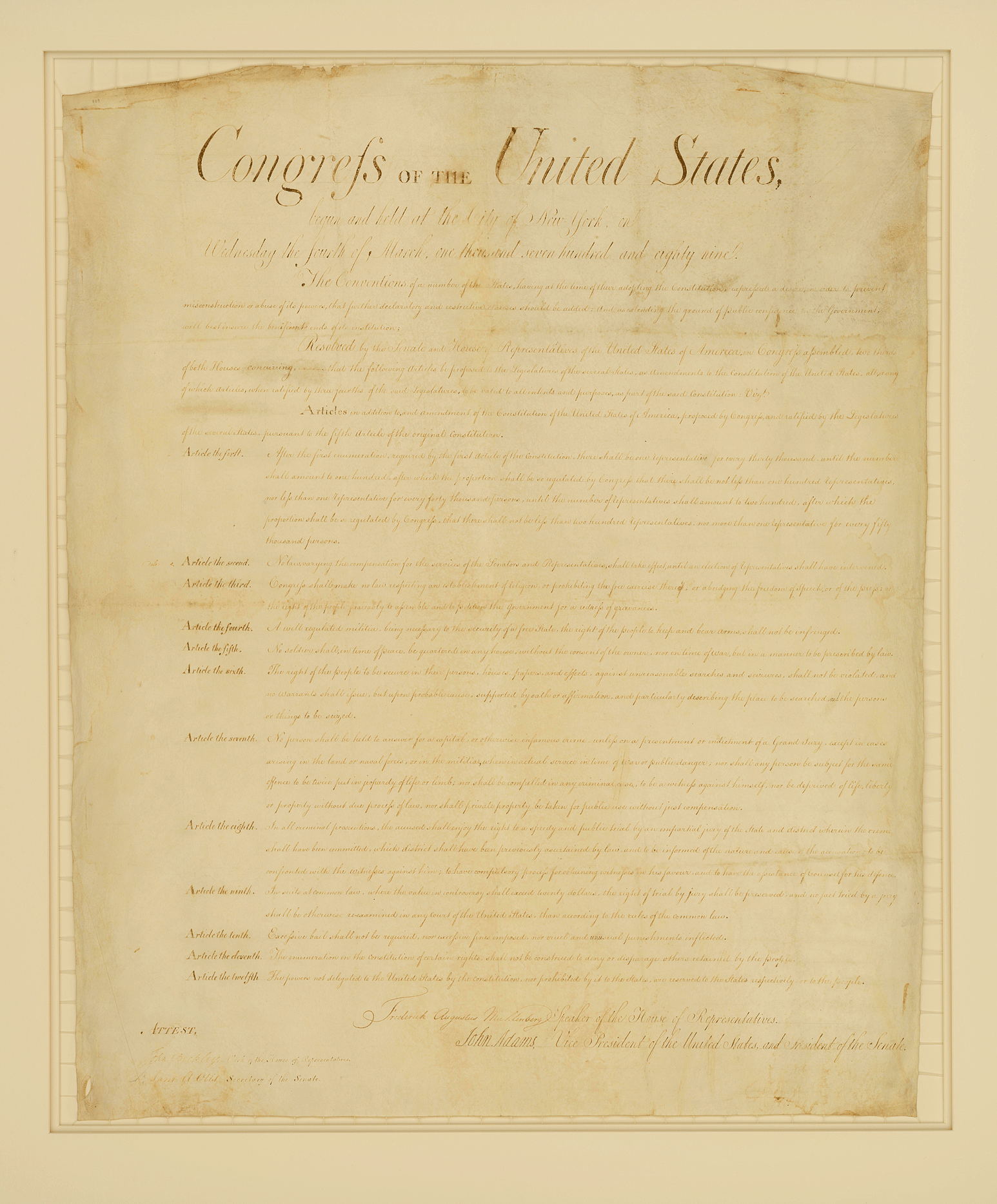
Congress of the United States
begun and held at the City of New-York, on
Wednesday the fourth of March,
one thousand seven hundred eighty nine.
The Conventions of a number of the States, having at the time of their adopting the Constitution, expressed a desire, in order to prevent misconstruction or abuse of its powers, that further declaratory and restrictive clauses should be added: And as extending the ground of Public confidence in the Government, will best insure the beneficent ends of its institution;
Resolved by the Senate and House of Representatives of the United States of America, in Congress assembled, two thirds of both Houses concurring, that the following Articles be proposed to the Legislatures of the several States, as Amendments to the Constitution of the United States, all, or any of which Articles, when ratified by three fourths of the said Legislatures, to be valid to all intents and purposes, as part of the said Constitution; Vizt
Articles in addition to, and Amendment of the Constitution of the United States of America, proposed by Congress, and ratified by the Legislatures of the several States, pursuant to the fifth Article of the original Constitution.
Article the first.
After the first enumeration, required by the first Article of the Constitution, there shall be one representative for every thirty thousand, until the number shall amount to one hundred, after which the proportion shall be so regulated by Congress that there shall be not less than one hundred representatives, nor less than one representative for every forty thousand persons, until the number of representatives shall amount to two hundred, after which the proportion shall be so regulated by Congress, that there shall not be less than two hundred representatives, nor more than one representative for every fifty thousand persons.
Article the second.
No law, varying the compensation for the services of the Senators and Representatives, shall take effect, until an election of representatives shall have intervened.
Article the third.
Congress shall make no law respecting an establishment of religion, or prohibiting the free exercise thereof; or abridging the freedom of Speech, or of the Press: or the right of the people peaceably to assemble and to Petition the Government for a redress of grievances.
Article the fourth.
A well regulated militia, being necessary to the security of a free State, the right of the people to keep and bear Arms, shall not be infringed.
Article the fifth.
No soldier shall, in time of Peace, be quartered in any house, without the consent of the owner, nor in time of War, but in a manner to be prescribed by law.
Article the sixth.
The right of the People to be secure in their persons, houses, papers, and effects, against unreasonable searches and seizures, shall not be violated, and no Warrants shall issue, but upon probable cause, supported by oath or affirmation, and particularly describing the place to be searched, and the persons or things to be seized.
Article the seventh.
No person shall be held to answer for a capital, or otherwise infamous crime, unless on a presentment or indictment of a Grand Jury, except in cases arising in the land or naval forces, or in the militia, when in actual service in time of War or Public danger; nor shall any person be subject for the same offence to be twice put in jeopardy of life or limb; nor shall be compelled in any criminal case, to be a witness against himself, nor be deprived of life, liberty or property without due process of law, nor shall private property be taken for public use without just compensation.
Article the eighth.
In all criminal prosecutions, the accused shall enjoy the right to a speedy and public trial by an impartial jury of the State and district wherein the crime shall have been committed, which district shall have been previously ascertained by law, and to be informed of the nature and cause of the accusation; to be confronted with the witnesses against him; to have compulsory process for obtaining witnesses in his favour, and to have the assistance of Counsel for his defence.
Article the ninth.
In suits at common law, where the value in controversy shall exceed twenty dollars, the right of trial by jury shall be preserved, and no fact tried by a jury shall be otherwise re-examined in any Court of the United States, than according to the rules of the common law.
Article the tenth.
Excessive bail shall not be required, nor excessive fines imposed, nor cruel and unusual punishments inflicted.
Article the eleventh.
The enumeration in the Constitution of certain rights, shall not be construed to deny or disparage others retained by the People.
Article the twelfth.
The powers not delegated to the United States by the Constitution, nor prohibited by it to the States, are reserved to the States respectively, or to the people.
Frederick Augustus Muhlenberg Speaker of the House of Representatives
John Adams, Vice President of the United States, and President of the Senate.
Attest,
John Beckley, Clerk of the House of Representatives.
Sam: A. Otis, Secretary of the Senate.
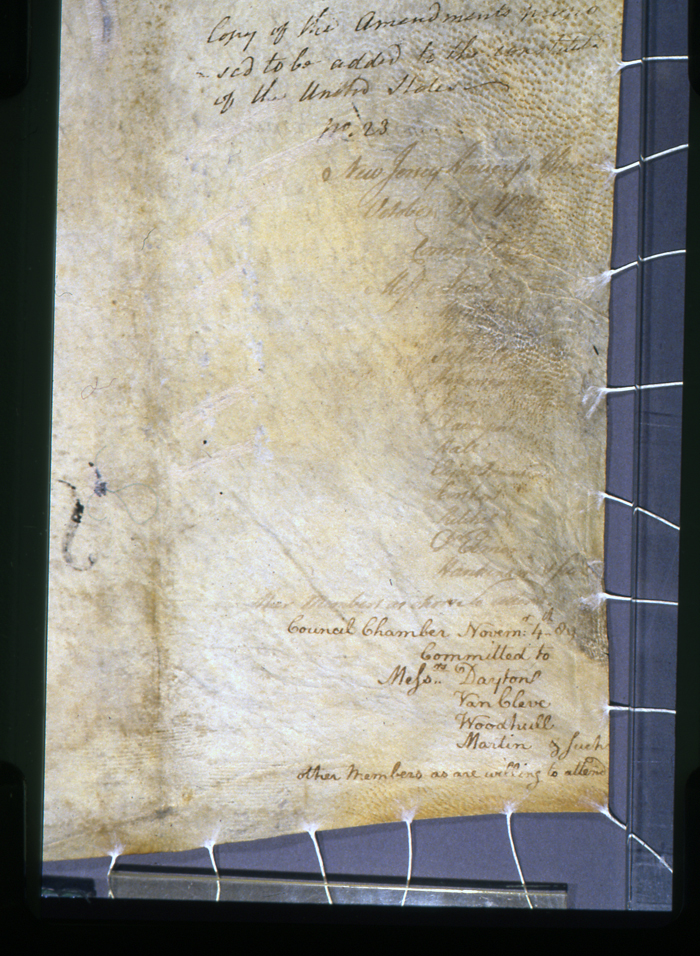
Verso of the Bill of Rights
Image captured at time of conservation, prior to encasing. Transcription based in part on the "Calendar of the New Jersey State Library Manuscript Collection...," WPA Historical Records Survey (1939), p. 71, item 352.
Copy of the Amendments proposed to be added to the constitution of the United States —
No. 23
New Jersey House of Assembly
October 29, 1789
Committed to
Messrs
[Isaac] Nicoll
[Daniel] Marsh
[James] Bonny
[Joseph] Stillwell
[John] Witherspoon
[Robert] Jones
[Franklin] Davenport
[Edward] Hall
Elijah Townsend
[Joshua] Corshon
[Aaron] Kitchel
Dr. [Eli] Elmer
[Aaron] Hankinson [Speaker] & such other Members as choose to attend
Council Chamber November 4th, [17]89
Committed to
Messrs
[Jonathan] Dayton
[Benjamin] Van Cleve
[William] Woodhull
[Ephraim] Martin & such other Members as are willing to attend
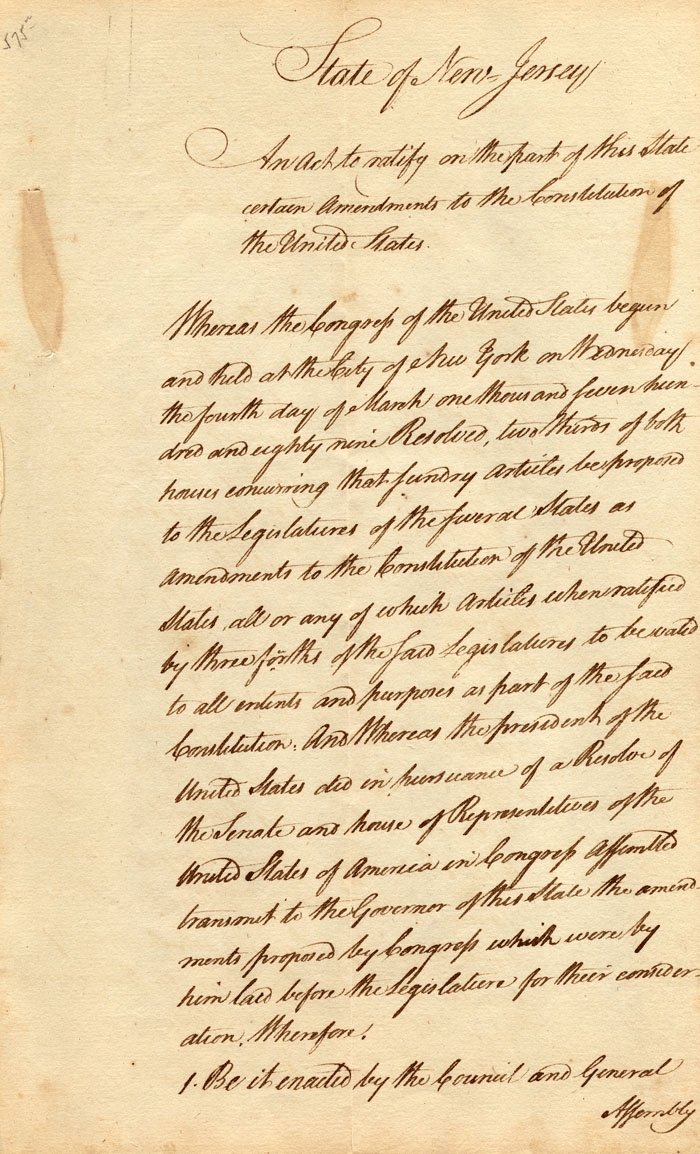
State of New Jersey
An Act to ratify on the part of this State
certain Amendments to the Constitution of
the United States.
Whereas the Congress of the United States begun and held at the City of New York on Wednesday the fourth Day of March one thousand seven hundred and eighty nine Resolved, two thirds of both houses concurring that sundry Articles be proposed to the Legislatures of the several States as amendments to the Constitution of the United States, all or any of which Articles when ratified by three fourths of the said Legislatures to be valid to all intents and purposes as part of the said Constitution: And Whereas the president of the United States did in pursuance of a Resolve of the Senate and house of Representatives of the United States of America in Congress assembled transmit to the Governor of this State the amendments proposed by Congress which were by him laid before the Legislature for their Consideration, Wherefore,1. Be it enacted by the Council and General
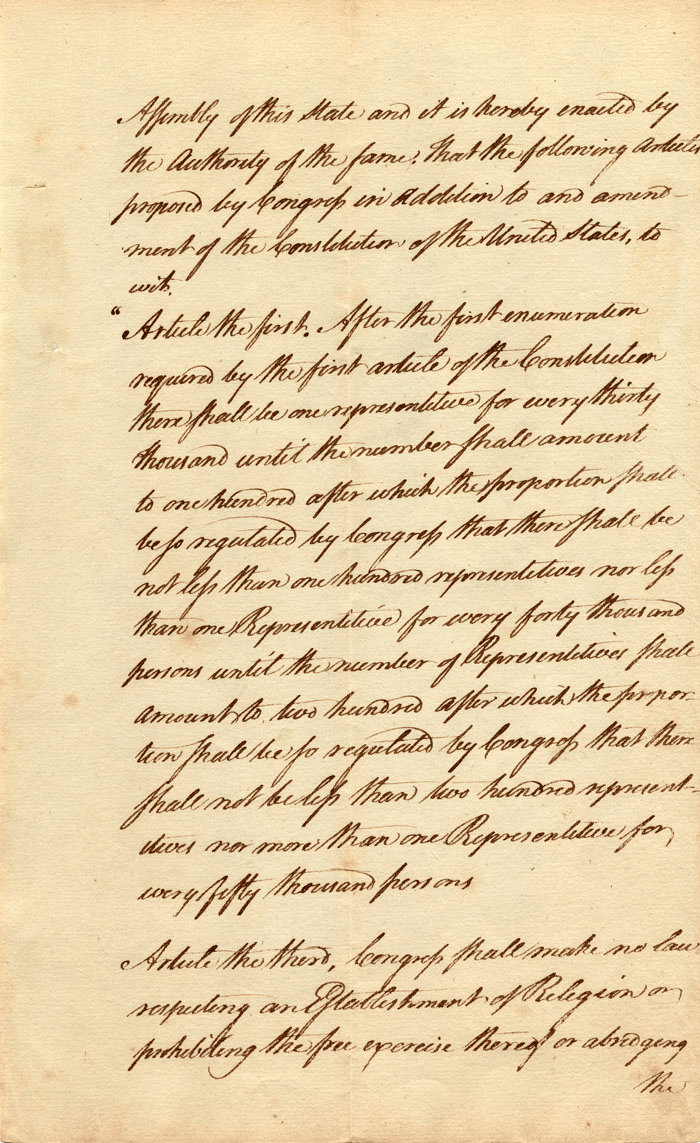
Assembly of this State, and it is hereby enacted by the Authority of the same, That the following Articles proposed by Congress in Addition to and amendment of the Constitution of the United States, to wit,
"Article the first. After the first enumeration required by the first article of the Constitution there shall be one representative for every thirty thousand until the number shall amount to one hundred after which the proportion shall be so regulated by Congress that there shall be not less than one hundred representatives, nor less than one Representative for every forty thousand persons until the number of Representatives shall amount to two hundred after which the proportion shall be so regulated by Congress that there shall not be less than two hundred representatives, nor more than one Representative for every fifty thousand persons.
Article the third. Congress shall make no law respecting an Establishment of Religion or prohibiting the free exercise thereof, or abridging
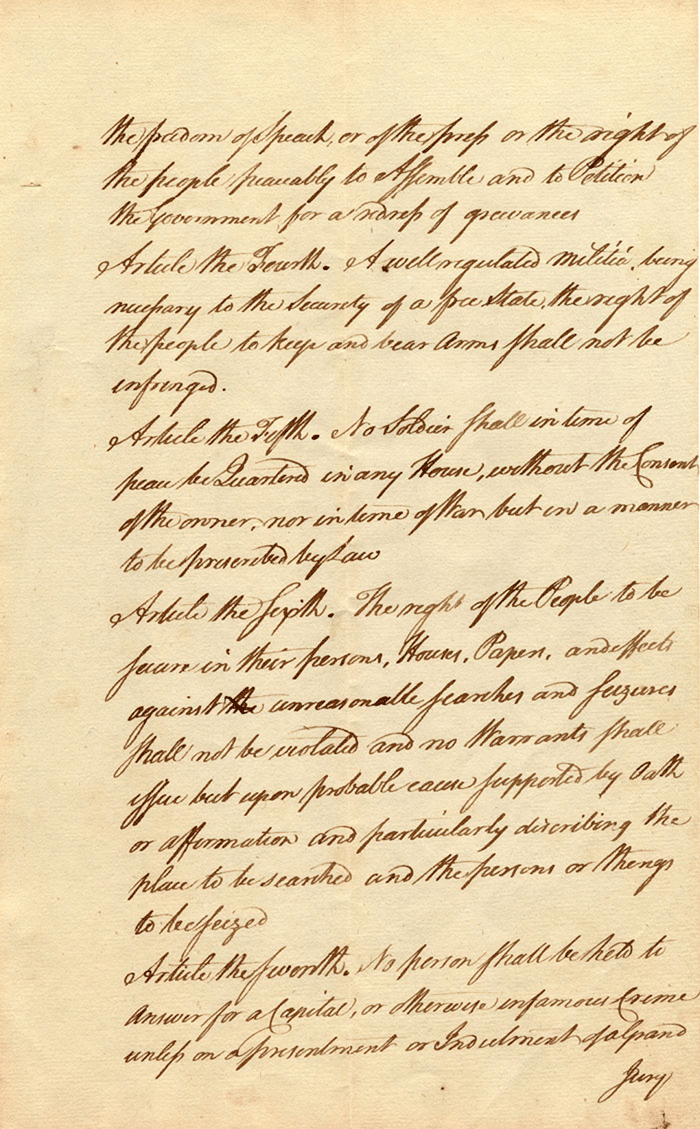
the freedom of Speech, or of the press, or the right of the people peaceably to Assemble and to Petition the Government for a redress of grievances.
Article the Fourth. A well regulated Militia being necessary to the Security of a free State, the right of the people to keep and bear Arms shall not be infringed.
Article the Fifth. No Soldier shall in time of peace be Quartered in any House, without the Consent of the owner, nor in time of War but in a manner to be prescribed by Law.
Article the Sixth. The right of the People to be secure in their persons, Houses, Papers, and effects against unreasonable Searches and Seizures shall not be violated and no Warrants shall issue but upon probable cause supported by Oath or Affirmation and particularly discribing the place to be searched and the person or things to be seized.
Article the Seventh. No person shall be held to answer for a Capital, or otherwise infamous Crime unless on a presentment or Indictment of a Grand
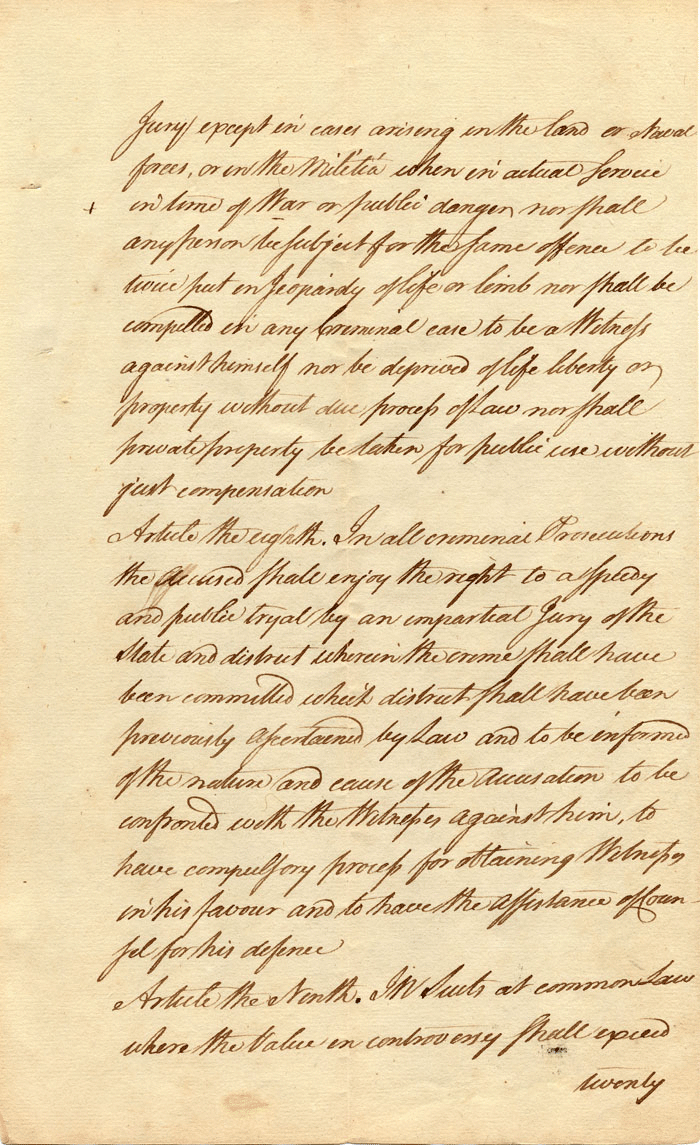
Jury except in cases arising in the land or Naval forces, or in the Militia when in actual Service in time of War or public danger nor shall any person be subject for the same offence to be twice put in Jeopardy of life or limb nor shall be compelled in any Criminal case to be a Witness against himself nor be deprived of life liberty or property without due process of law nor shall private property be taken for public use without just compensation.
Article the eighth. In all criminal Prosecutions the Accused shall enjoy the right to a speedy and public tryal by an impartial Jury of the State and district wherein the crime shall have been committed which district shall have been previously ascertained by Law and to be informed of the nature and cause of the Accusation to be confronted with the Witnesses against him, to have compulsory process for obtaining Witnesses in his favour and to have the assistance of Counsel for his defence.
Article the Ninth. In Suits at common Law where the Value in controversy shall exceed
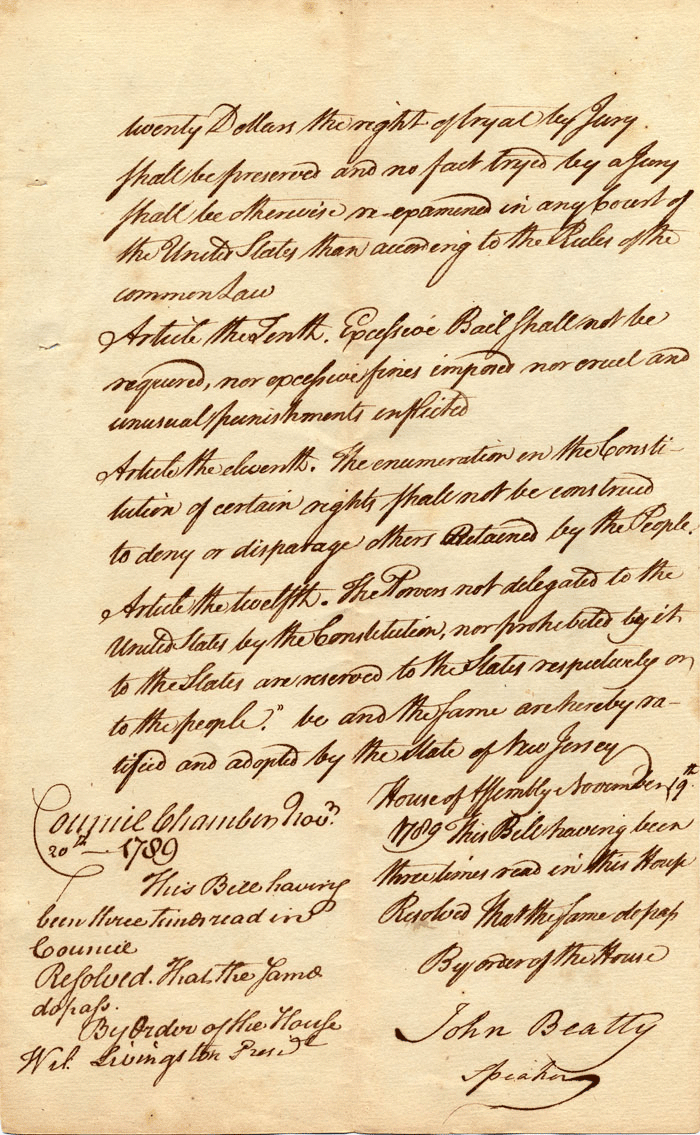
twenty Dollars the right of tryal by Jury shall be preserved and no fact tryed by a Jury shall be otherwise re-examined in any Court of the United States than according to the Rules of the common Law.
Article the Tenth. Excessive Bail shall not be required, nor excessive fines imposed nor cruel and unusual punishments inflicted.
Article the eleventh. The enumeration in the Constitution of certain rights shall not be construed to deny or disparage others Retained by the People.
Article the twelfth. The Powers not delegated to the United States by the Constitution, nor prohibited by it to the States are reserved to the States respectively or to the people." be and the same are hereby ratified and adopted by the State of New Jersey.
Council Chamber Nov.m 20th—1789
This Bill having been three times read in Council.
Resolved, That the same do pass.
By Order of the House
Wil. Livingston Pres'd.
House of Assembly November 19th 1789
This Bill having been three times read in this House
Resolved That the same do pass.
By Order of the House
John Beatty
Speaker
An Act to ratify on the part of this State certain amendments to the Constitution of the United States House of Assembly November 19th 1789 This Bill having been three times read in this House is pased. Maskell Ewing Council Chamber Nov.m 20th 1789 This Bill having been three times read in Council is passed. — B. Reed
The Judicial power of the United States shall not be construed to extend to any suit in law or equity, commenced or prosecuted against one of the United States by Citizens of another State, or by Citizens or Subjects of any Foreign State.
Ratified by Required Number of States, 7 February 1795.
References to proposed amendment
We find no record of ratification of the 11th Amendment by the State of New Jersey. Excerpted below are the only references found in the legislative minutes relative to the amendment as proposed.
Text from minutes of General Assembly, 14 June 1794:
His Excellency laid before Council a Resolution of the Senate and House of Representatives of the United States of America in Congress assembled, with a proposed Amendment to the Constitution of the United States respecting the Suability of States by Individuals; whereupon,
On Motion,
Ordered, That the said Resolution be delivered to the House of Assembly,
Ordered, That Mr. Mayhew do wait on the House of Assembly therewith.
Text from minutes of Legislative Council, 14 June 1794:
Mr. Mayhew from Council presented a Resolution of the Senate and House of Representatives of the United States, with a proposed Amendment to the Constitution of the United States, respecting the Suability of States by Individuals, which was read and ordered a second Reading.
The Electors shall meet in their respective states, and vote by ballot for President and VicePresident, one of whom, at least, shall not be an inhabitant of the same state with themselves; they shall name in their ballots the person voted for as President, and in distinct ballots the person voted for as Vice-President, and they shall make distinct lists of all persons voted for as President, and of all persons voted for as Vice-President, and of the number of votes for each, which lists they shall sign and certify, and transmit sealed to the seat of the government of the United States, directed to the President of the Senate;--The President of the Senate shall, in the presence of the Senate and House of Representatives, open all the certificates and the votes shall then be counted;--The person having the greatest number of votes for President, shall be the President, if such number be a majority of the whole number of Electors appointed; and if no person have such majority, then from the persons having the highest numbers not exceeding three on the list of those voted for as President, the House of Representatives shall choose immediately, by ballot, the President. But in choosing the President, the votes shall be taken by states, the representation from each state having one vote; a quorum for this purpose shall consist of a member or members from two-thirds of the states, and a majority of all the states shall be necessary to a choice. And if the House of Representatives shall not choose a President whenever the right or choice shall devolve upon them, before the fourth day of March next following, then the Vice-President shall act as President as in the case of the death or other constitutional disability of the President.--The person having the greatest number of votes as Vice-President, shall be the Vice-President, if such number be a majority of the whole number of Electors appointed, and if no person have a majority, then from the two highest numbers on the list, the Senate shall choose the Vice-President; a quorum for the purpose shall consist of two-thirds of the whole number of Senators, and a majority of the whole number shall be necessary to a choice. But no person constitutionally ineligible to the office of President shall be eligible to that of Vice-President of the United States.
Ratified by Required Number of States, 15 June 1804.
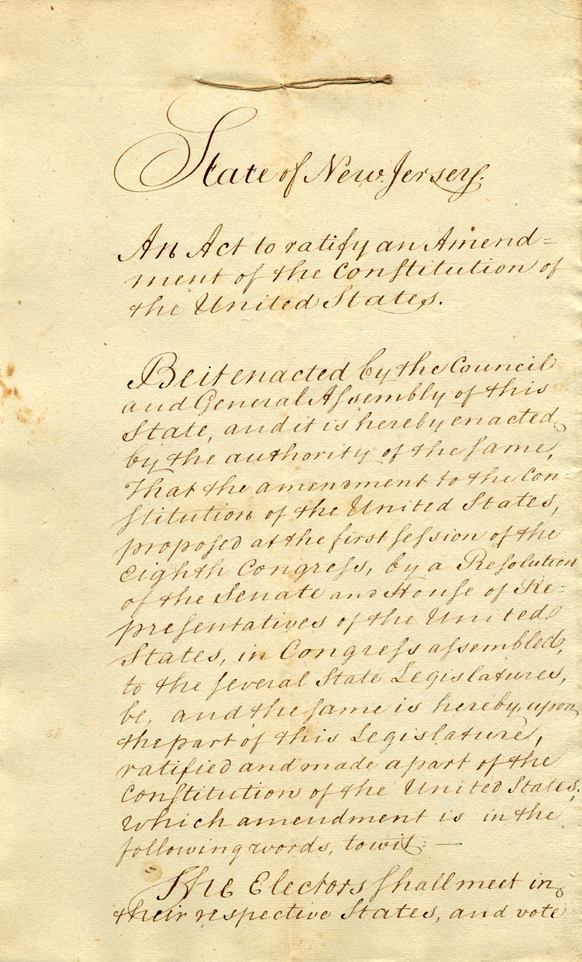
State of New Jersey
An Act to ratify an Amendment of the Constitution of the United States.
Be it enacted by the Council and General Assembly of this State, and it is hereby enacted by the authority of the same, That the amendment to the Constitution of the United States, proposed at the first session of the Eighth Congress, by a Resolution of the Senate and House of Representatives of the United States, in Congress assembled, to the several State Legislatures, be, and the same is hereby, upon the part of this Legislature, ratified and made a part of the Constitution of the United States; which amendment is in the following words, to wit:
The Electors shall meet in their respective States, and vote
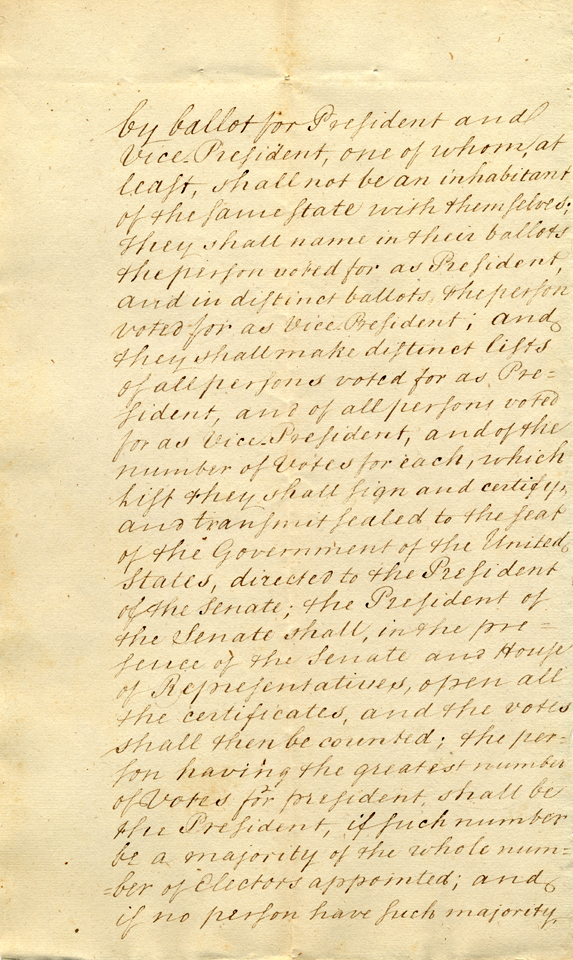
by ballot for President and Vice President, one of whom, at least, shall not be an inhabitant of the same State with themselves; They shall name in their ballots the person voted for as President, and in distinct ballots, the person voted for as Vice President; and they shall make distinct lists of all persons voted for as President, and of all persons voted for as Vice-President, and of the number of votes for each, which list they shall sign and certify, and transmit sealed to the seat of the Government of the United States, directed to the President of the Senate; the President of the Senate shall, in the presence of the Senate and House of Representatives, open all the certificates, and the votes shall then be counted; the person having the greatest number of votes for president shall be the President, if such number be a majority of the whole number of Electors appointed; and if no person have such majority
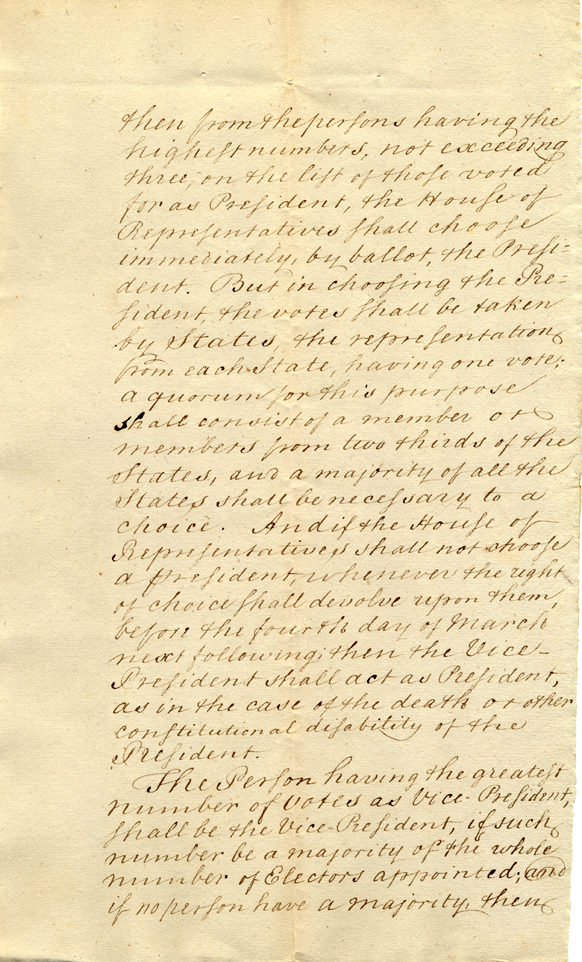
by ballot for President and Vice President, one of whom, at least, shall not be an inhabitant of the same State with themselves; They shall name in their ballots the person voted for as President, and in distinct ballots, the person voted for as Vice President; and they shall make distinct lists of all persons voted for as President, and of all persons voted for as Vice-President, and of the number of votes for each, which list they shall sign and certify, and transmit sealed to the seat of the Government of the United States, directed to the President of the Senate; the President of the Senate shall, in the presence of the Senate and House of Representatives, open all the certificates, and the votes shall then be counted; the person having the greatest number of votes for president shall be the President, if such number be a majority of the whole number of Electors appointed; and if no person have such majority
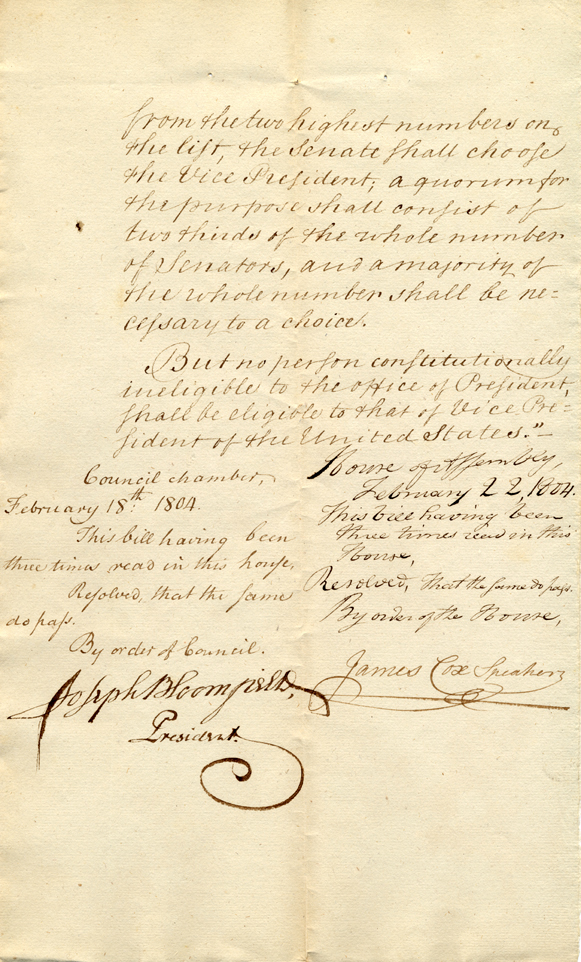
from the two highest numbers on the list, the Senate shall choose the Vice President; a quorum for the purpose shall consist of two thirds of the whole number of Senators, and a majority of the whole number shall be necessary to a choice.
But no person constitutionally ineligible to the office of President shall be eligible to that of Vice President of the United States.”
Council chamber,
February 18th 1804
This bill having been three times read in this house,
Resolved, that the same do pass.
By order of Council.
Joseph Bloomfield, President
House of Assembly,
February 22, 1804
This bill having been three times read in this House,
Resolved, that the same do pass.
By order of the House,
James Cox, Speaker
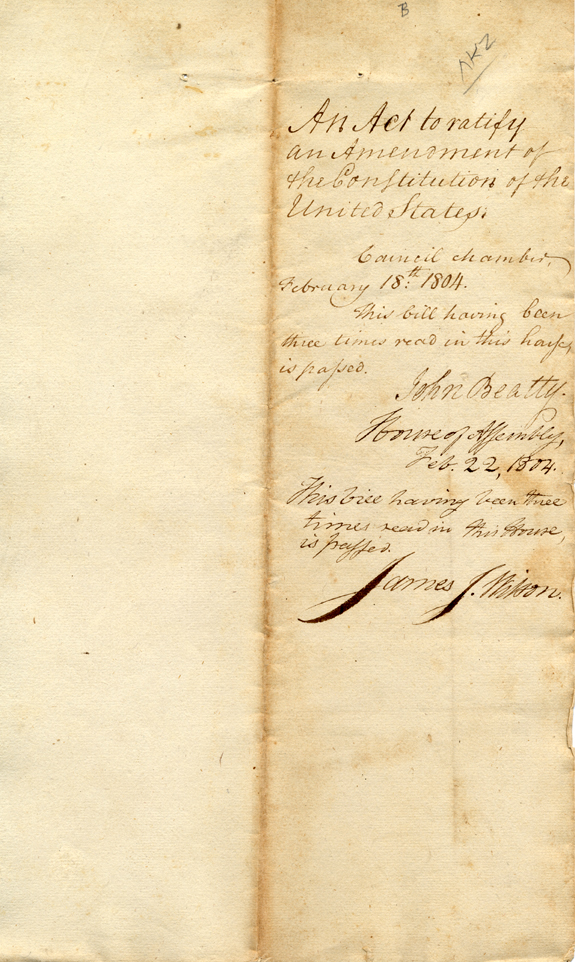
An Act to ratify an Amendment of the Constitution of the United States.
Council chamber,
February 18th 1804.
This bill having been three times read in this house, is passed.
John Beatty
House of Assembly,
February 22, 1804.
This bill having been three times read in this House, is passed.
James J. Wilson
Section 1. Neither slavery nor involuntary servitude, except as a punishment for crime whereof the party shall have been duly convicted, shall exist within the United States, or any place subject to their jurisdiction.
Section 2. The Congress shall have power to enforce this article by appropriate legislation.
Ratified by Required Number of States, 6 December 1865.
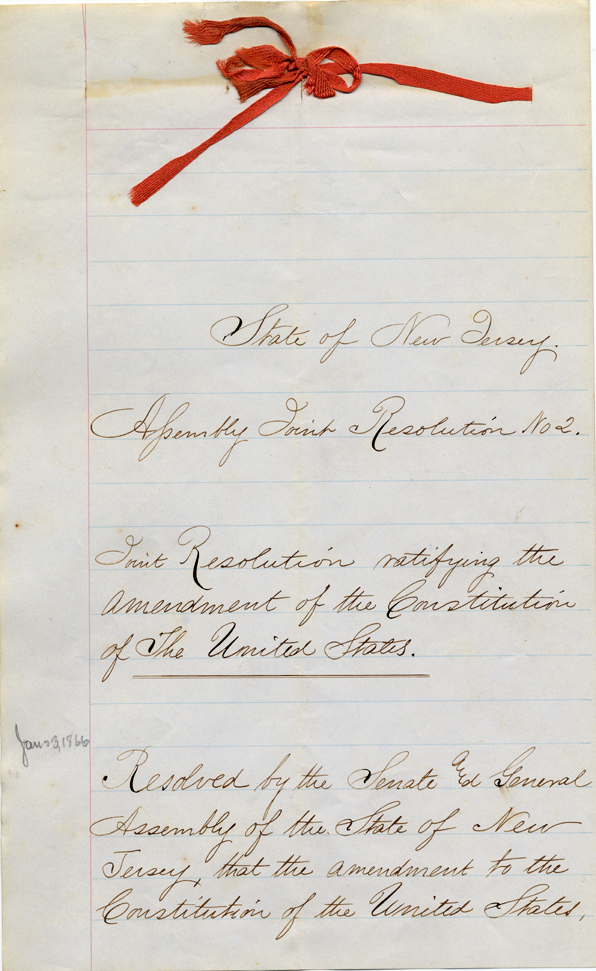
State of New Jersey
Assembly Joint Resolution No. 2
Joint Resolution ratifying the amendment of the Constitution of the United States.
RESOLVED, by the Senate and General Assembly of the State of New Jersey, that the amendment to the Constitution of the United States,
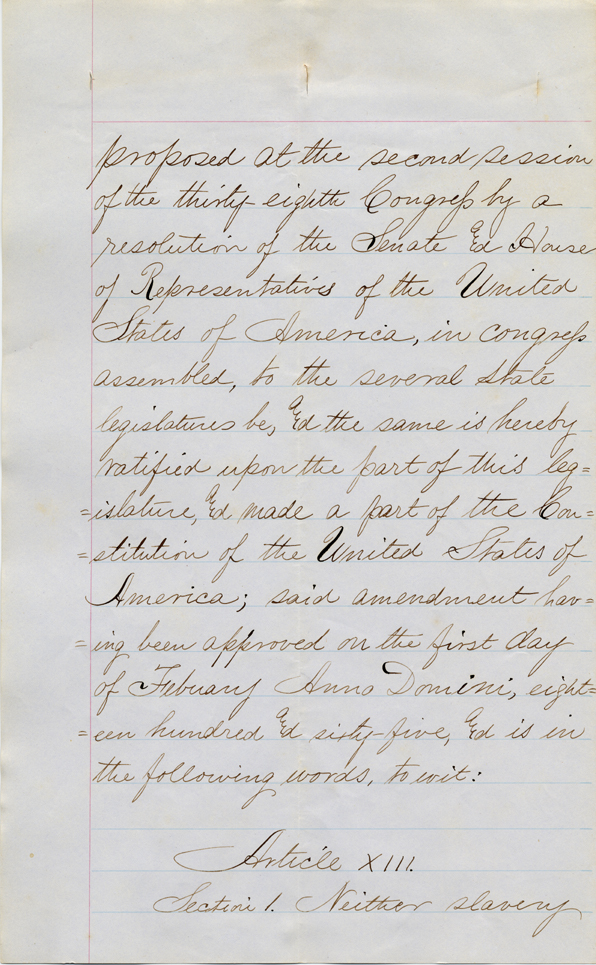
proposed at the second session of the thirty-eighth Congress by a resolution of the Senate and House of Representatives of the United States of America, in congress assembled, to the several State legislatures be, and the same is hereby ratified upon the part of this legislature, and made a part of the Constitution of the United States of America; said amendment having been approved on the first day of February Anno Domini, eighteen hundred and sixty-five, and is in the following words, to wit:
Article XIII.
Section I. Neither slavery
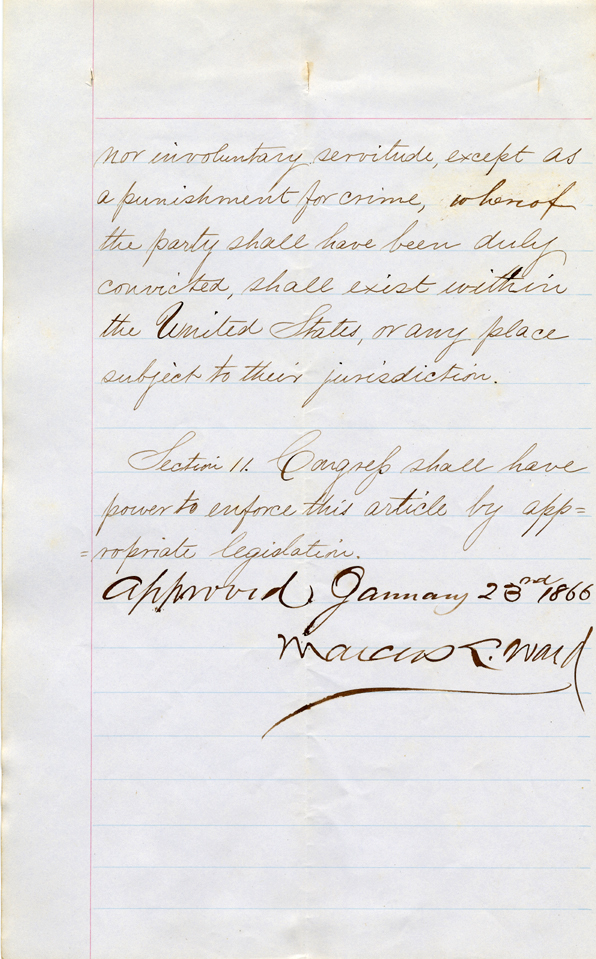
nor involuntary servitude, except as a punishment for crime, whereof the party shall have been duly convicted, shall exist within the United States, or any place subject to their jurisdiction.
Section II. Congress shall have power to enforce this article by appropriate legislation.
Approved January 23rd, 1866.
Marcus L. Ward
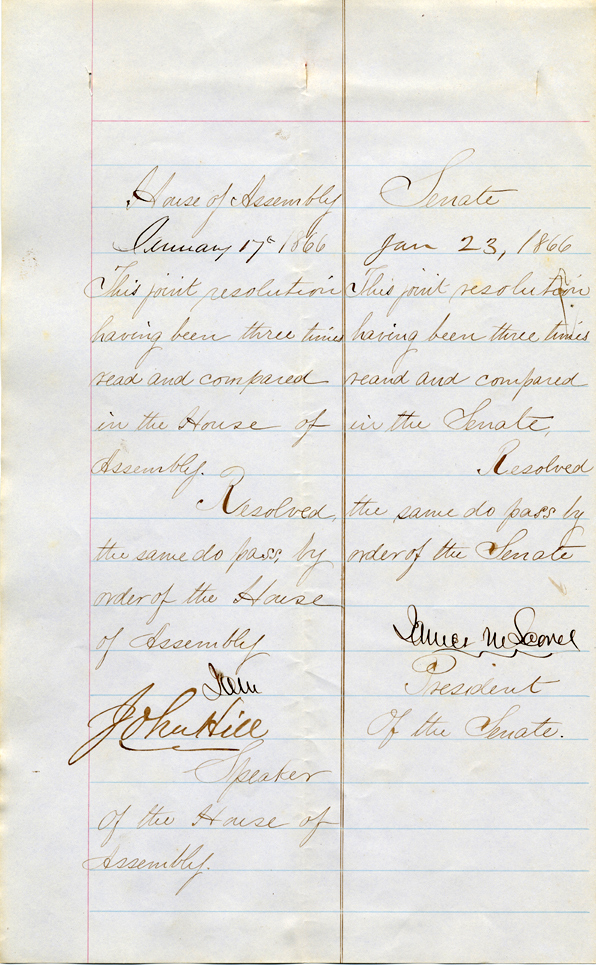
House of Assembly
January 17th 1866
This joint resolution having been three times read and compared in the House of Assembly,
Resolved, the Same do pass by order of the House of Assembly.
John Hill, Speaker of the House of Assembly
Senate
January 23, 1866
This joint resolution having been three times read in the Senate,
Resolved the same do pass by order of the Senate.
James M. Scovel, President of the Senate
Section 1. All persons born or naturalized in the United States, and subject to the jurisdiction thereof, are citizens of the United States and of the State wherein they reside. No State shall make or enforce any law which shall abridge the privileges or immunities of citizens of the United States; nor shall any State deprive any person of life, liberty, or property, without due process of law; nor deny to any person within its jurisdiction the equal protection of the laws.
Section 2. Representatives shall be apportioned among the several States according to their respective numbers, counting the whole number of persons in each State, excluding Indians not taxed. But when the right to vote at any election for the choice of electors for President and Vice President of the United States, Representatives in Congress, the Executive and Judicial officers of a State, or the members of the Legislature thereof, is denied to any of the male inhabitants of such State, being twenty-one years of age, and citizens of the United States, or in any way abridged, except for participation in rebellion, or other crime, the basis of representation therein shall be reduced in the proportion which the number of such male citizens shall bear to the whole number of male citizens twenty-one years of age in such State.
Section 3. No person shall be a Senator or Representative in Congress, or elector of President and Vice President, or hold any office, civil or military, under the United States, or under any State, who, having previously taken an oath, as a member of Congress, or as an officer of the United States, or as a member of any State legislature, or as an executive or judicial officer of any state, to support the Constitution of the United States, shall have engaged in insurrection or rebellion against the same, or given aid or comfort to the enemies thereof. But Congress may by a vote of two-thirds of each House, remove such disability.
Section 4. The validity of the public debt of the United States, authorized by law, including debts incurred for payment of pensions and bounties for services in suppressing insurrection or rebellion, shall not be questioned. But neither the United States nor any State shall assume or pay any debt or obligation incurred in aid of insurrection or rebellion against the United States, or any claim for the loss or emancipation of any slave; but all such debts, obligations and claims shall be held illegal and void.
Section 5. The Congress shall have power to enforce, by appropriate legislation, the provisions of this article.
Ratified by Required Number of States, 9 July 1868.
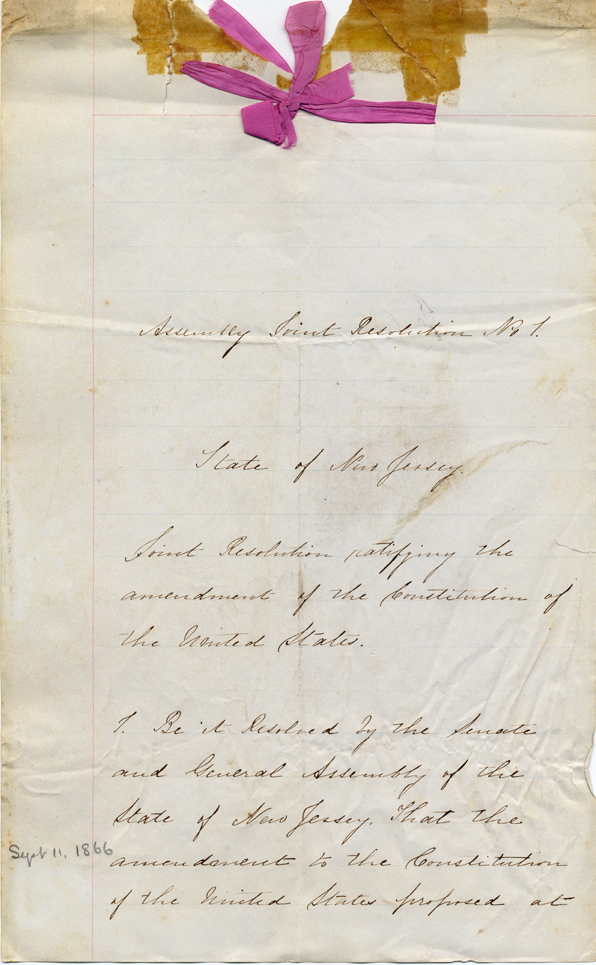
Assembly Joint Resolution No. 1
State of New Jersey
Joint Resolution ratifying the amendment of the Constitution of the United States
1. Be it Resolved by the Senate and General Assembly of the State of New Jersey that the amendment to the Constitution of the United States proposed at
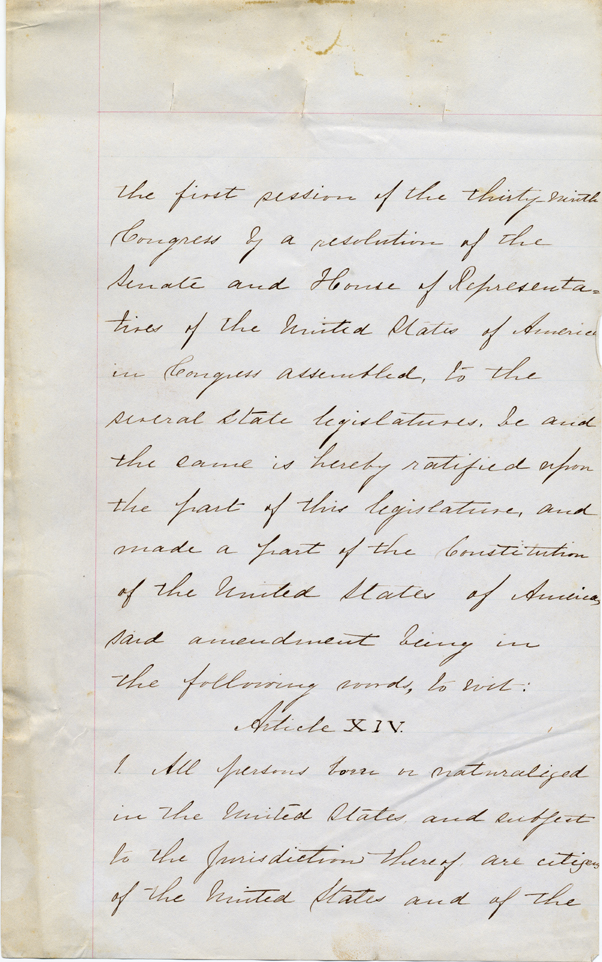
the first session of the thirty-ninth Congress by a resolution of the Senate and House of Representatives of the United States of America in Congress assembled, to the several state legislatures, be and the same is hereby ratified upon the part of this legislature and made a part of the Constitution of the United States of America, said amendment being in the following words, to wit:
Article XIV
1. All persons born or naturalized in the United States and subject to the jurisdiction thereof are citizens of the United States and of the
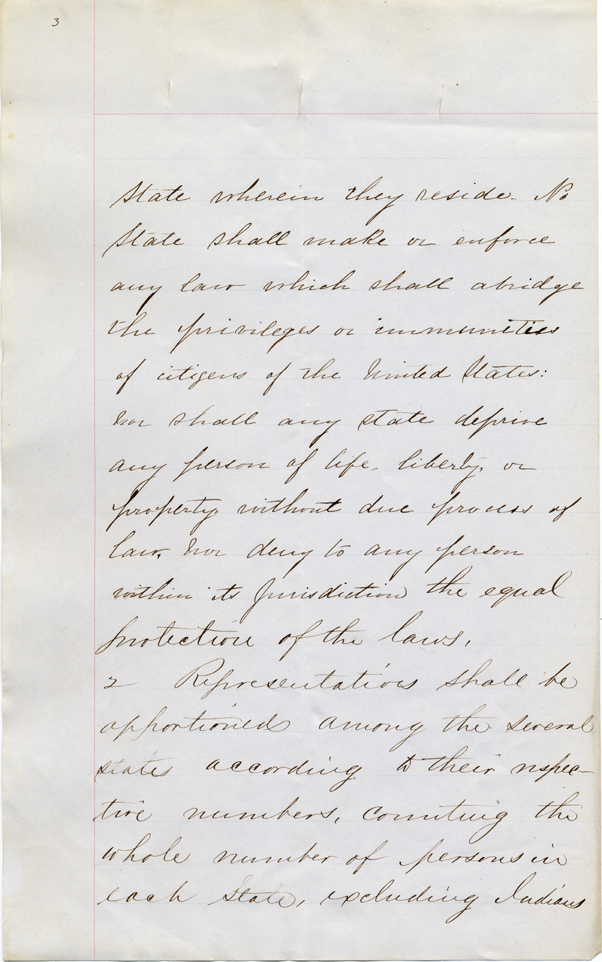
State wherein they reside. No State shall make or enforce any law which shall abridge the privileges or immunities of citizens of the United States; nor shall any State deprive any person of life, liberty, or property without due process of law, nor deny to any person within its jurisdiction the equal protection of the laws.
2 - Representatives shall be apportioned among the several states according to their respective numbers, counting the whole number of persons in each State, excluding Indians
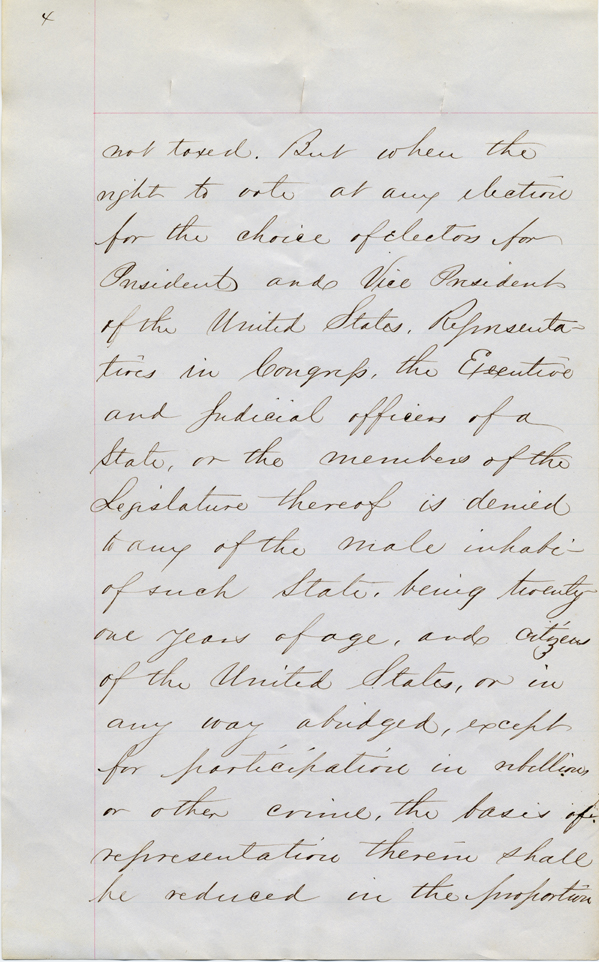
not taxed. But when the right to vote at any election for the choice of electors for President and Vice President of the United States, Representatives in Congress, the Executive and Judicial officers of a State, or the members of the Legislature thereof is denied to any of the male inhabitants of such State, being twenty-one years of age, and citizens of the United States, or in any way abridged, except for participation in rebellions or other crime, the basis of representation therein shall be reduced in the proportion
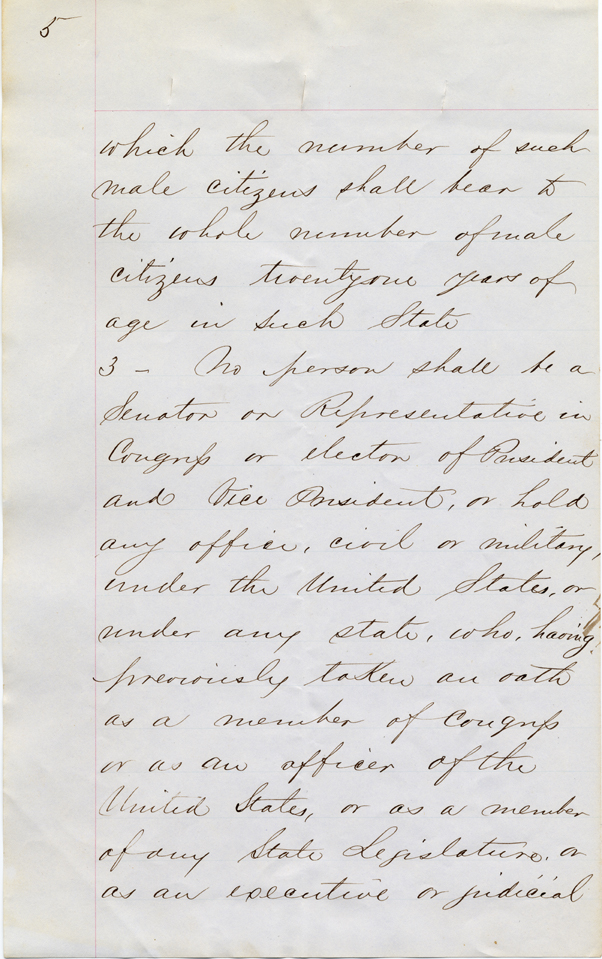
which the number of such male citizens shall bear to the whole number of male citizens twenty-one years of age in such State.
3 - No person shall be a Senator or Representative in Congress or elector of President and Vice President, or hold any office, civil or military, under the United States, or under any state, who, having previously taken an oath as a member of Congress or as an officer of the United States, or as a member of any State Legislature, or as an executive or judicial
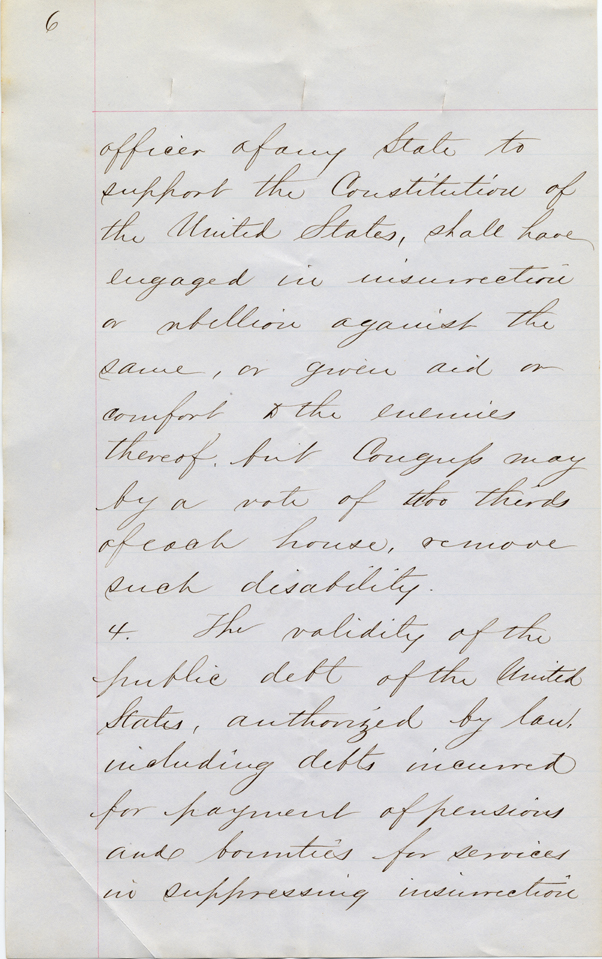
officer of any State to support the Constitution of the United States, shall have engaged in insurrection or rebellion against the same, or given aid or comfort to the enemies thereof, but Congress may by a vote of two-thirds of each house, remove such disability.
4. The validity of the public debt of the United States, authorized by law, including debts incurred for payment of pensions and bounties for services in suppressing insurrection
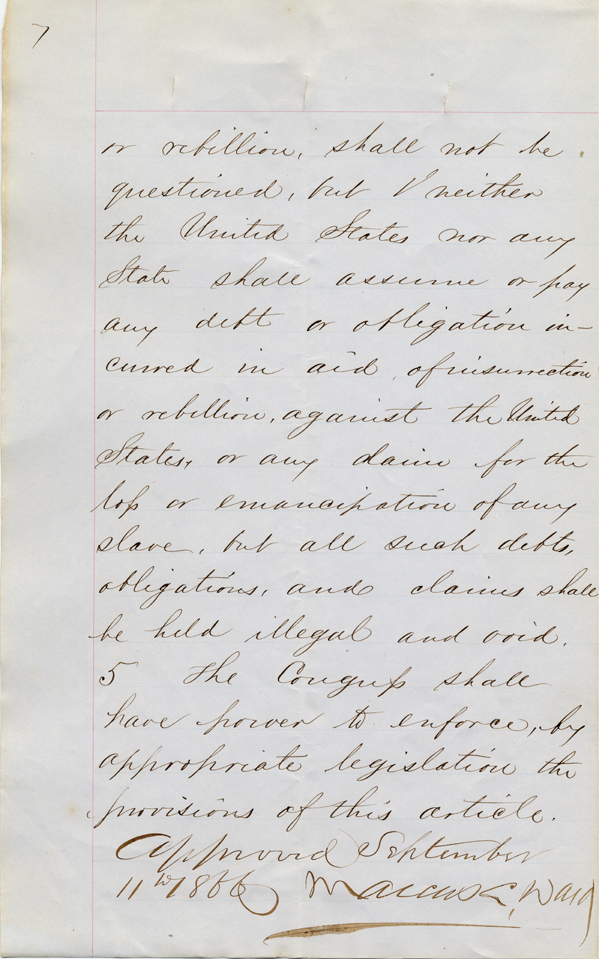
or rebellion, shall not be questioned, but neither the United States nor any State shall assume or pay any debt or obligation incurred in aid of insurrection or rebellion, against the United States, or any claim for the loss or emancipation of any slave, but all such debts, obligations, and claims shall be held illegal and void.
5. The Congress shall have power to enforce, by appropriate legislation the provisions of this article.
Approved September 11, 1866
Marcus L. Ward
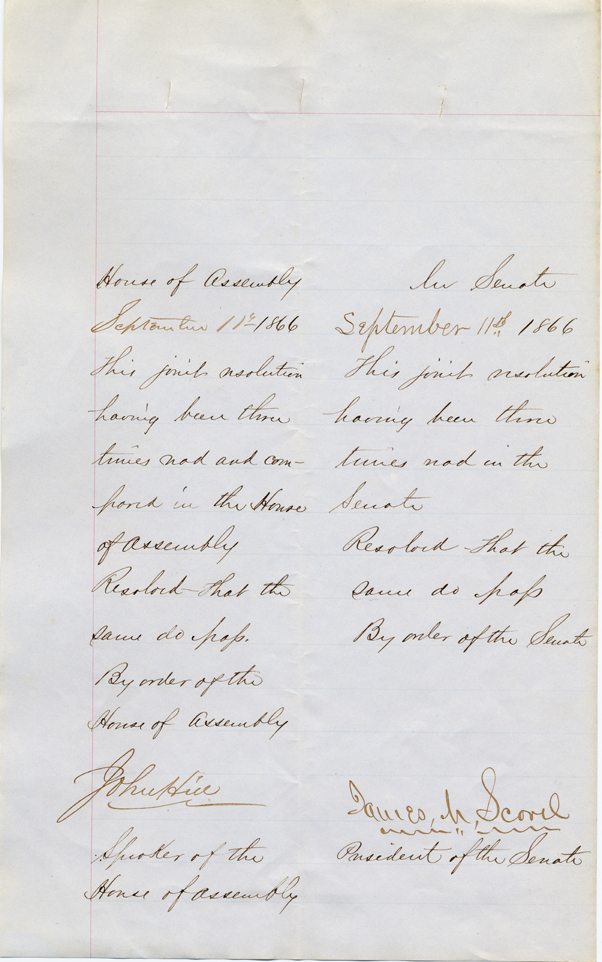
House of Assembly
September 11, 1866
This joint resolution having been three times read and compared in the House of Assembly
Resolved that the same do pass.
By order of the House of Assembly.
John Hill, Speaker of the House of Assembly
In Senate
September 11, 1866
This joint resolution having been three times read in the Senate.
Resolved that the same do pass.
By order of the Senate.
James M. Scovel, President of the Senate
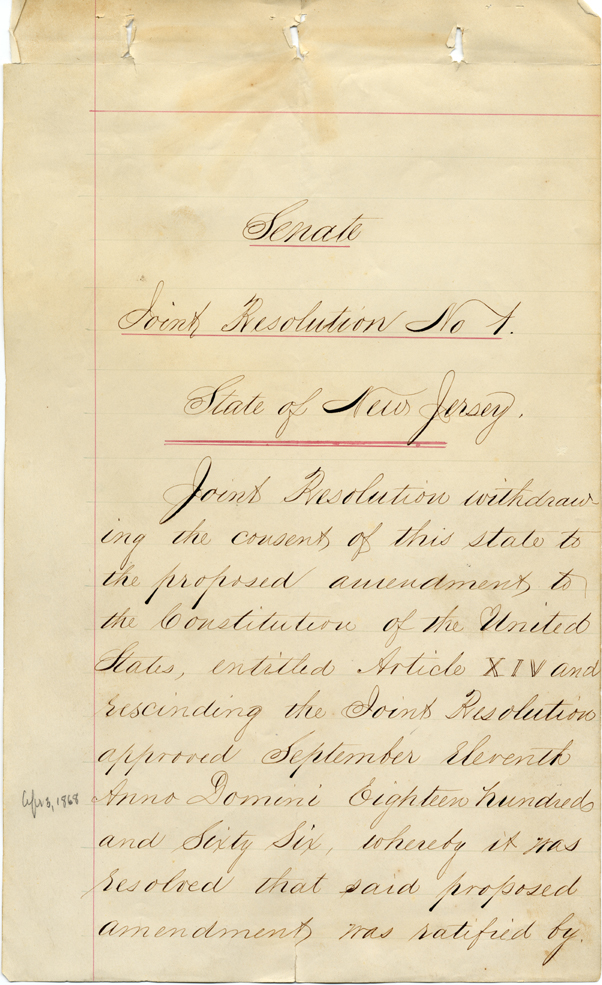
Senate
Joint Resolution No. 1
State of New Jersey
Joint Resolution withdrawing the consent of this state to the proposed amendment to the Constitution of the United States, entitled Article XIV and rescinding the Joint Resolution approved September Eleventh Anno Domini Eighteen hundred and Sixty Six, whereby it was resolved that said proposed amendment was ratified by
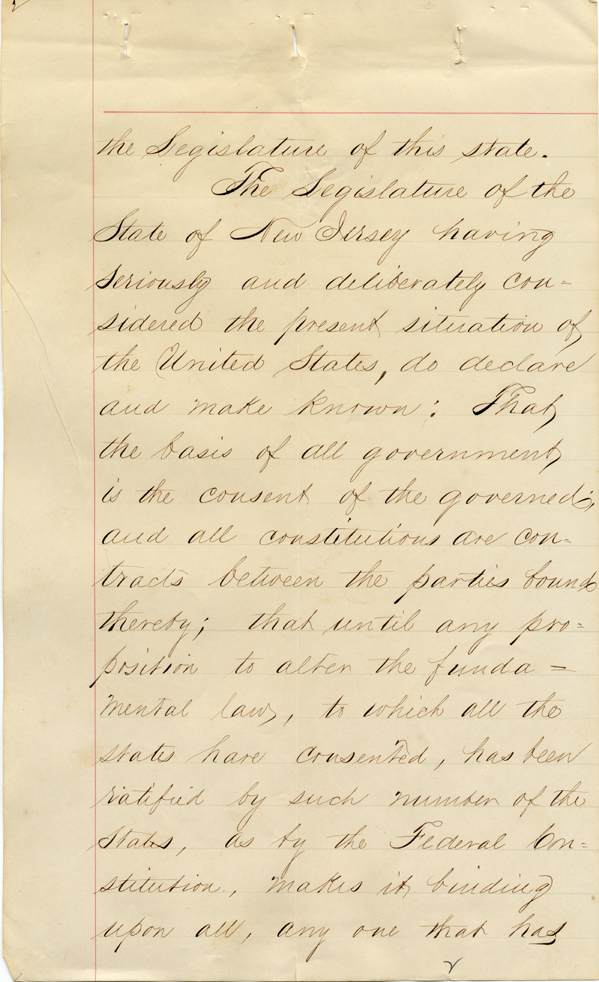
the Legislature of this state.
The Legislature of the State of New Jersey having seriously and deliberately considered the present situation of the United States, do declare and make known: That the basis of all government is the consent of the governed; and all constitutions are contracts between the parties bound thereby; that until any proposition to alter the fundamental law, to which all the states have consented, has been ratified by such number of the States, as by the Federal Constitution, makes it binding upon all, any one that has
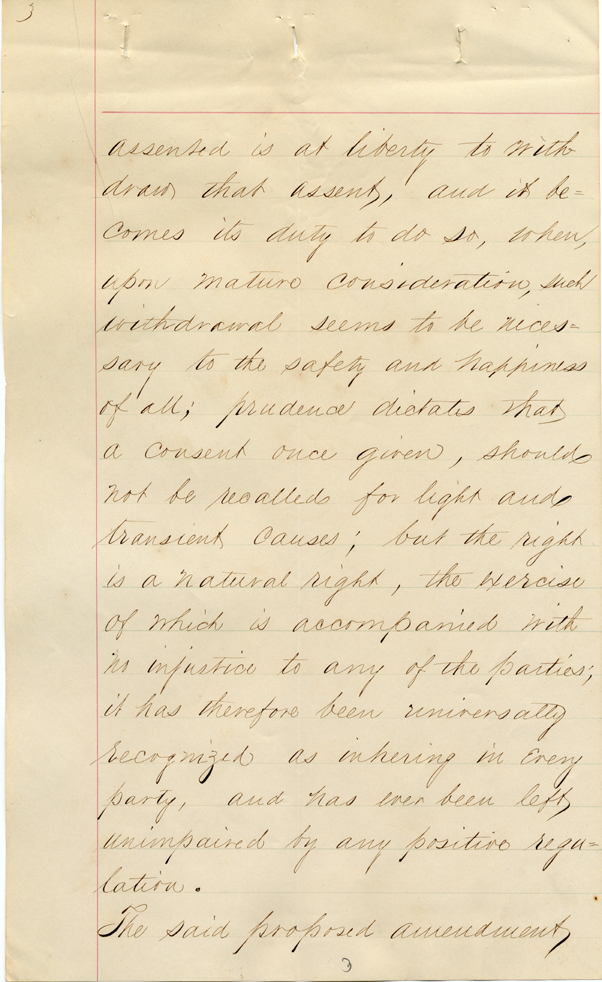
assented is at liberty to withdraw that assent, and it becomes its duty to do so, when, upon mature consideration, such withdrawal seems to be necessary to the safety and happiness of all; prudence dictates that a consent once given, should not be recalled for light and transient causes; but the right is a natural right, the exercise of which is accompanied with no injustice to any of the parties; it has therefore been universally recognized as inhering in every party, and has ever been left unimpaired by any positive regulation.
The said proposed amendment
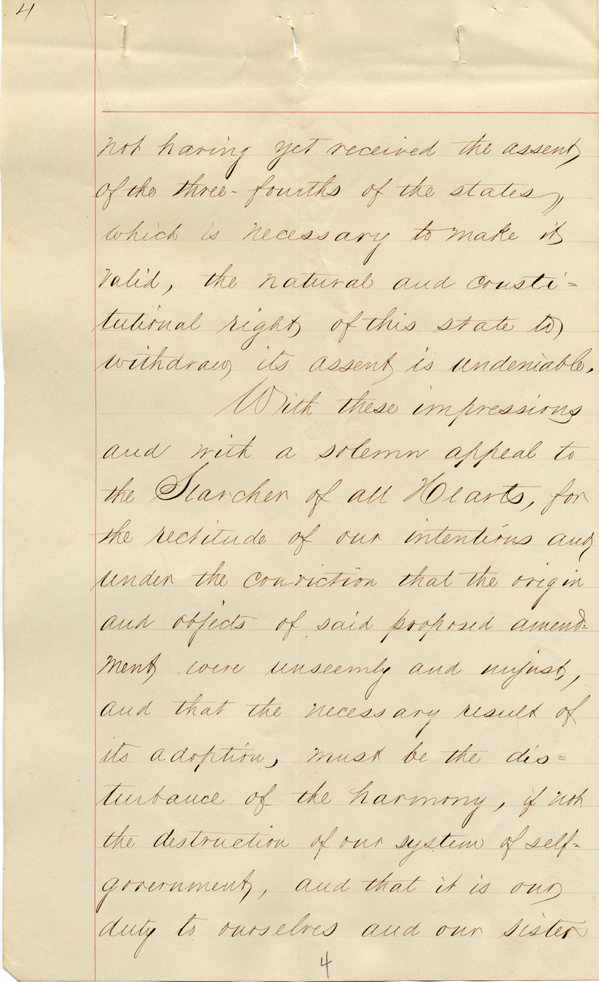
not having yet received the assent of the three‐fourths of the states which is necessary to make it valid, the natural and constitutional right of this state to withdraw its assent is undeniable.
With these impressions and with a solemn appeal to the Searcher of all Hearts, for the rectitude of our intentions and under the conviction that the origin and objects of said proposed amendment were unseemly and unjust, and that the necessary result of its adoption, must be the disturbance of the harmony, if not the destruction of our system of self‐government, and that it is our duty to ourselves and our sister
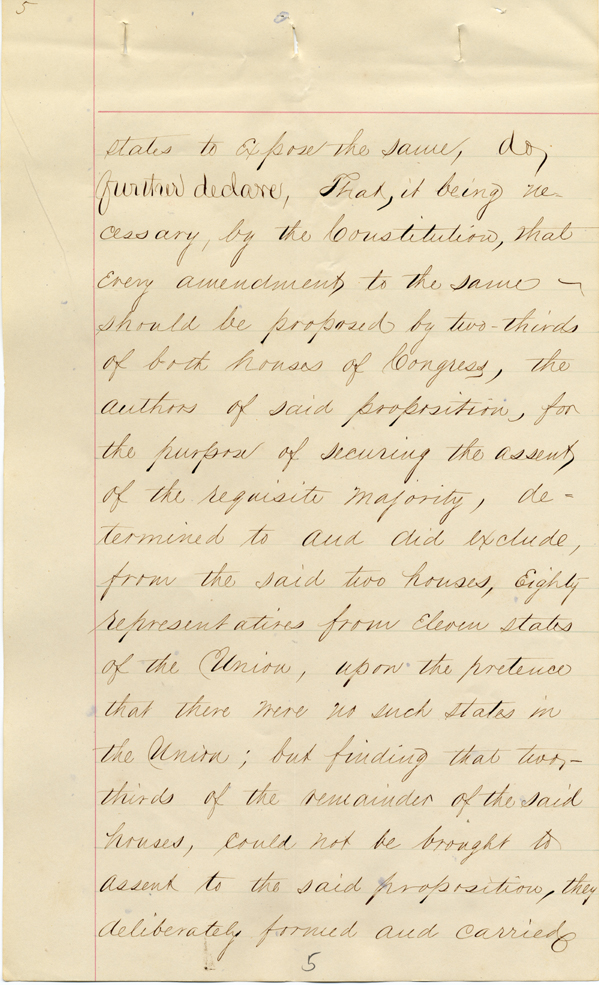
states to expose the same, do further declare, That, it being necessary, by the Constitution, that every amendment to the same should be proposed by two‐thirds of both houses of Congress, the authors of said proposition, for the purpose of securing the assent of the requisite majority, determined to and did exclude, from the said two houses, Eighty representatives from Eleven states of the Union, upon the pretence that there were no such states in the Union; but finding that two‐thirds of the remainder of the said houses, could not be brought to assent to the said proposition, they deliberately formed and carried
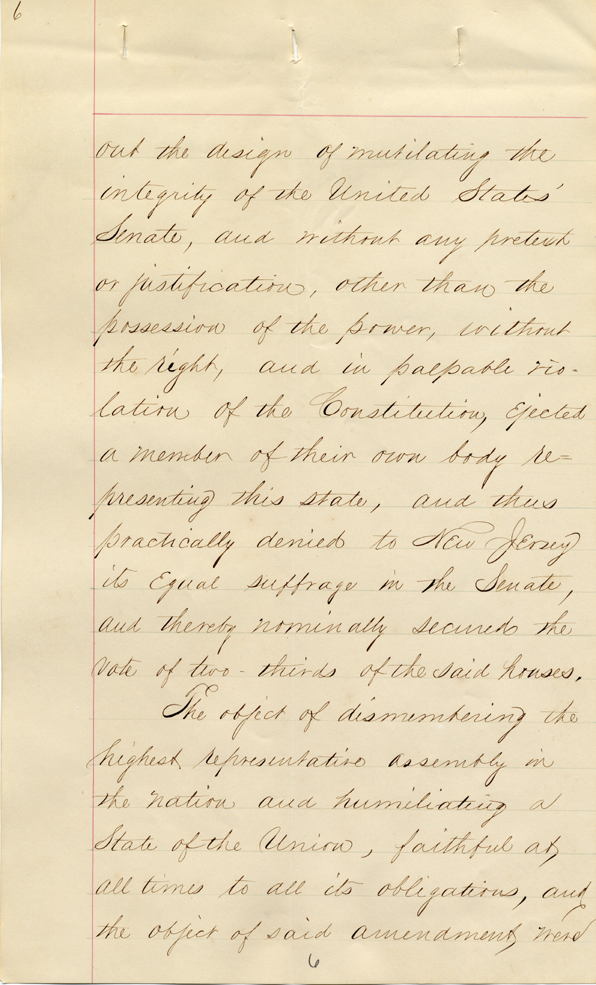
out the design of mutilating the integrity of the United States’ Senate, and without any pretext or justification, other than the possession of the power, without the right, and in palpable violation of the Constitution, Ejected a member of their own body representing this state, and thus practically denied to New Jersey its Equal suffrage in the Senate, and thereby nominally secured the vote of two‐thirds of the said houses.
The object of dismembering the highest representative assembly in the nation and humiliating a State of the Union, faithful at all times to all its obligations and the object of said amendment were
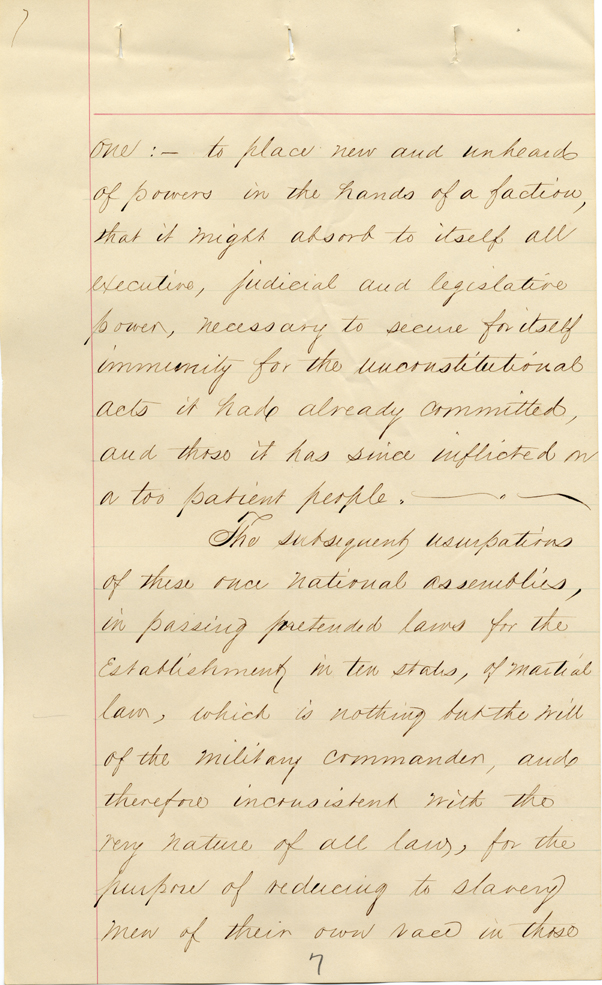
one: ‐ to place new and unheard of powers in the hands of a faction, that it might absorb to itself all executive, judicial and legislative power, necessary to secure for itself immunity for the unconstitutional acts it had already committed, and those it has since inflicted on a too patient people.
The subsequent usurpations of these once national assemblies, in passing pretended laws for the establishment in ten states, of martial law, which is nothing but the will of the military commander, and therefore inconsistent with the very nature of all laws, for the purpose of reducing to slavery men of their own race in those
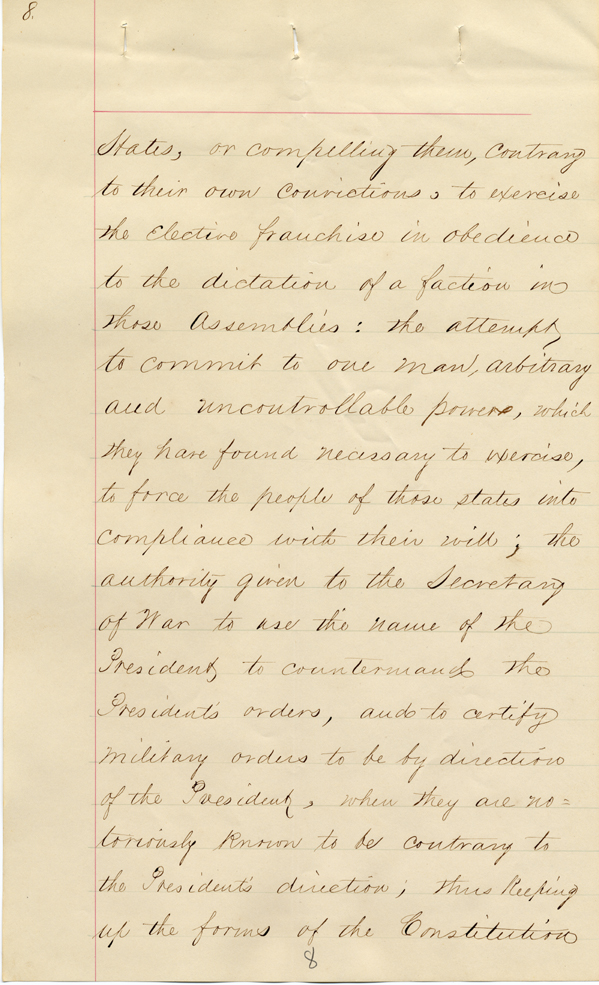
States, or compelling them, contrary to their own convictions, to exercise the elective franchise in obedience to the dictation of a faction in those Assemblies: the attempt to commit to one man, arbitrary and uncontrollable power, which they have found necessary to exercise, to force the people of those states into compliance with their will; the authority given to the Secretary of War to use the name of the President, to countermand the President’s orders, and to certify military orders to be by direction of the President, when they are notoriously known to be contrary to the President’s direction, thus keeping up the forms of the Constitution
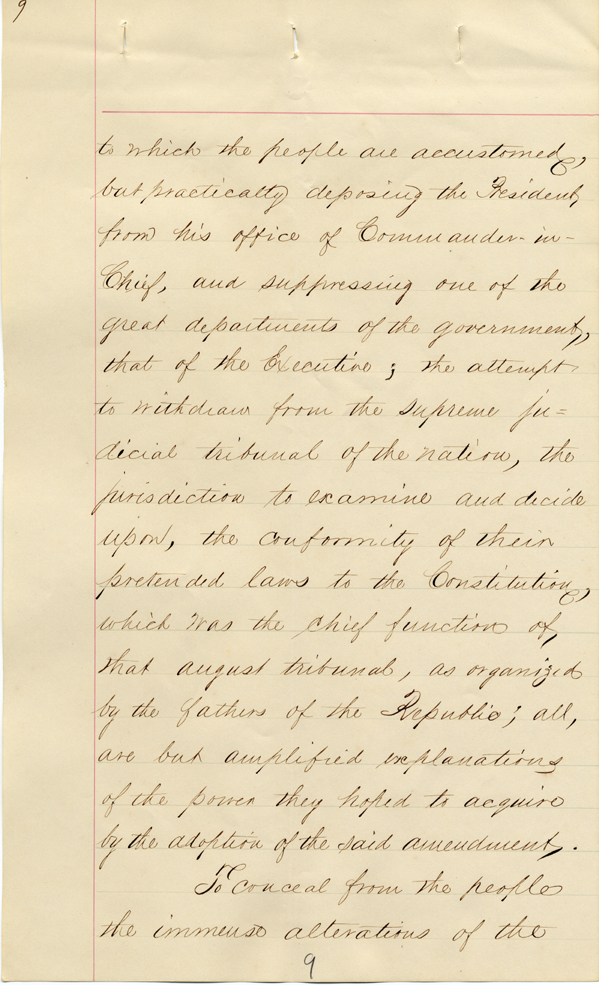
to which the people are accustomed, but practically deposing the President from his office of Commander‐in‐Chief, and suppressing one of the great departments of the government, that of the Executive; the attempt to withdraw from the supreme judicial tribunal of the nation, the jurisdiction to examine and decide upon, the conformity of their pretended laws to the Constitution, which was the chief function of that august tribunal, as organized by the fathers of the Republic; all, are but amplified explanations of the power they hoped to acquire by the adoption of the said amendment.
To conceal from the people the immense alterations of the
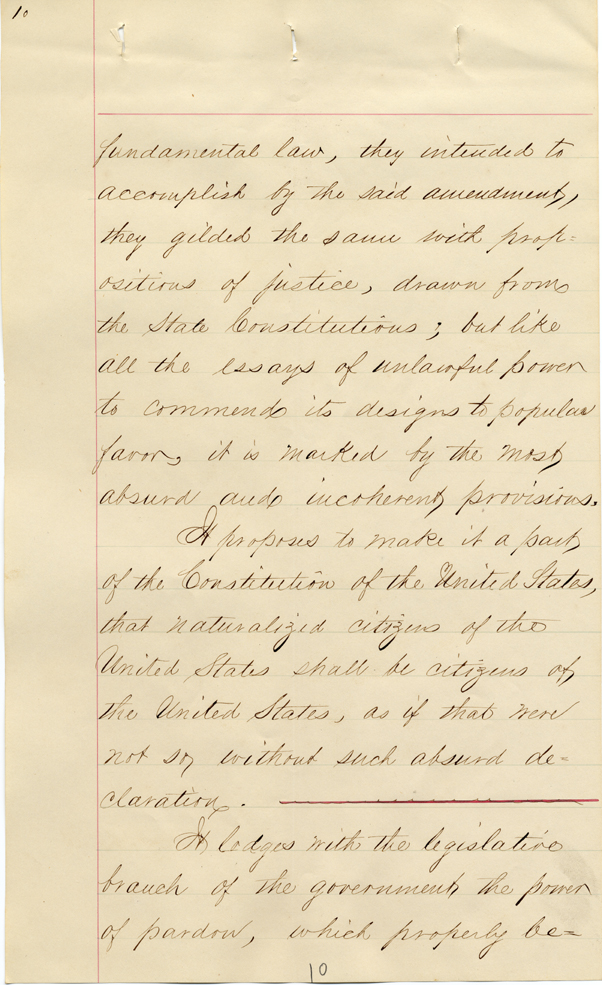
fundamental law, they intended to accomplish by the said amendment, they gilded the same with propositions of justice, drawn from the State Constitutions; but like all the essays of unlawful power to commend its designs to populace favor, it is marked by the most absurd and incoherent provisions.
It proposes to make it a part of the Constitution of the United States, that naturalized citizens of the United States shall be citizens of the United States, as if that were not so without such absurd declaration.
It lodges with the legislative branch of the government the power of pardon, which properly be‐
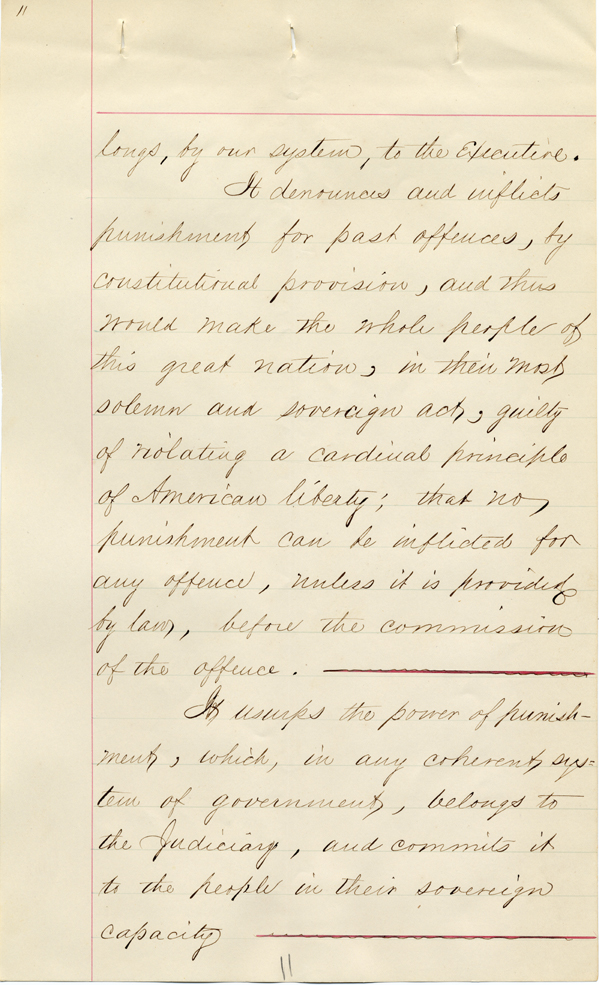
longs, by our system, to the Executive.
It denounces and inflicts punishment for past offences, by constitutional provision, and thus would make the whole people of this great nation, in their most solemn and sovereign act, guilty of violating a cardinal principle of American liberty; that no punishment can be inflicted for any offence, unless it is provided by law, before the commission of the offence.
It usurps the power of punishment, which, in any coherent system of government, belongs to the Judiciary, and commits it to the people in their sovereign capacity.
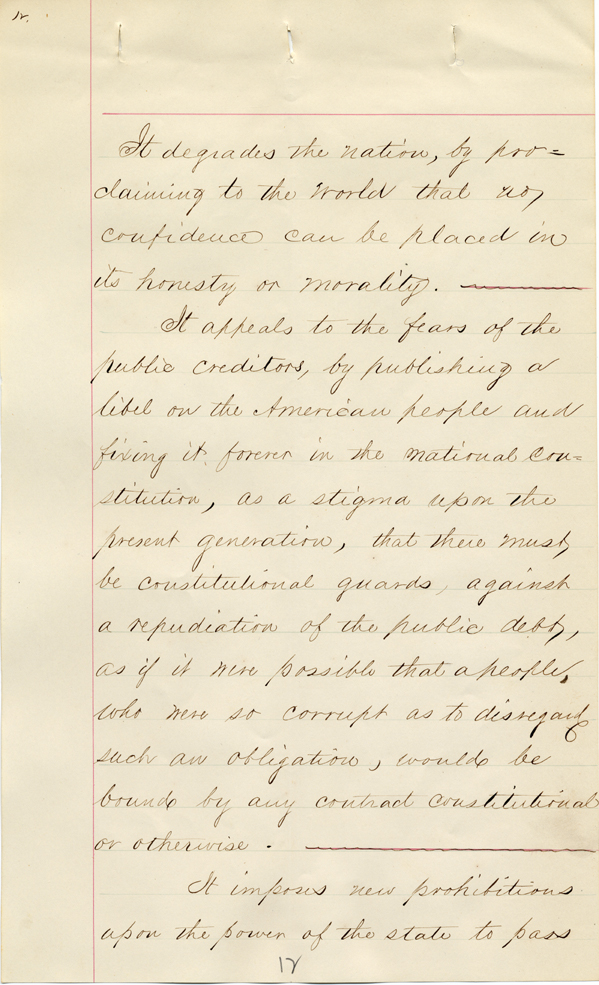
It degrades the nation, by proclaiming to the world that no confidence can be placed in its honesty or morality.
It appeals to the fears of the public creditors, by publishing a libel on the American people and fixing it forever in the national constitution, as a stigma upon the present generation, that there must be constitutional guards against a repudiation of the public debt, as if it were possible that a people, who were so corrupt as to disregard such an obligation, would be bound by any contract constitutional or otherwise.
It imposes new prohibitions upon the power of the state to pass
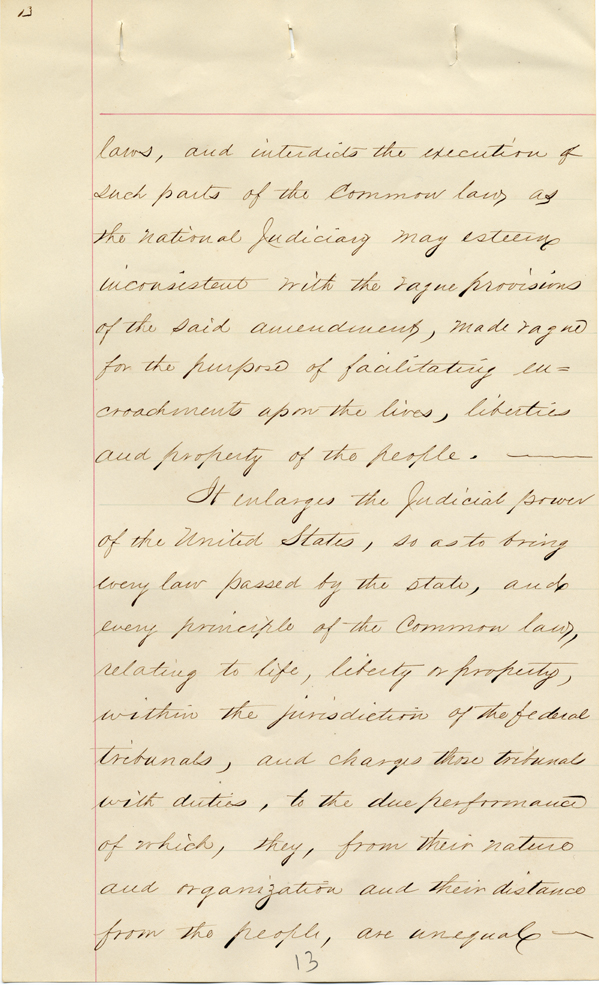
laws, and interdicts the execution of such parts of the Common law as the national Judiciary may esteem inconsistent with the vague provisions of the said amendment, made vague for the purpose of facilitating encroachments upon the lives, liberties and property of the people.
It enlarges the Judicial power of the United States, so as to bring every law passed by the state, and every principle of the Common law, relating to life, liberty or property, within the jurisdiction of the federal tribunals, and charges those tribunals with duties, to the due performance of which, they, from their nature and organization and their distance from the people, are unequal.
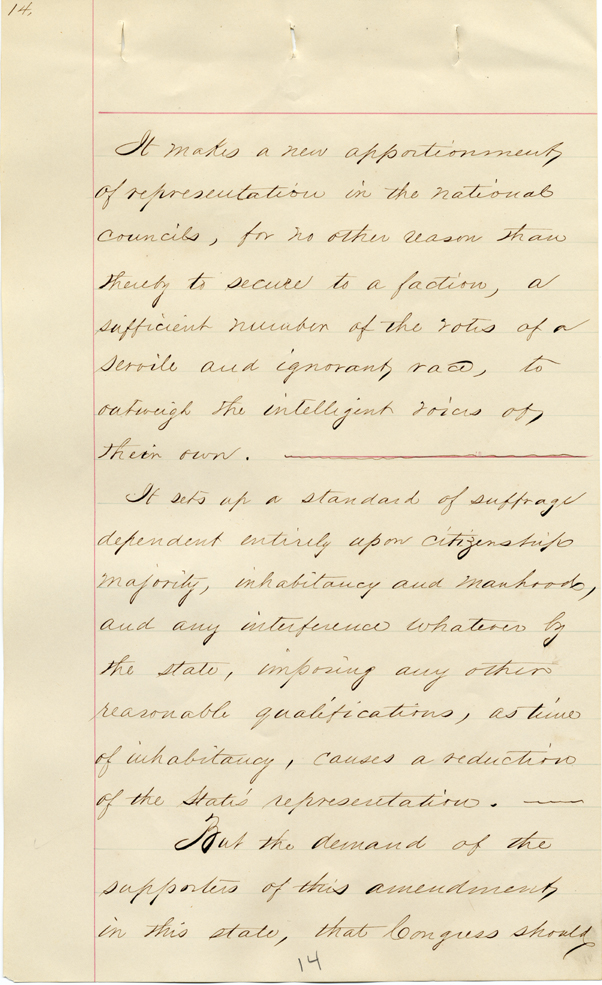
It makes a new apportionment of representation in the national councils, for no other reason than thereby to secure to a faction, a sufficient number of the votes of a servile and ignorant race, to outweigh the intelligent voices of their own.
It sets up a standard of suffrage dependent entirely upon citizenship majority, inhabitancy and manhood, and any interference whatever by the state, imposing any other reasonable qualifications, as time of inhabitancy, causes a reduction of the State’s representation.
But the demand of the supporters of this amendment in this state, that Congress should
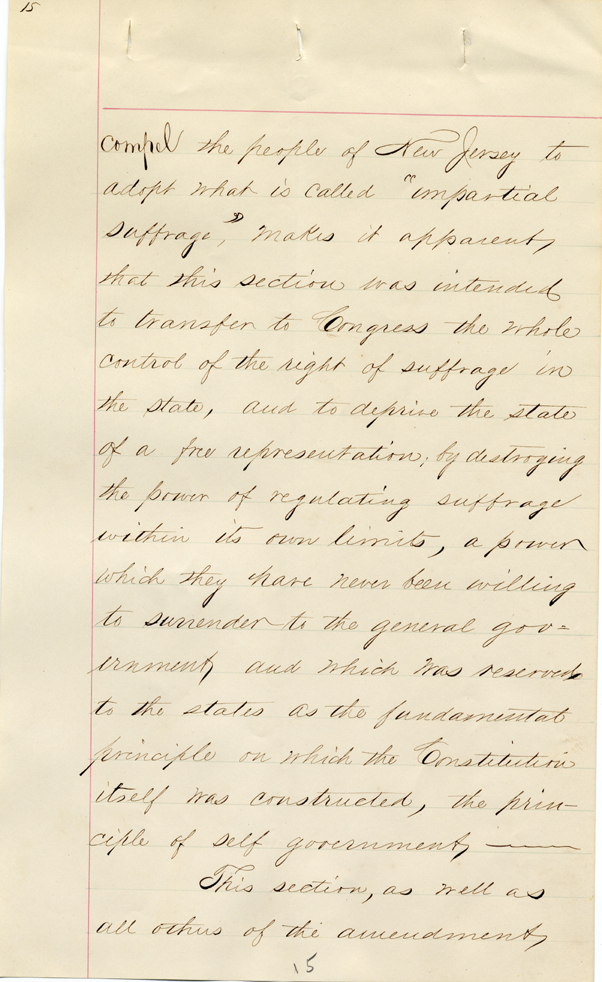
compel the people of New Jersey to adopt what is called “impartial suffrage,” makes it apparent that this section was intended to transfer to Congress the whole control of the right of suffrage in the state, and to deprive the state of a free representation, by destroying the power of regulating suffrage within its own limits, a power which they have never been willing to surrender to the general government and which was reserved to the states as the fundamental principal on which the Constitution itself was constructed, the principle of self government.
This section, as well as all others of the amendment
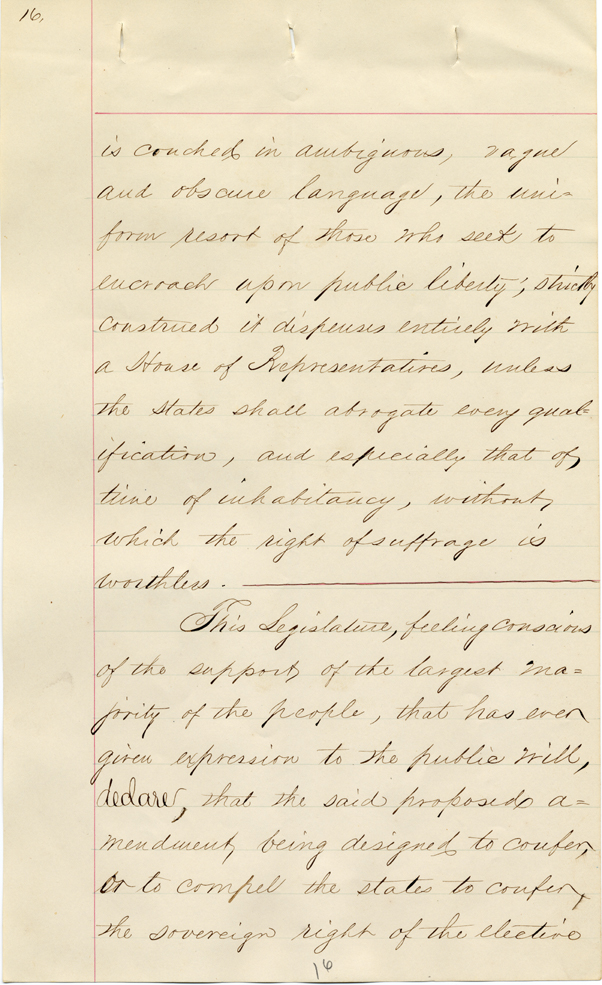
is couched in ambiguous, vague and obscure language, the uniform resort of those who seek to encroach upon public liberty; strictly construed it dispenses entirely with a House of Representatives, unless the states shall abrogate every qualification, and especially that of time of inhabitancy, without which the right of suffrage is worthless.
This Legislature, feeling conscious of the support of the largest majority of the people, that has even given expression to the public will, declare, that the said proposed amendment being designed to confer, or to compel the states to confer, the sovereign right of the elective
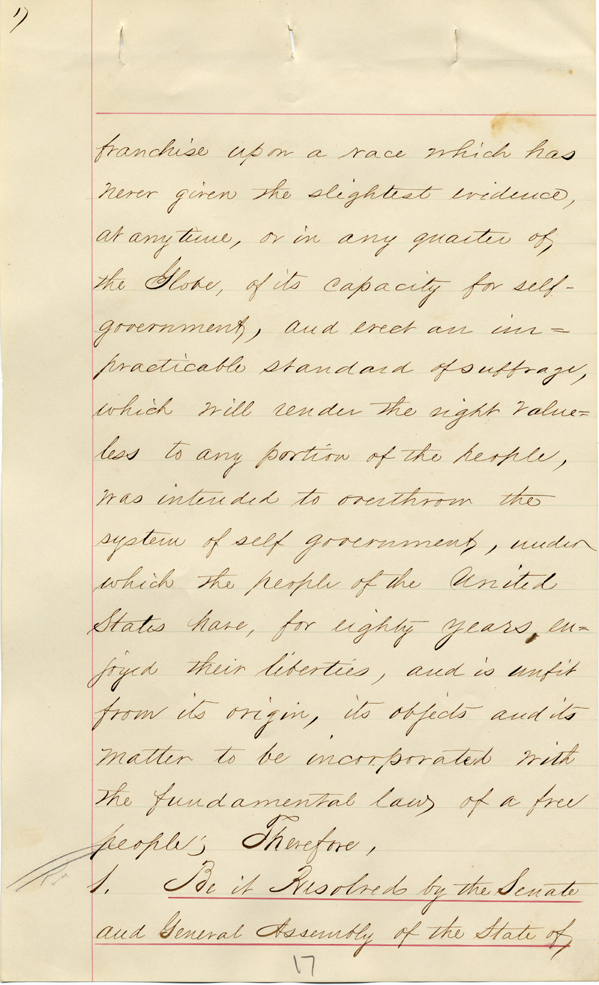
franchise upon a race which has never given the slightest evidence, at any time, or in any quarter of the Globe, of its capacity for self‐government, and erect an impracticable standard of suffrage, which will render the right valueless to any portion of the people, was intended to overthrow the system of self government, under which the people of the United States have, for eighty years, enjoyed their liberties, and is unfit from its origin, its objects and its matter to be incorporated with the fundamental law of a free people; Therefore,
1. Be it Resolved by the Senate and General Assembly of the State of
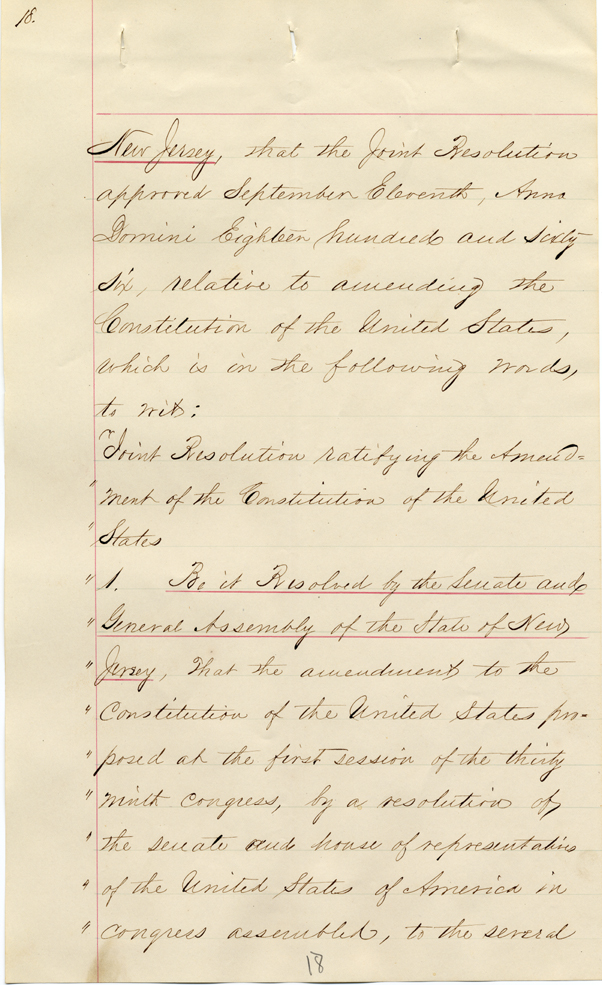
New Jersey, that the Joint Resolution approved September Eleventh, Anno Domini Eighteen hundred and Sixty‐Six relative to amending the Constitution of the United States, which is in the following words, to wit:
“Joint Resolution ratifying the Amendment of the Constitution of the United States
1. Be it Resolved by the Senate and General Assembly of the State of New Jersey, that the amendment to the Constitution of the United States proposed at the first session of the thirty ninth Congress, by a resolution of the senate and house of representatives of the United States of America in Congress assembled, to the several
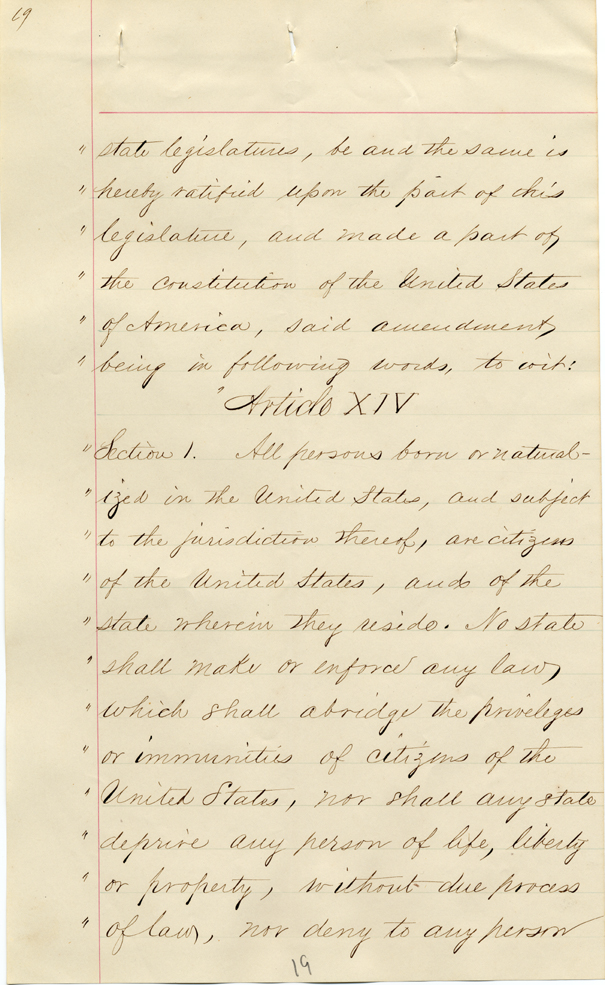
state legislatures, be and the same is hereby ratified upon the part of this legislature, and made a part of the constitution of the United States of America, said amendment being in following words, to wit:
Article XIV
Section 1. All persons born or naturalized in the United States, and subject to the jurisdiction thereof, are citizens of the United States, and of the state wherein they reside. No state shall make or enforce any law which shall abridge the privileges or immunities of citizens of the United States, nor shall any state deprive any person of life, liberty or property, without due process of law, nor deny to any person
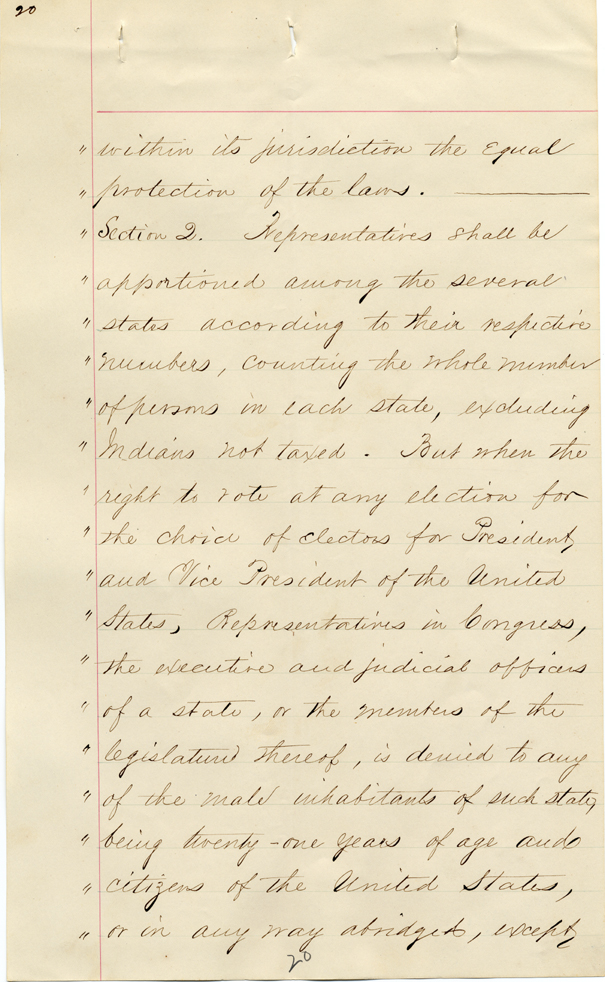
within its jurisdiction the Equal protection of the laws.
Section 2. Representatives shall be apportioned among the several states according to their respective numbers, counting the whole number of persons in each state, excluding Indians not taxed. But when the right to vote at any election for the choice of Electors for President and Vice President of the United States, Representatives in Congress, the executive and judicial officers of a state, or the members of the legislature thereof, is denied to any of the male inhabitants of such state, being twenty‐ one years of age and citizens of the United States, or in any way abridged, except
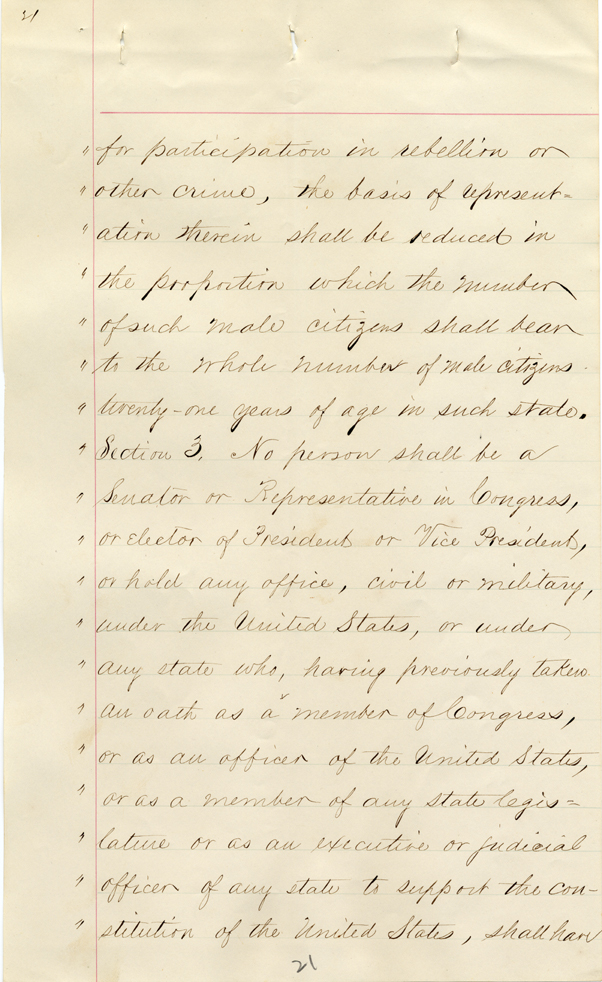
for participation in rebellion or other crime, the basis of representation therein shall be reduced in the proportion which the number of such male citizens shall bear to the whole number of male citizens twenty‐one years of age in such state.
Section 3. No person shall be a Senator or Representative in Congress, or Elector of President or Vice President, or hold any office, civil or military, under the United States, or under any state who, having previously taken an oath as a member of Congress, or as an officer of the United States, or as a member of any state legislature or as an executive or judicial officer of any state to support the constitution of the United States, shall have
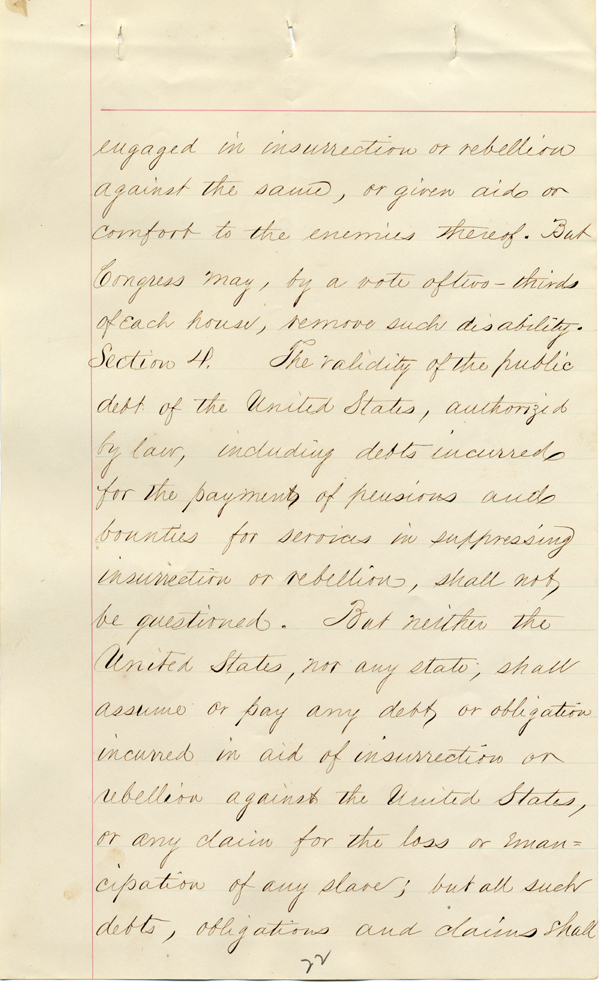
engaged in insurrection or rebellion against the same, or given aid or comfort to the enemies thereof. But Congress may, by a vote of two‐thirds of each house, remove such disability.
Section 4. The validity of the public debt of the United States, authorized by law, including debts incurred for the payment of pensions and bounties for services in suppressing insurrection or rebellion, shall not be questioned. But neither the United States, nor any state, shall assume or pay any debt or obligation incurred in aid of insurrection or rebellion against the United States, or any claim for the loss or Emancipation of any slave; but all such debts, obligations and claims shall
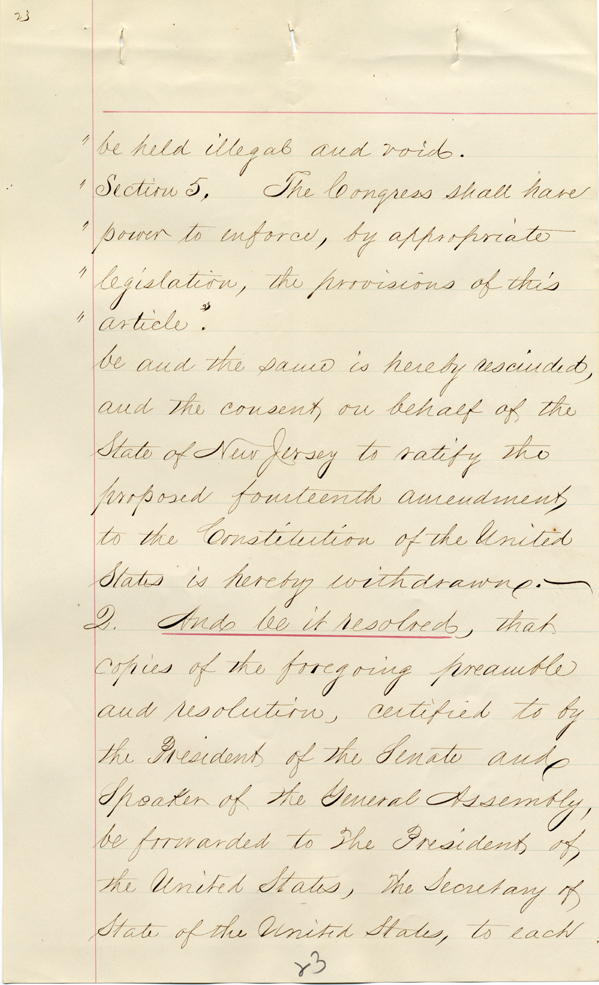
be held illegal and void.
Section 5. The Congress shall have power to enforce, by appropriate legislation, the provisions of this article.”
Be and the same is hereby rescinded, and the consent on behalf of the State of New Jersey to ratify the proposed fourteenth amendment to the Constitution of the United States is hereby withdrawn.
2. And be it resolved, that copies of the foregoing preamble and resolution, certified to by the President of the Senate and Speaker of the General Assembly, be forwarded to the President of the United States, the Secretary of State of the United States, to each
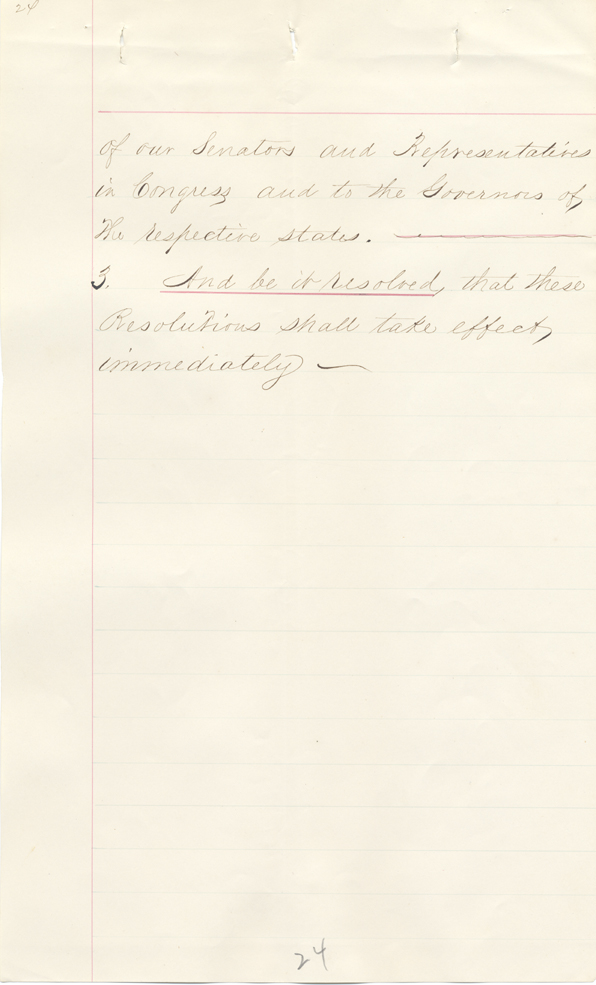
of our Senators and Representatives in Congress and to the Governors of the respective states.
3. And be it resolved, that these Resolutions shall take effect immediately.
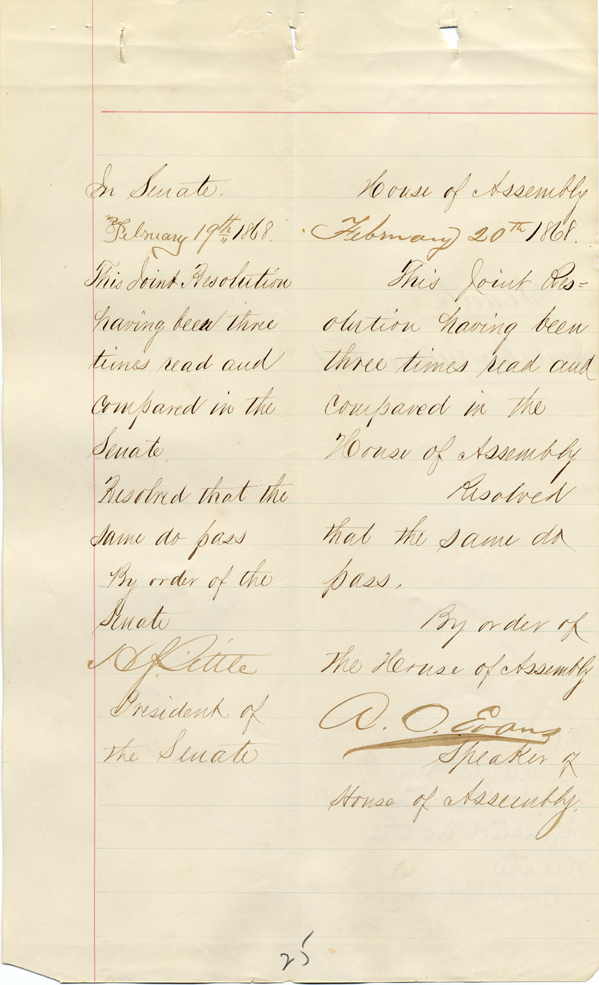
In Senate,
February 19th, 1868.
This Joint Resolution having been three times read and compared in the Senate, Resolved, that the same do pass.
By order of the Senate.
H. S. Little, President of the Senate
House of Assembly,
February 20th, 1868.
This Joint Resolution having been three times read and compared in the House of Assembly, Resolved, that the same do pass.
By order of the House of Assembly.
A. O. Evans, Speaker of House of Assembly
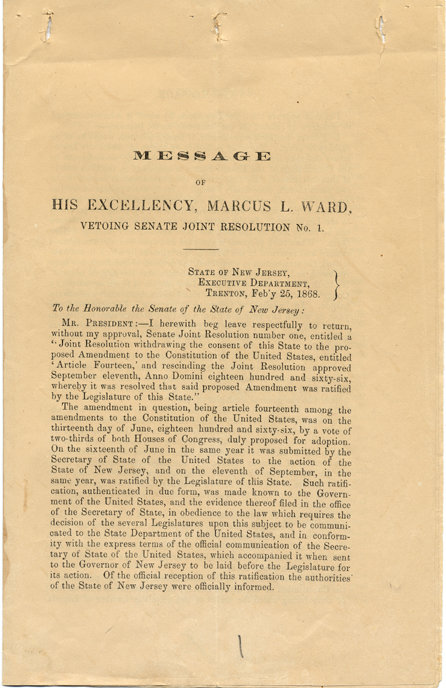
Message
Of
His Excellency, Marcus L. Ward,
Vetoing Senate Joint Resolution No. 1
State of New Jersey,
Executive Department,
Trenton, Feb’y 25, 1868
To the Honorable the Senate of the State of New Jersey:
MR. PRESIDENT: — I herewith beg leave respectfully to return, without my approval, Senate Joint Resolution number one, entitled a “Joint Resolution withdrawing the consent of this State to the proposed Amendment to the Constitution of the United States, entitled ‘Article Fourteen,’ and rescinding the Joint Resolution approved September eleventh, Anno Domini eighteen hundred and sixty-six, whereby it was resolved that said proposed Amendment was ratified by the Legislature of this State.”
The amendment in question, being article fourteenth among the amendments to the Constitution of the United States, was on the thirteenth day of June, eighteen hundred and sixty-six, by a vote of two-thirds of both Houses of Congress, duly proposed for adoption. On the sixteenth of June in the same year it was submitted by the Secretary of State of the United States to the action of the State of New Jersey, and on the eleventh of September, in the same year, was ratified by the Legislature of this State. Such ratification, authenticated in due form, was made known to the Government of the United States, and the evidence thereof filed in the office of the Secretary of State, in obedience to the law which requires the decision of the several Legislatures upon this subject to be communicated to the State Department of the United States, and in conformity with the express terms of the official communication of the Secretary of State of the United States, which accompanied it when sent to the Governor of New Jersey to be laid before the Legislature for its action. Of the official reception of this ratification the authorities of the State of New Jersey were officially informed.
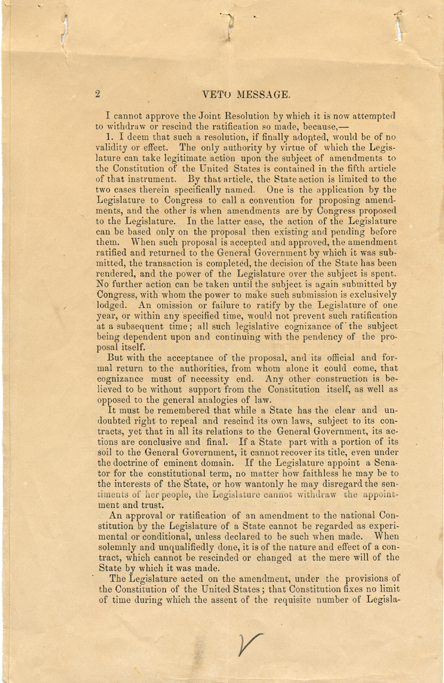
I cannot approve the Joint Resolution by which it is now attempted to withdraw or rescind the ratification so made, because,—
1. I deem that such a resolution, if finally adopted, would be of no validity or effect. The only authority by virtue of which the Legislature can take legitimate action upon the subject of amendments to the Constitution of the United States is contained in the fifth article of that instrument. By that article, the State action is limited to the two cases therein specifically named. One is the application by the Legislature to Congress to call a convention for proposing amendments, and the other is when amendments are by Congress proposed to the Legislature. In the latter case, the action of the Legislature can be based only on the proposal then existing and pending before them. When such proposal is accepted and approved, the amendment ratified and returned to the General Government by which it was submitted, the transaction is completed, the decision of the State has been rendered, and the power of the Legislature over the subject is spent. No further action can be taken until the subject is again submitted by Congress, with whom the power to make such submission is exclusively lodged. An omission or failure to ratify by the Legislature of one year, or within any specified time, would not prevent such ratification at a subsequent time; all such legislative cognizance of the subject being dependent upon and continuing with the pendency of the proposal itself.
But with the acceptance of the proposal, and its official and formal return to the authorities, from whom alone it could come, that cognizance must of necessity end. Any other construction is believed to be without support from the Constitution itself, as well as opposed to the general analogies of law.
It must be remembered that while a State has the clear and undoubted right to repeal and rescind its own laws, subject to its contracts, yet that in all its relations to the General Government, its actions are conclusive and final. If a State part with a portion of its soil to the General Government, it cannot recover its title, even under the doctrine of eminent domain. If the Legislature appoint a Senator for the constitutional term, no matter how faithless he may be to the interests of the State, or how wantonly he may disregard the sentiments of her people, the Legislature cannot withdraw the appointment and trust.
An approval or ratification of an amendment to the national Constitution by the Legislature of a State cannot be regarded as experimental or conditional, unless declared to be such when made. When solemnly and unqualifiedly done, it is of the nature and effect of a contract, which cannot be rescinded or changed at the mere will of the State by which it was made.
The Legislature acted on the amendment, under the provisions of the Constitution of the United States; that Constitution fixes no limit of time during which the assent of the requisite number of Legisla-
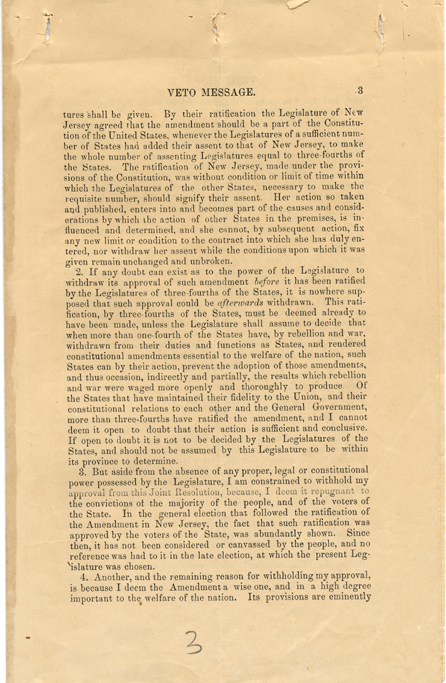
tures shall be given. By their ratification the Legislature of New Jersey agreed that the amendment should be a part of the Constitution of the United States, whenever the Legislatures of a sufficient number of States had added their assent to that of New Jersey, to make the whole number of assenting Legislatures equal to three-fourths of the States. The ratification of New Jersey, made under the provisions of the Constitution, was without condition or limit of time within which the Legislatures of the other States, necessary to make the requisite number, should signify their assent. Her action so taken and published, enters into and becomes part of the causes and considerations by which the action of other States in the premises, is influenced and determined, and she cannot, by subsequent action, fix any new limit or condition to the contract into which she has duly entered nor withdraw her assent while the conditions upon which it was given remain unchanged and unbroken.
2. If any doubt can exist as to the power of the Legislature to withdraw its approval of such amendment before it has been ratified by the Legislatures of three-fourths of the States, it is nowhere supposed that such approval could be afterwards withdrawn. This ratification, by three-fourths of the States, must be deemed already to have been made, unless the Legislature shall assume to decide that when more than one-fourth of the States have, by rebellion and war, withdrawn from their duties and functions as States, and rendered constitutional amendments essential to the welfare of the nation, such States can by their action, prevent the adoption of those amendments, and thus occasion, indirectly and partially, the results which rebellion and war were waged more openly and thoroughly to produce. Of the States that have maintained their fidelity to the Union, and their constitutional relations to each other and the General Government, more than three-fourths have ratified the amendment, and I cannot deem it open to doubt that their action is sufficient and conclusive. If open to doubt it is not to be decided by the Legislatures of the States, and should not be assumed by this Legislature to be within its province to determine.
3. But aside from the absence of any proper, legal or constitutional power possessed by the Legislature, I am constrained to withhold my approval from this Joint Resolution, because, I deem it repugnant to the convictions of the majority of the people, and of the voters of the State. In the general election that followed the ratification of the Amendment in New Jersey, the fact that such ratification was approved by the voters of the State, was abundantly shown. Since then, it has not been considered or canvassed by the people, and no reference was had to it in the late election, at which the present Legislature was chosen.
4. Another, and the remaining reason for withholding my approval, is because I deem the Amendment a wise one, and in a high degree important to the welfare of the nation. Its provisions are eminently
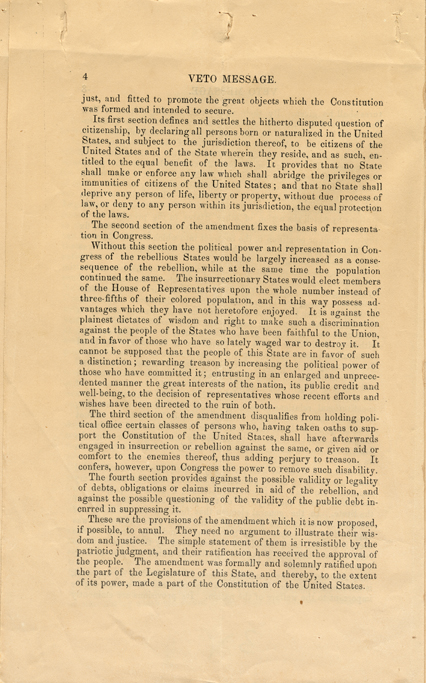
just, and fitted to promote the great objects which the Constitution was formed and intended to secure.
Its first section defines and settles the hitherto disputed question of citizenship, by declaring all persons born or naturalized in the United States, and subject to the jurisdiction thereof, to be citizens of the United States and of the State wherein they reside, and as such, entitled to the equal benefit of the laws. It provides that no State shall make or enforce any law which shall abridge the privileges or immunities of citizens of the United States; and that no State shall deprive any person of life, liberty or property, without due process of law, or deny to any person within its jurisdiction, the equal protection of the laws.
The second section of the amendment fixes the basis of representation in Congress.
Without this section the political power and representation in Congress of the rebellious States would be largely increased as a consequence of the rebellion, while at the same time the population continued the same. The insurrectionary States would elect members of the House of Representatives upon the whole number instead of three-fifths of their colored population, and in this way possess advantages which they have not heretofore enjoyed. It is against the plainest dictates of wisdom and right to make such a discrimination against the people of the States who have been faithful to the Union, and in favor of those who have so lately waged war to destroy it. It cannot be supposed that the people of this State are in favor of such a distinction; rewarding treason by increasing the political power of those who have committed it; entrusting in an enlarged and unprecedented manner the great interests of the nation, its public credit and well-being, to the decision of representatives whose recent efforts and wishes have been directed to the ruin of both.
The third section of the amendment disqualifies from holding political office certain classes of persons who, having taken oaths to support the Constitution of the United States, shall have afterwards engaged in insurrection or rebellion against the same, or given aid or comfort to the enemies thereof, thus adding perjury to treason. It confers, however, upon Congress the power to remove such disability.
The fourth section provides against the possible validity or legality of debts, obligations or claims incurred in aid of the rebellion, and against the possible questioning of the validity of the public debt incurred in suppressing it.
These are the provisions of the amendment which it is now proposed, if possible, to annul. They need no argument to illustrate their wisdom and justice. The simple statement of them is irresistible by the patriotic judgment, and their ratification has received the approval of the people. The amendment was formally and solemnly ratified upon the part of the Legislature of this State, and thereby, to the extent of its power, made a part of the Constitution of the United States.
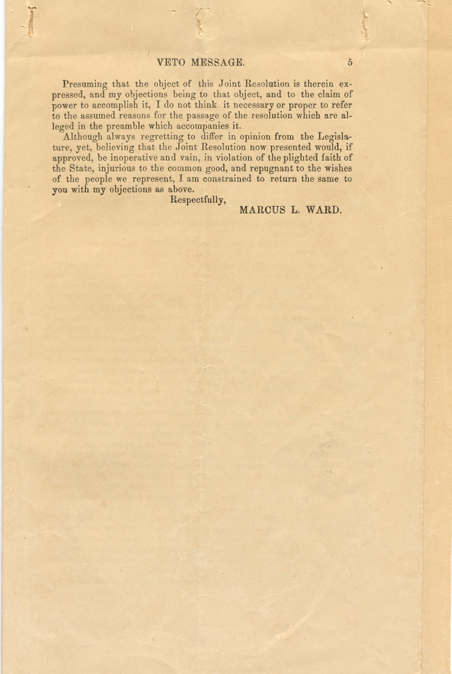
Presuming that the object of this Joint Resolution is therein expressed, and my objections being to that object, and to the claim of power to accomplish it, I do not think it necessary or proper to refer to the assumed reasons for the passage of the resolution which are alleged in the preamble which accompanies it.
Although always regretting to differ in opinion from the Legislature, yet, believing that the Joint Resolution now presented would, if approved, be inoperative and vain, in violation of the plighted faith of the State, injurious to the common good, and repugnant to the wishes of the people we represent, I am constrained to return the same to you with my objections as above.
Respectfully,
MARCUS L. WARD
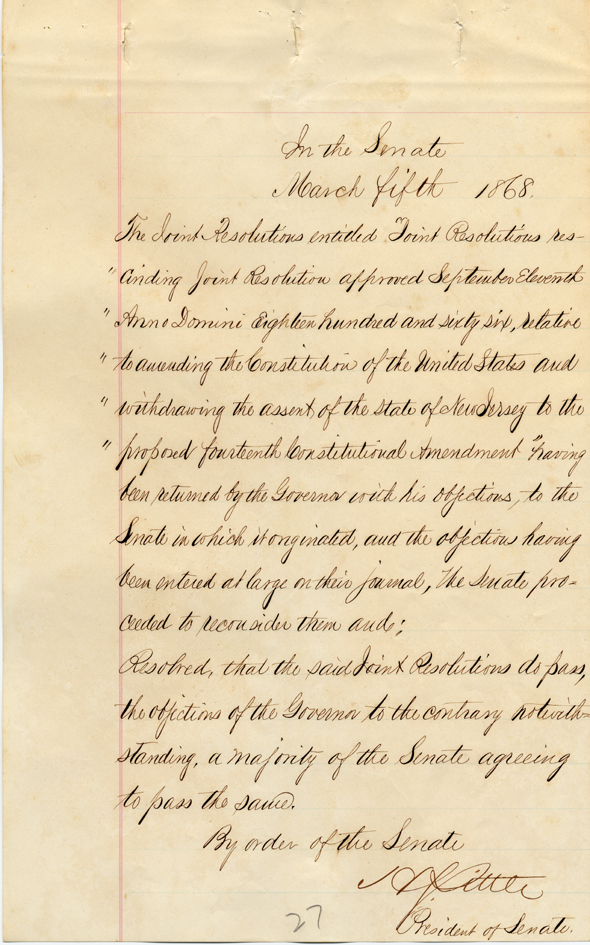
In the Senate
March fifth 1868
The Joint Resolutions entitled “Joint Resolutions rescinding Joint Resolution approved September Eleventh Anno Domini Eighteen hundred and sixty six relative to amending the Constitution of the United States and withdrawing the assent of the State of New Jersey to the proposed fourteenth Constitutional Amendment” having been returned by the Governor with his objections to the Senate in which it originated, and the objections having been entered at large on their journal, the Senate proceeded to reconsider them and:
Resolved, That the said Joint Resolutions do pass, the objections of the Governor to the contrary notwithstanding, a majority of the Senate agreeing to pass the same.
By order of the Senate
H. S. Little, President of Senate
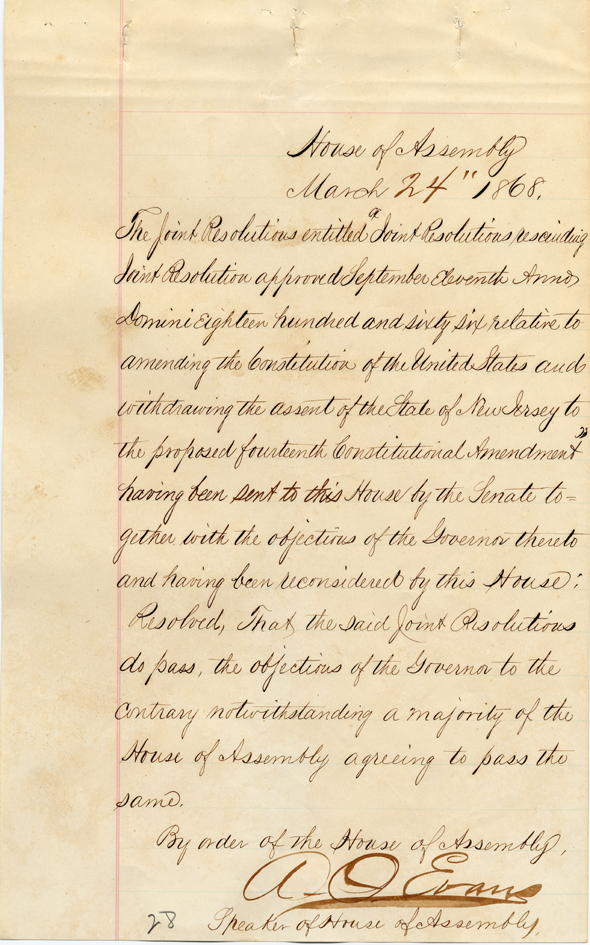
House of Assembly
March 24, 1868
The Joint Resolutions entitled “Joint Resolutions rescinding Joint Resolution approved September Eleventh Anno Domini Eighteen hundred and sixty six relative to amending the Constitution of the United States and withdrawing the assent of the State of New Jersey to the proposed fourteenth Constitutional Amendment” having been sent to this House by the Senate together with the objections of the Governor thereto and having been reconsidered by this House:
Resolved, That the said Joint Resolutions do pass, the objections of the Governor to the contrary notwithstanding a majority of the House of Assembly agreeing to pass the same.
By order of the House of Assembly,
A. O. Evans, Speaker of House of Assembly
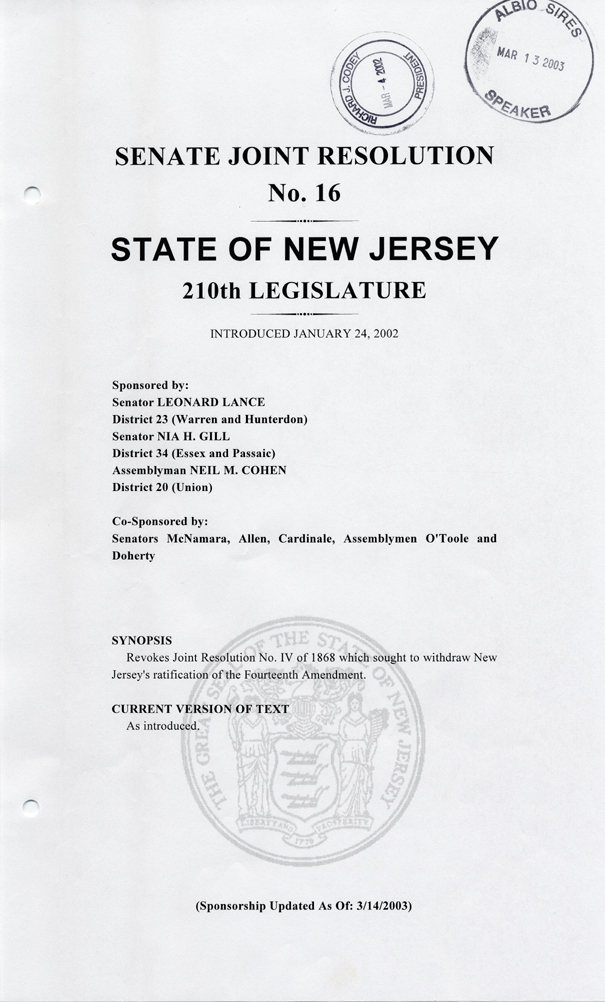
Senate Joint Resolution
No. 16
State of New Jersey
210th Legislature
INTRODUCED JANUARY 24, 2002
Sponsored by:
Senator LEONARD LANCE
District 23 (Warren and Hunterdon)
Senator NIA H. GILL
District 34 (Essex and Passaic)
Assemblyman NEIL M. COHEN
District 20 (Union)
Co-Sponsored by:
Senators McNamara, Allen, Cardinale, Assemblymen O'Toole and Doherty
SYNOPSIS
Revokes Joint Resolution No. IV of 1868 which sought to withdraw New Jersey’s ratification of the Fourteenth Amendment.
CURRENT VERSION OF TEXT
As introduced.
(Sponsorship Updated As Of: 3/14/2003)
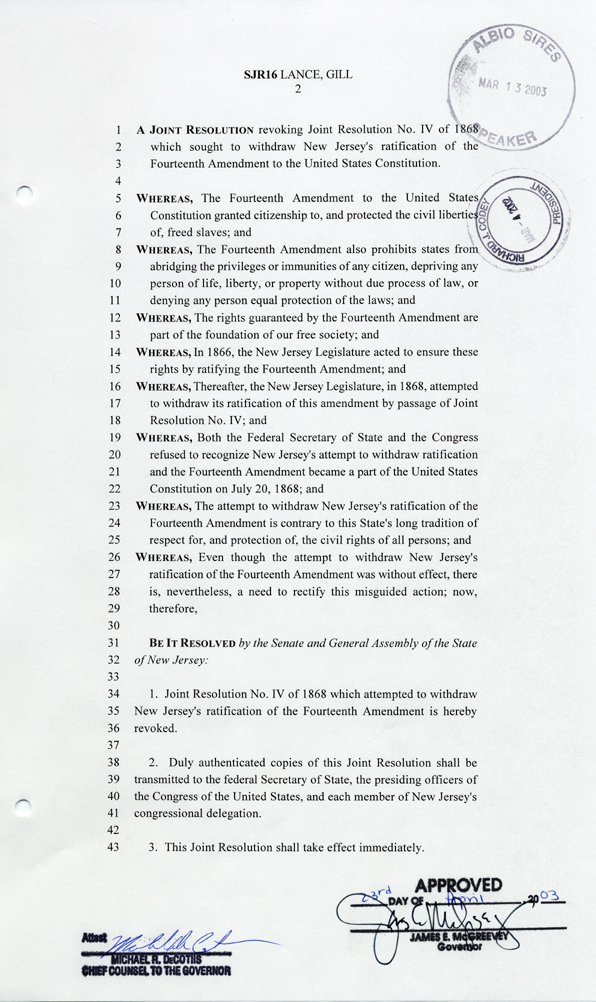
A JOINT RESOLUTION revoking Joint Resolution No. IV of 1868 which sought to withdraw New Jersey’s ratification of the Fourteenth Amendment to the United States Constitution.
WHEREAS, The Fourteenth Amendment to the United States Constitution granted citizenship to, and protected the civil liberties of, freed slaves; and
WHEREAS, The Fourteenth Amendment also prohibits states from abridging the privileges or immunities of any citizen, depriving any person of life, liberty, or property without due process of law, or denying any person equal protection of the laws; and
WHEREAS, The rights guaranteed by the Fourteenth Amendment are part of the foundation of our free society; and
WHEREAS, In 1866, the New Jersey Legislature acted to ensure these rights by ratifying the Fourteenth Amendment; and
WHEREAS, Thereafter, the New Jersey Legislature, in 1868, attempted to withdraw its ratification of this amendment by passage of Joint Resolution No. IV; and
WHEREAS, Both the Federal Secretary of State and the Congress refused to recognize New Jersey’s attempt to withdraw ratification and the Fourteenth Amendment became a part of the United States Constitution on July 20, 1868; and
WHEREAS, The attempt to withdraw New Jersey’s ratification of the Fourteenth Amendment is contrary to this State’s long tradition of respect for, and protection of, the civil rights of all persons; and
WHEREAS, Even though the attempt to withdraw New Jersey’s ratification of the Fourteenth Amendment was without effect, there is, nevertheless, a need to rectify this misguided action; now, therefore,
BE IT RESOLVED by the Senate and General Assembly of the State of New Jersey:
1. Joint Resolution No. IV of 1868 which attempted to withdraw New Jersey’s ratification of the Fourteenth Amendment is hereby revoked.
2. Duly authenticated copies of this Joint Resolution shall be transmitted to the federal Secretary of State, the presiding officers of the Congress of the United States, and each member of New Jersey’s congressional delegation.
3. This Joint Resolution shall take effect immediately.
APPROVED
23rd DAY of APRIL 2003
James E. McGreevey, Governor
Attest,
Michael R. DeCotiis,
Chief Counsel to the Governor
STATEMENT
This Joint Resolution revokes Joint Resolution No. IV of 1868 which attempted to withdraw New Jersey’s ratification of the Fourteenth Amendment to the United States Constitution.
Section 1. The right of citizens of the United States to vote shall not be denied or abridged by the United States or by any State on account of race, color, or previous condition of servitude.
Section 2. The Congress shall have power to enforce this article by appropriate legislation.
Ratified by Required Number of States, 3 February 1870.
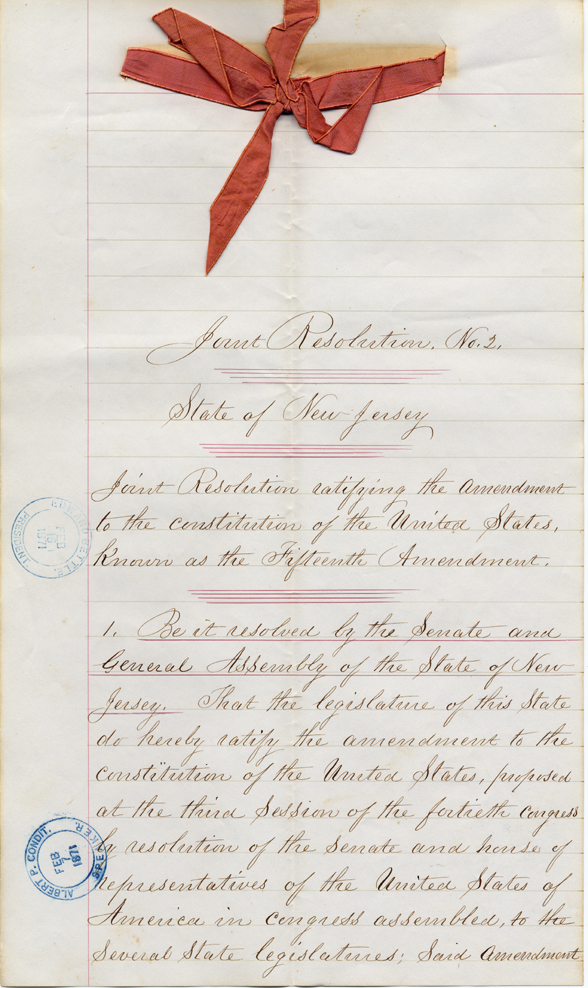
Joint Resolution No. 2
State of New Jersey
Joint Resolution ratifying the amendment to the constitution of the United States, known as the Fifteenth Amendment.
1. Be it resolved by the Senate and General Assembly of the State of New Jersey. That the legislature of this State do hereby ratify the amendment to the constitution of the United States, proposed at the third session of the fortieth congress by resolution of the Senate and house of representatives of the United States of America in congress assembled, to the Several State legislatures; Said amendment
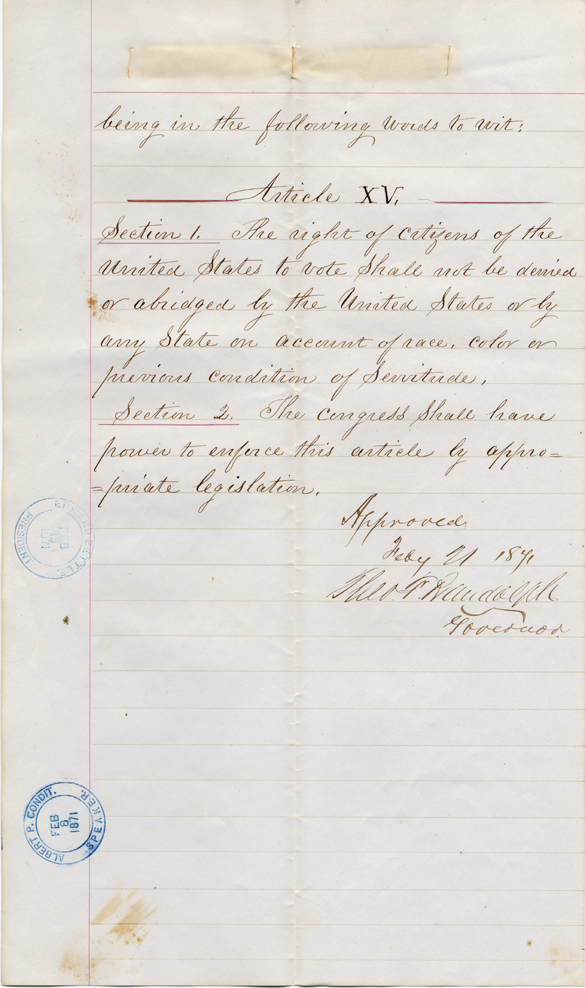
being in the following words to wit:
Article XV.
Section 1. The right of citizens of the United States to vote Shall not be denied or abridged by the United States or by any State on account of race, color or previous condition of Servitude.
Section 2. The congress Shall have power to enforce this article by appropriate legislation.
Approved
Feby 21 1871
Theodore F. Randolph, Governor
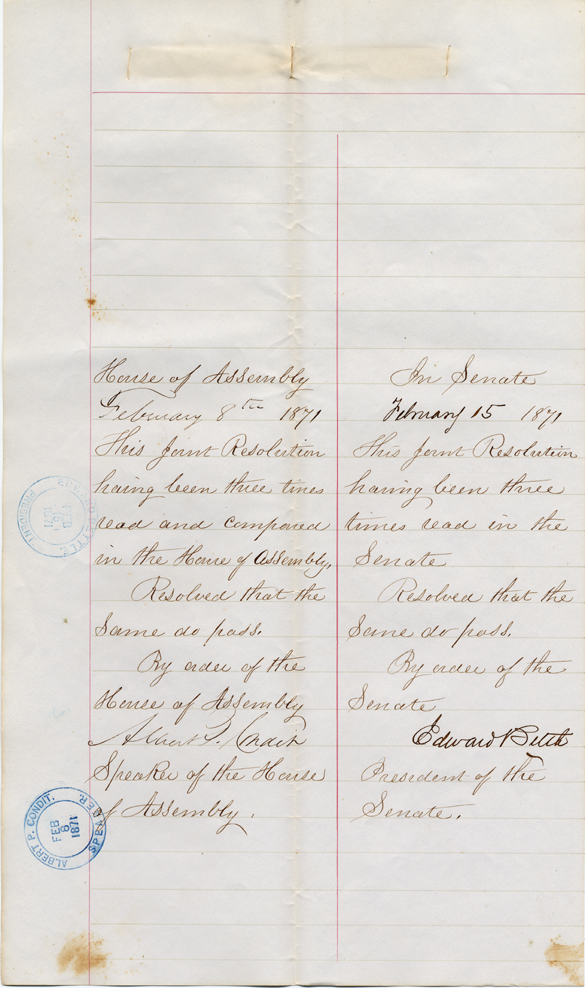
House of Assembly
February 8th 1871
This Joint Resolution having been three times read and compared in the House of Assembly,
Resolved that the Same do pass.
By order of the House of Assembly
Albert P. Condit, Speaker of the House of Assembly
In Senate
February 15 1871
This Joint Resolution having been three times read in the Senate
RESOLVED, That the same do pass.
By order of the General Assembly.
Marion West Higgins, Speaker of the General Assembly
The Congress shall have power to lay and collect taxes on incomes, from whatever source derived, without apportionment among the several States, and without regard to any census or enumeration.
Ratified by Required Number of States, 3 February 1913.
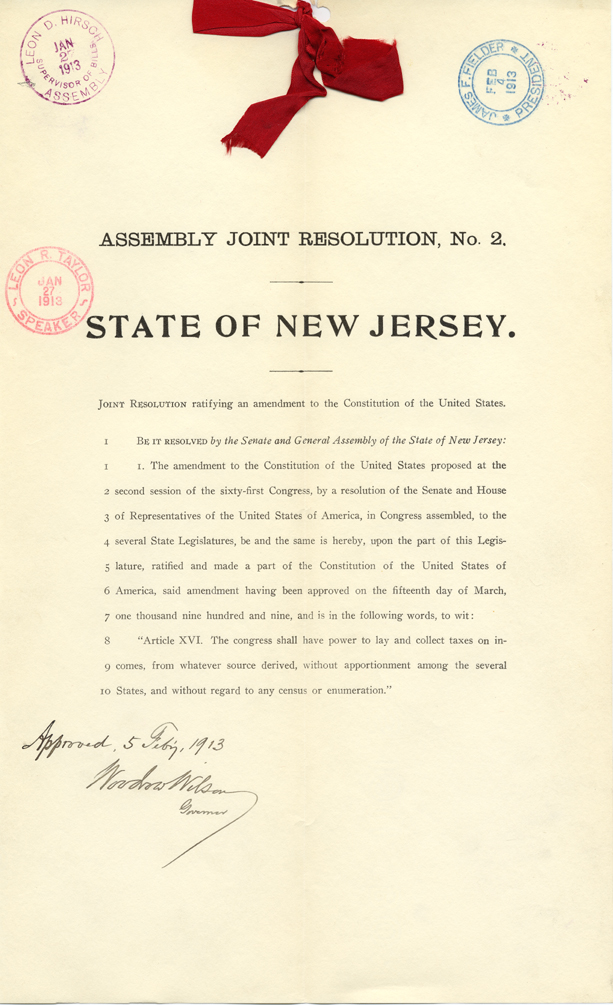
Assembly Joint Resolution, No. 2
State of New Jersey
Joint Resolution ratifying an amendment to the Constitution of the United States
BE IT RESOLVED by the Senate and General Assembly of the State of New Jersey:
1. The amendment to the Constitution of the United States proposed at the second session of the sixty-first Congress, by a resolution of the Senate and House of Representatives of the United States of America, in Congress assembled, to the several State Legislatures, be and the same is hereby, upon the part of this Legislature, ratified and made a part of the Constitution of the United States of America, said amendment having been approved on the fifteenth day of March, one thousand nine hundred and nine, and is in the following words, to wit:
“Article XVI. The congress shall have power to lay and collect taxes on incomes, from whatever source derived, without apportionment among the several States, and without regard to any census or enumeration.”
Approved
5 Feb’y, 1913
Woodrow Wilson, Governor
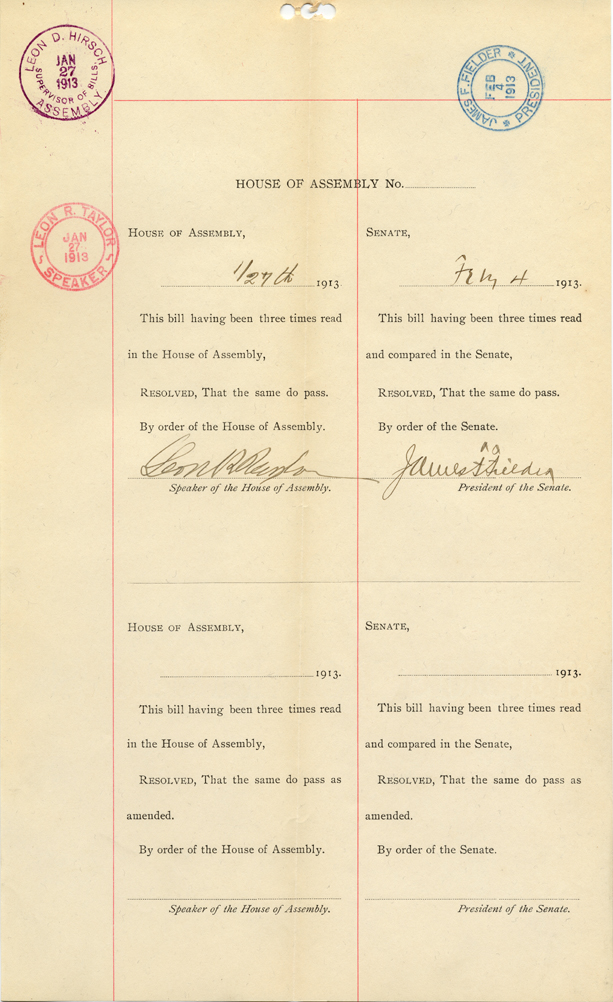
HOUSE OF ASSEMBLY No. ___
HOUSE OF ASSEMBLY,
1/27th 1913
This bill having been three times read in the House of Assembly,
RESOLVED, That the same do pass.
By order of the House of Assembly.
Leon R. Taylor, Speaker of the House of Assembly
SENATE,
Feby 4 1913
This bill having been three times read and compared in the Senate,
RESOLVED, That the same do pass.
By order of the Senate.
James F. Fielder, President of the Senate
The Senate of the United States shall be composed of two Senators from each State, elected by the people thereof, for six years; and each Senator shall have one vote. The electors in each State shall have the qualifications requisite for electors of the most numerous branch of the State legislatures.
When vacancies happen in the representation of any State in the Senate, the executive authority of such State shall issue writs of election to fill such vacancies: Provided, That the legislature of any State may empower the executive thereof to make temporary appointments until the people fill the vacancies by election as the legislature may direct.
This amendment shall not be so construed as to affect the election or term of any Senator chosen before it becomes valid as part of the Constitution.
Ratified by Required Number of States, 8 April 1913.
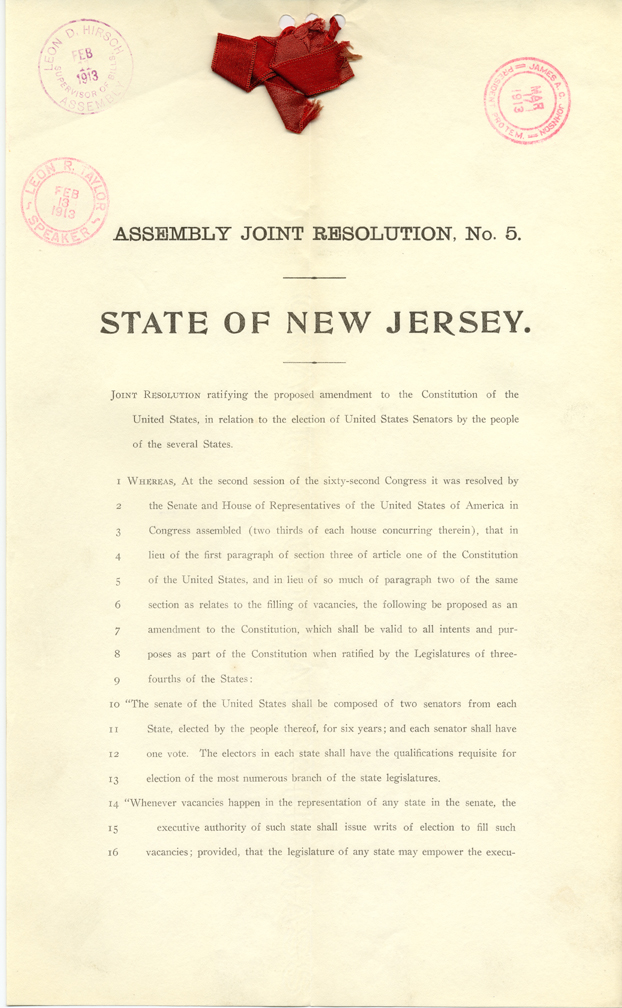
Assembly Joint Resolution, No. 5
State of New Jersey
Joint Resolution ratifying the proposed amendment to the Constitution of the United States, in relation to the election of United States Senators by the people of the several States.
WHEREAS, At the second session of the sixty-second Congress it was resolved by the Senate and House of Representatives of the United States of America in Congress assembled (two thirds of each house concurring therein), that in lieu of the first paragraph of section three of article one of the Constitution of the United States, and in lieu of so much of paragraph two of the same section as relates to the filling of vacancies, the following be proposed as an amendment to the Constitution, which shall be valid to all intents and purposes as part of the Constitution when ratified by the Legislatures of three-fourths of the States:
“The senate of the United States shall be composed of two senators from each State, elected by the people thereof, for six years; and each senator shall have one vote. The electors in each state shall have the qualifications requisite for election of the most numerous branch of the state legislatures.
“Whenever vacancies happen in the representation of any state in the senate, the executive authority of such state shall issue writs of election to fill such vacancies; provided, that the legislature of any state may empower the execu-
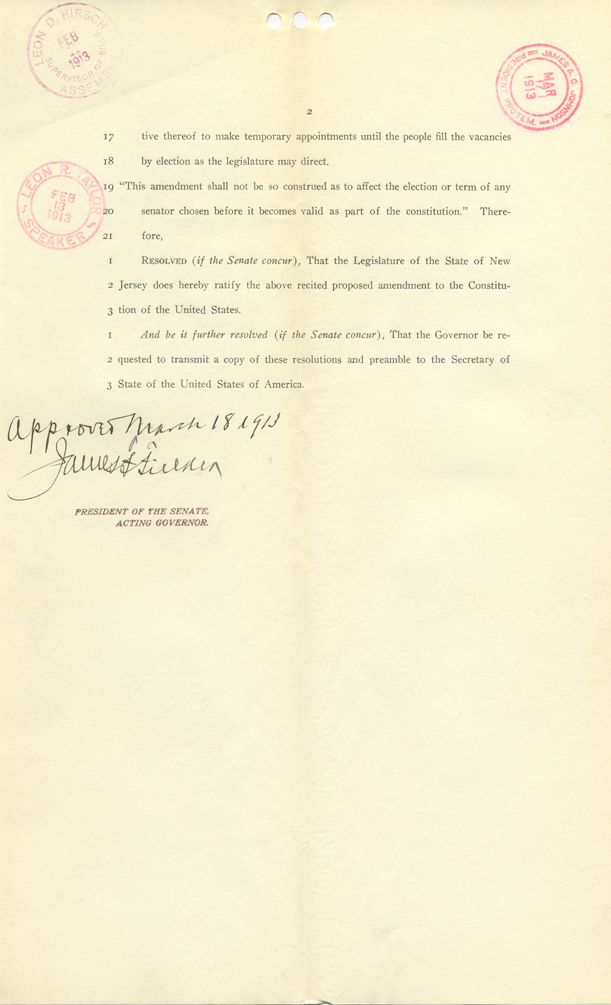
tive thereof to make temporary appointments until the people fill the vacancies by election as the legislature may direct.
“This amendment shall not be so construed as to affect the election or term of any senator chosen before it becomes valid as part of the constitution.” Therefore,
RESOLVED (if the Senate concur), That the Legislature of the State of New Jersey does hereby ratify the above recited proposed amendment to the Constitution of the United States.
And be it further resolved (if the Senate concur), That the Governor be requested to transmit a copy of these resolutions and preamble to the Secretary of State of the United States of America.
Approved
March 18 1913
James F. Fielder, President of the Senate, Acting Governor
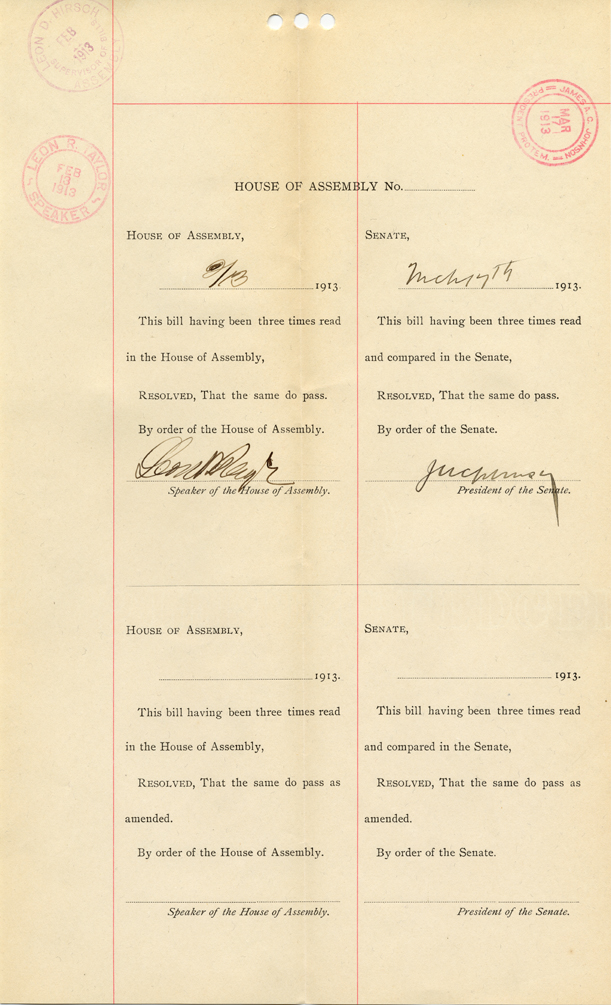
HOUSE OF ASSEMBLY No. ___
HOUSE OF ASSEMBLY,
2/13 1913
This bill having been three times read in the House of Assembly,
RESOLVED, That the same do pass.
By order of the House of Assembly.
Leon R. Taylor, Speaker of the House of Assembly
SENATE,
March 17 1913
This bill having been three times read and compared in the Senate,
RESOLVED, That the same do pass.
By order of the Senate.
James A.C. Johnson, President of the Senate
Section 1. After one year from the ratification of this article the manufacture, sale, or transportation of intoxicating liquors within, the importation thereof into, or the exportation thereof from the United States and all territory subject to the jurisdiction thereof for beverage purposes is hereby prohibited.
Section 2. The Congress and the several States shall have concurrent power to enforce this article by appropriate legislation
Section 3. This article shall be inoperative unless it shall have been ratified as an amendment to the Constitution by the legislatures of the several States, as provided in the Constitution, within seven years from the date of the submission hereof to the States by the Congress.
Ratified by Required Number of States, 16 January 1919.
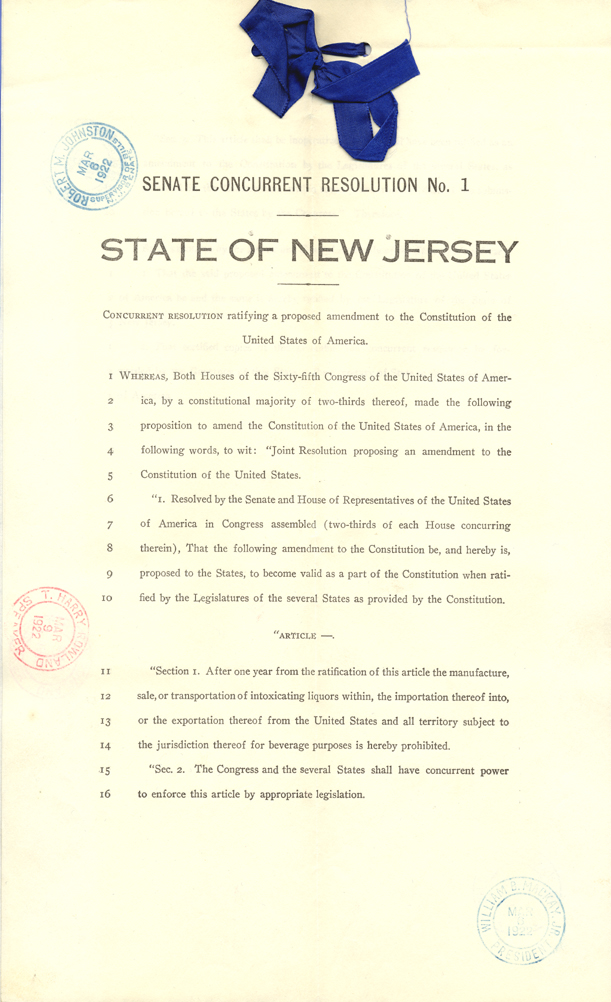
Senate Concurrent Resolution No. 1
State of New Jersey
CONCURRENT RESOLUTION ratifying a proposed amendment to the Constitution of the United States of America.
WHEREAS, Both Houses of the Sixty-fifth Congress of the United States of America, by a constitutional majority of two-thirds thereof, made the following proposition to amend the Constitution of the United States of America, in the following words, to wit: “Joint Resolution proposing an amendment to the Constitution of the United States.
“ARTICLE —
“Section 1. After one year from the ratification of this article the manufacture, sale, or transportation of intoxicating liquors within, the importation thereof into, or the exportation thereof from the United States and all territory subject to the jurisdiction thereof for beverage purposes is hereby prohibited.
“Sec. 2. The Congress and the several States shall have concurrent power to enforce this article by appropriate legislation.
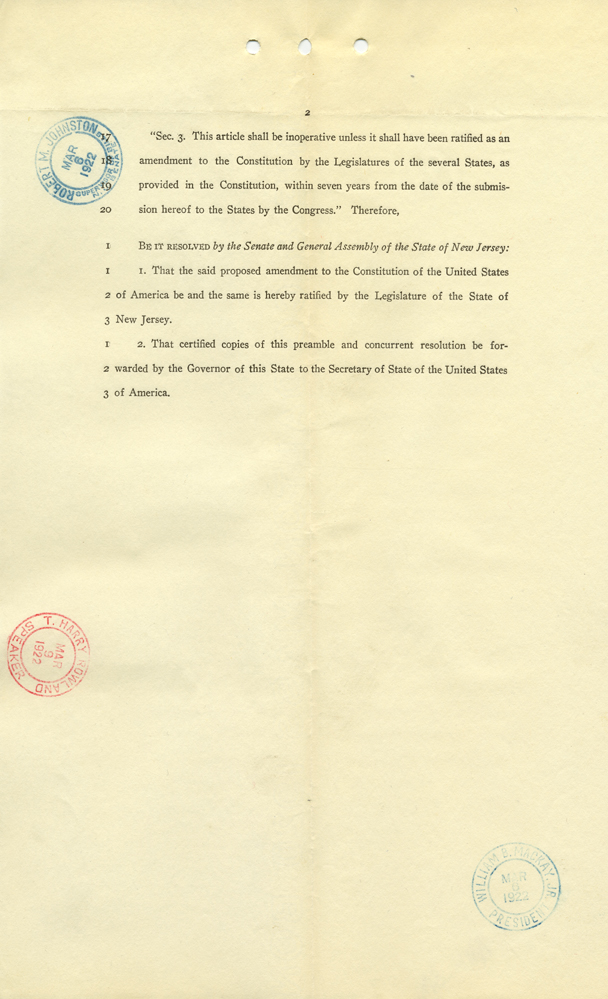
“Sec. 3. This article shall be inoperative unless it shall have been ratified as an amendment to the Constitution by the Legislatures of the several States, as provided in the Constitution, within seven years from the date of the submission hereof to the States by the Congress.” Therefore,
BE IT RESOLVED by the Senate and General Assembly of the State of New Jersey:
1. That the said proposed amendment to the Constitution of the United States of America be and the same is hereby ratified by the Legislature of the State of New Jersey.
2. That certified copies of this preamble and concurrent resolution be forwarded by the Governor of this State to the Secretary of State of the United States of America.
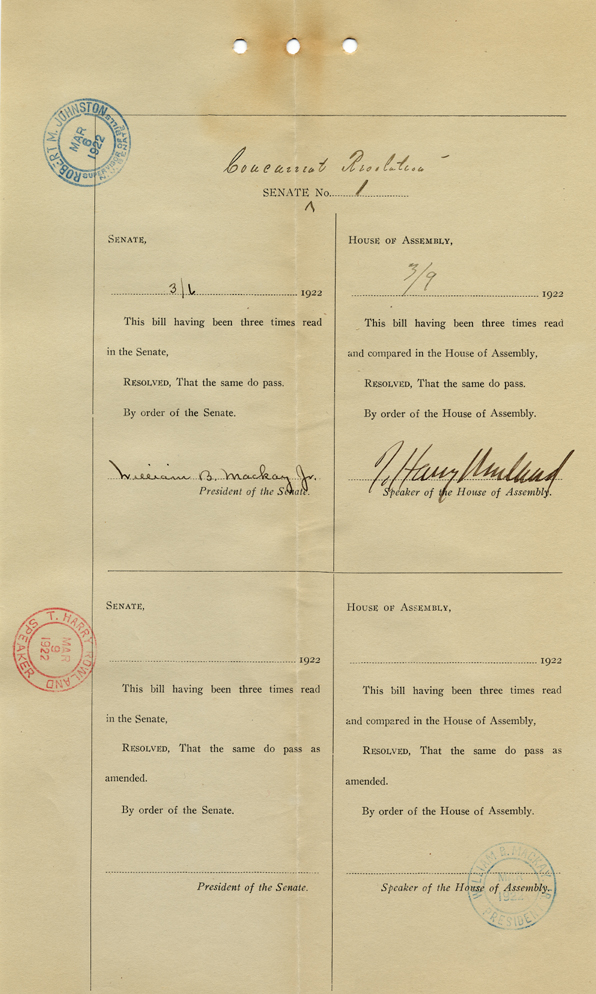
SENATE CONCURRENT RESOLUTION No. 1
SENATE,
3/6, 1922
This bill having been three times read in the Senate,
RESOLVED, That the same do pass.
By order of the Senate.
William B. Mackay Jr., President of the Senate
HOUSE OF ASSEMBLY,
3/9, 1922
This bill having been three times read and compared in the House of Assembly,
RESOLVED, That the same do pass.
By order of the House of Assembly.
T. Harry Rowland, Speaker of the House of Assembly
The right of citizens of the United States to vote shall not be denied or abridged by the United States or by any State on account of sex.
Congress shall have power to enforce this article by appropriate legislation.
Ratified by Required Number of States, 18 August 1920.
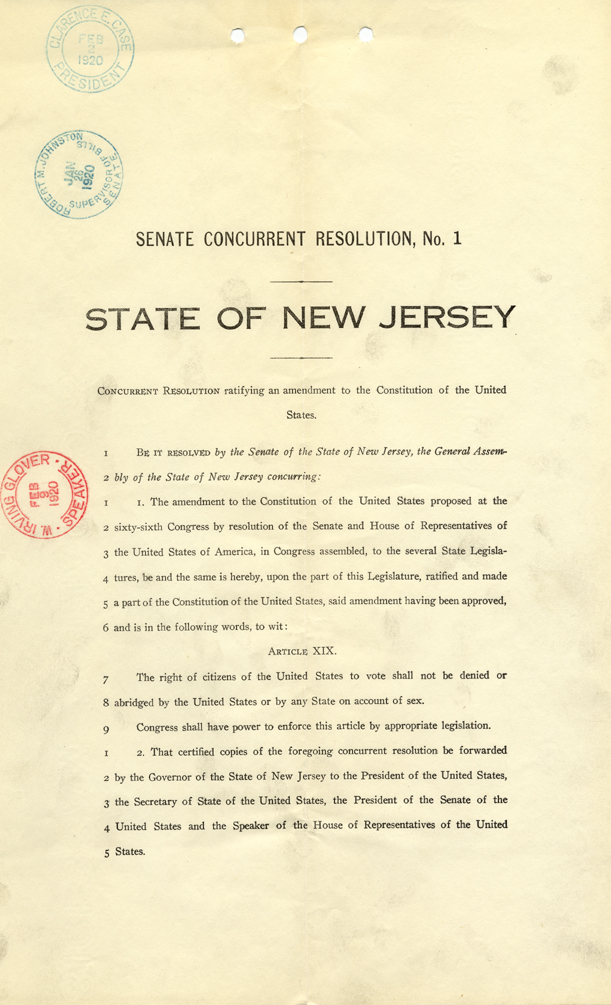
Senate Concurrent Resolution No. 1
State of New Jersey
CONCURRENT RESOLUTION ratifying an amendment to the Constitution of the United States.
BE IT RESOLVED by the Senate of the State of New Jersey, the General Assembly of the State of New Jersey concurring:
1. The amendment to the Constitution of the United States proposed at the sixty-sixth Congress by resolution of the Senate and House of Representatives of the United States of America, in Congress assembled, to the several State Legislatures, be and the same is hereby, upon the part of this Legislature, ratified and made a part of the Constitution of the United States, said amendment having been approved, and is in the following words, to wit:
ARTICLE XIX
The right of citizens of the United States to vote shall not be denied or abridged by the United States or by any State on account of sex.
Congress shall have power to enforce this article by appropriate legislation.
2. That certified copies of the foregoing concurrent resolution be forwarded by the Governor of the State of New Jersey to the President of the United States, the Secretary of State of the United States, the President of the Senate of the United States and the Speaker of the House of Representatives of the United States.
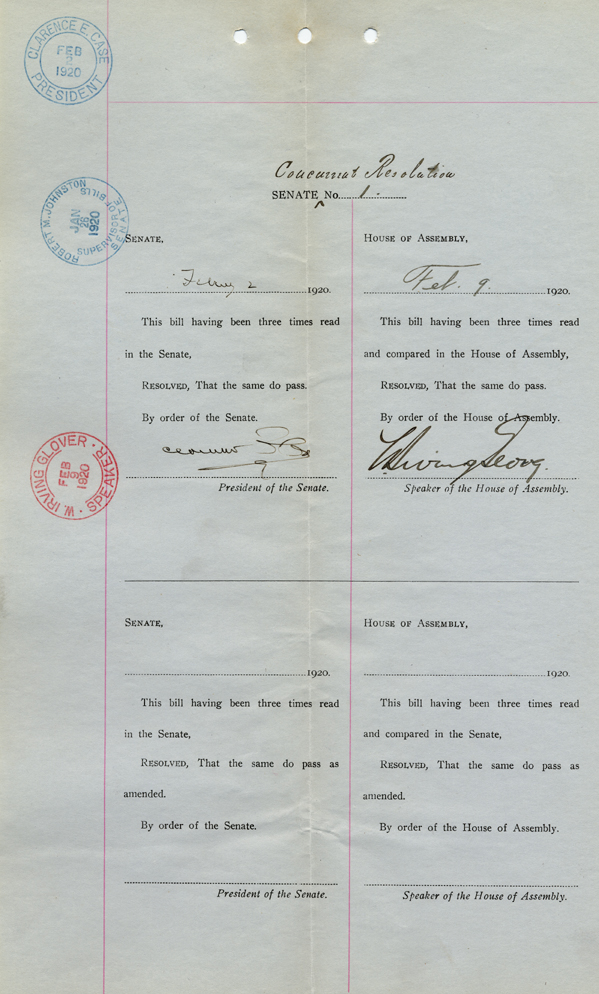
SENATE CONCURRENT RESOLUTION No. 1
SENATE,
February 2, 1920
This bill having been three times read in the Senate,
RESOLVED, That the same do pass.
By order of the Senate.
Clarence E. Case, President of the Senate
HOUSE OF ASSEMBLY,
February 9, 1920
This bill having been three times read and compared in the House of Assembly,
RESOLVED, That the same do pass.
By order of the House of Assembly.
W. Irving Glover, Speaker of the House of Assembly
Correspondence taken from the following collections:
Governor Walter Evans Edge, Correspondence, 1917-1919.
Governor Edward I. Edwards, Correspondence, 1920-1922.
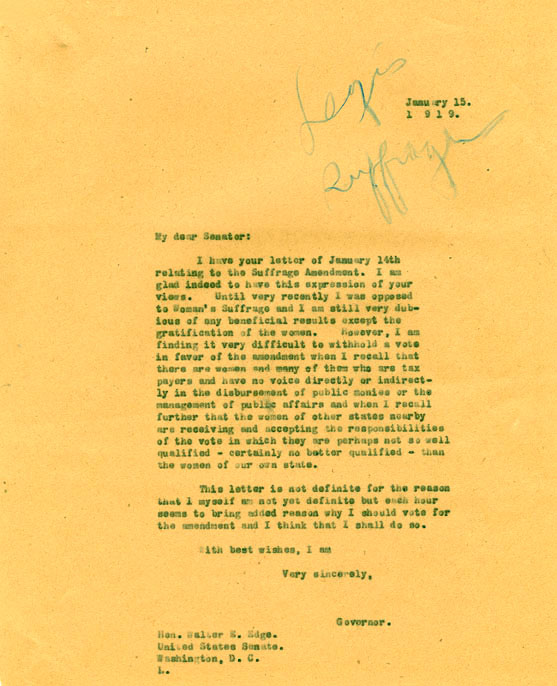
Letter from Acting New Jersey Governor William N. Runyon to Senator Edge (Governor of New Jersey), 15 January 1919, explaining why women should get the right to vote.
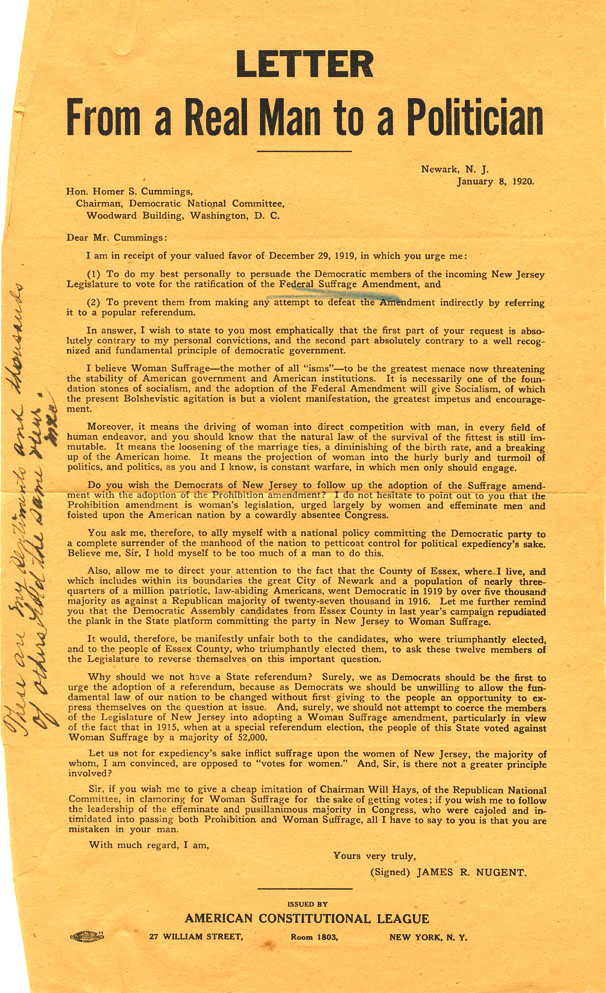
"Letter from a Real Man to a Politician," 8 January 1920, is against a woman's right to vote.
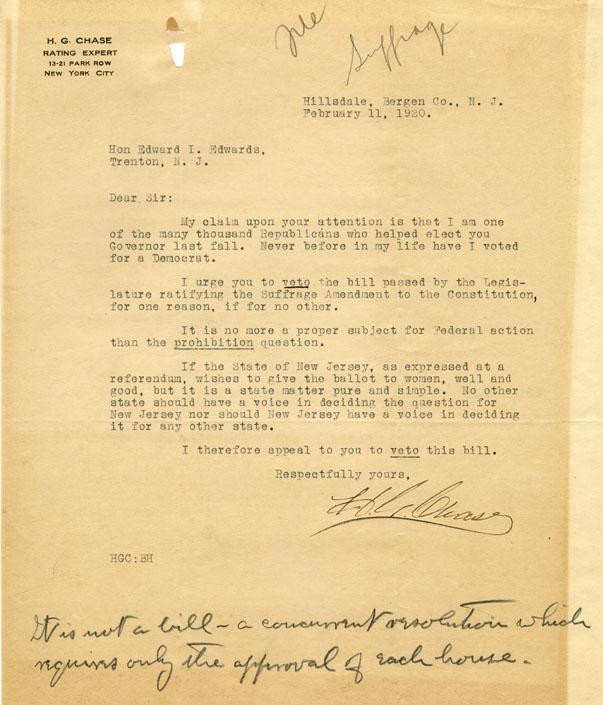
Letter from H. G. Chase to Governor Edwards, 11 February 1920, against women's suffrage. The author believes it should be a state issue.
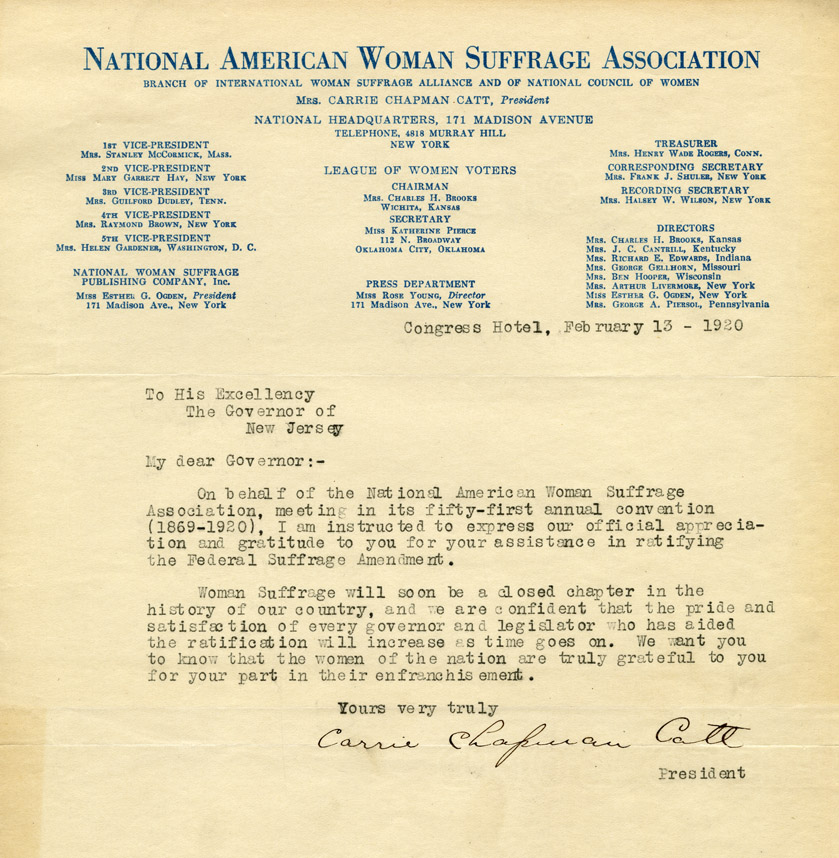
Letter from Carrie Chapman Catt, President of the National American Woman Suffrage Association, to Governor Edwards, 13 February 1920.
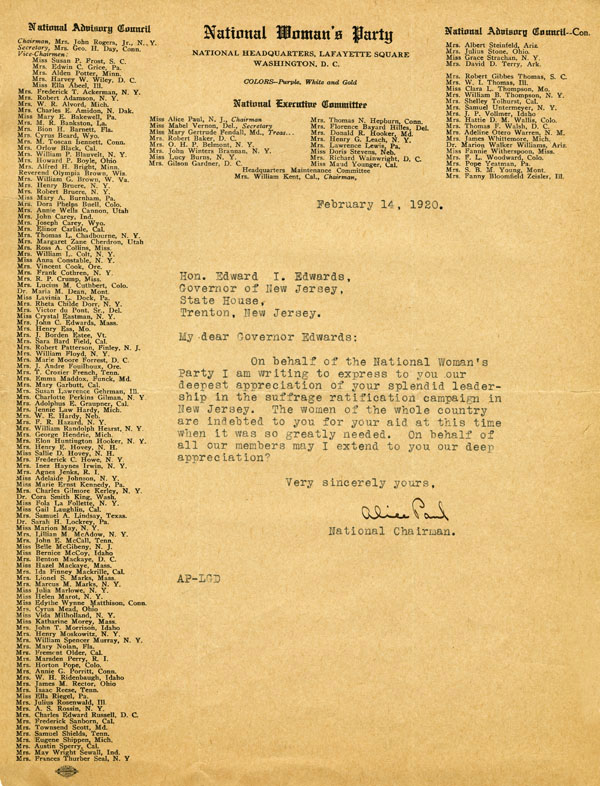
Letter from Alice Paul, National Chairman to the National Women's Party, to Governor Edwards, 14 February 1920.
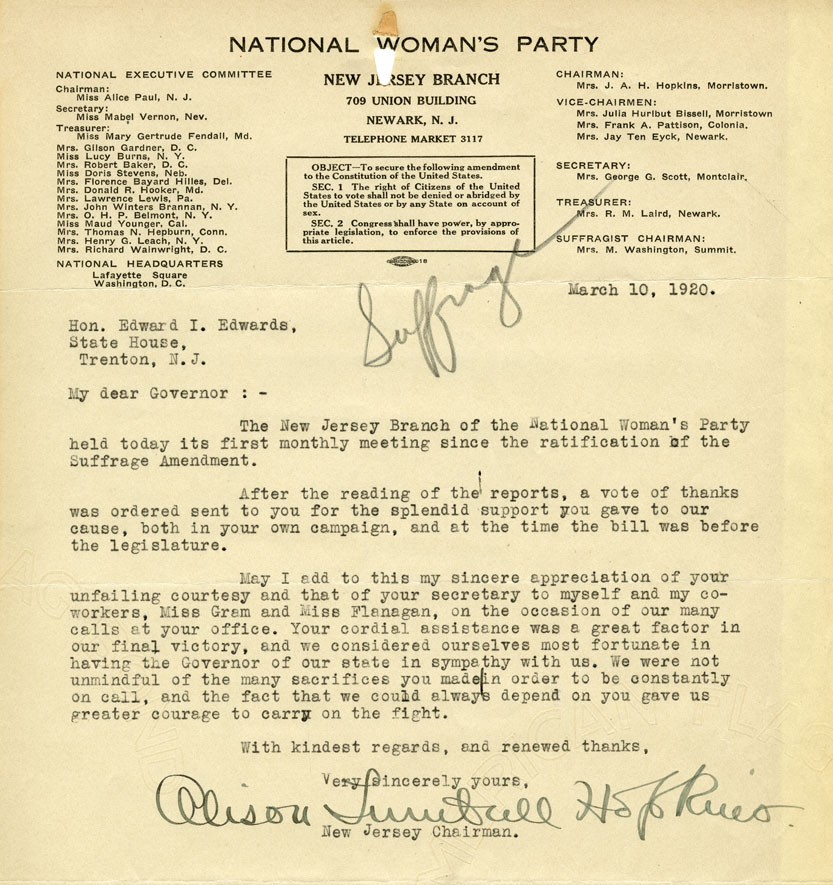
Letter from Allison Hopkins, New Jersey Chairman of the National Woman's Party, to Governor Edwards, 10 March 1920
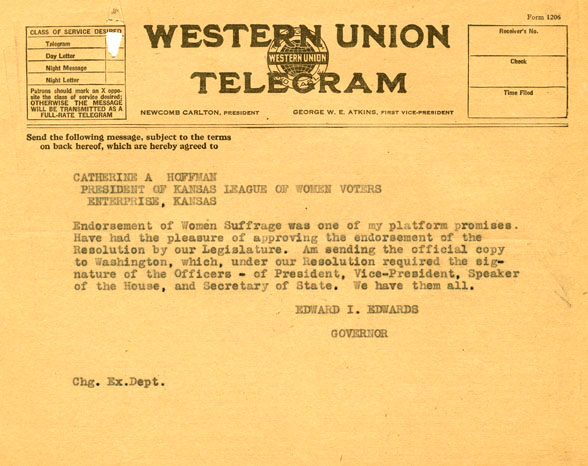
Telegram from Governor Edwards to Carrie Hoffman, President of Kansas League of Women Voters, 1920, stating that women's suffrage was one of the governor's platform promises.
Section 1. The terms of the President and Vice President shall end at noon on the 20th day of January, and the terms of Senators and Representatives at noon on the 3d day of January, of the years in which such terms would have ended if this article had not been ratified; and the terms of their successors shall then begin.
Section 2. The Congress shall assemble at least once in every year, and such meeting shall begin at noon on the 3d day of January, unless they shall by law appoint a different day.
Section 3. If, at the time fixed for the beginning of the term of the President, the President elect shall have died, the Vice President elect shall become President. If a President shall not have been chosen before the time fixed for the beginning of his term, or if the President elect shall have failed to qualify, then the Vice President elect shall act as President until a President shall have qualified; and the Congress may by law provide for the case wherein neither a President elect nor a Vice President elect shall have qualified, declaring who shall then act as President, or the manner in which one who is to act shall be selected, and such person shall act accordingly until a President or Vice President shall have qualified.
Section 4. The Congress may by law provide for the case of the death of any of the persons from whom the House of Representatives may choose a President whenever the right of choice shall have devolved upon them, and for the case of the death of any of the persons from whom the Senate may choose a Vice President whenever the right of choice shall have devolved upon them.
Section 5. Sections 1 and 2 shall take effect on the 15th day of October following the ratification of this article.
Section 6. This article shall be inoperative unless it shall have been ratified as an amendment to the Constitution by the legislatures of three-fourths of the several States within seven years from the date of its submission.
Ratified by Required Number of States, 23 January 1933.
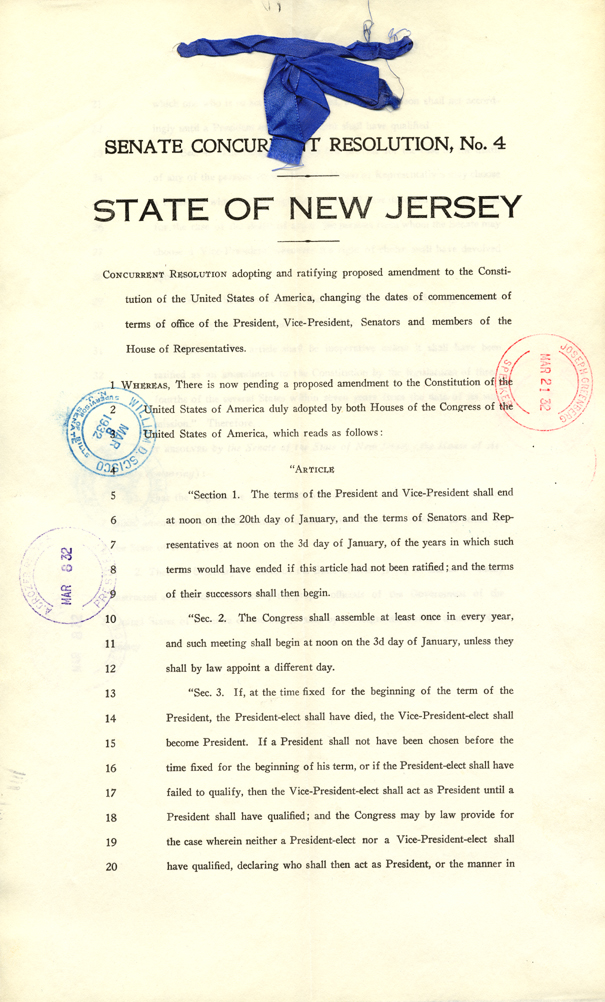
Senate Concurrent Resolution, No. 4
State of New Jersey
CONCURRENT RESOLUTION adopting and ratifying proposed amendment to the Constitution of the United States of America, changing the dates of commencement of terms of office of the President, Vice-President, Senators and members of the House of Representatives.
WHEREAS, There is now pending a proposed amendment to the Constitution of the United States of America duly adopted by both Houses of the Congress of the United States of America, which reads as follows:
“ARTICLE
"Section 1. The terms of the President and Vice-President shall end at noon on the 20th day of January, and the terms of Senators and Representatives at noon on the 3d day of January, of the years in which such terms would have ended if this article had not been ratified; and the terms of their successors shall then begin.
"Sec. 2. The Congress shall assemble at least once in every year, and such meeting shall begin at noon on the 3d day of January, unless they shall by law appoint a different day.
"Sec. 3. If, at the time fixed for the beginning of the term of the President, the President-elect shall have died, the Vice-President-elect shall become President. If a President shall not have been chosen before the time fixed for the beginning of his term, or if the President-elect shall have failed to qualify, then the Vice-President-elect shall act as President until a President shall have qualified; and the Congress may by law provide for the case wherein neither a President-elect nor a Vice-President-elect shall have qualified, declaring who shall then act as President, or the manner in
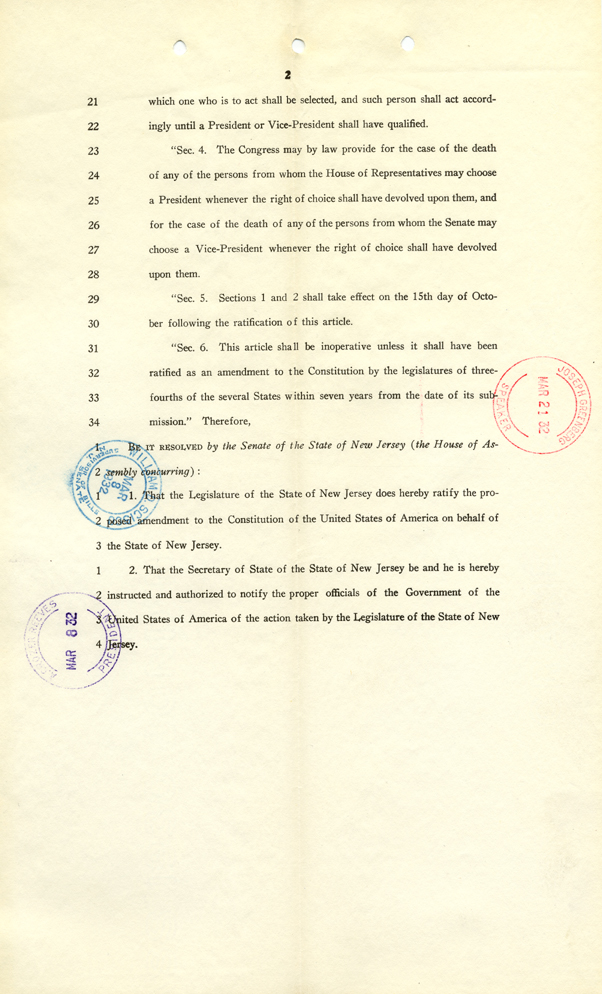
which one who is to act shall be selected, and such person shall act accordingly until a President or Vice-President shall have qualified.
"Sec. 4. The Congress may by law provide for the case of the death of any of the persons from whom the House of Representatives may choose a President whenever the right of choice shall have devolved upon them, and for the case of the death of any of the persons from whom the Senate may choose a Vice-President whenever the right of choice shall have devolved upon them.
"Sec. 5. Sections 1 and 2 shall take effect on the 15th day of October following the ratification of this article.
"Sec. 6. This article shall be inoperative unless it shall have been ratified as an amendment to the Constitution by the legislatures of three-fourths of the several States within seven years from the date of its submission.” Therefore,
BE IT RESOLVED by the Senate of the State of New Jersey (the House of Assembly concurring):
1. That the Legislature of the State of New Jersey does hereby ratify the proposed amendment to the Constitution of the United States of America on behalf of the State of New Jersey.
2. That the Secretary of State of the State of New Jersey be and he is hereby instructed and authorized to notify the proper officials of the Government of the United States of America of the action taken by the Legislature of the State of New Jersey.
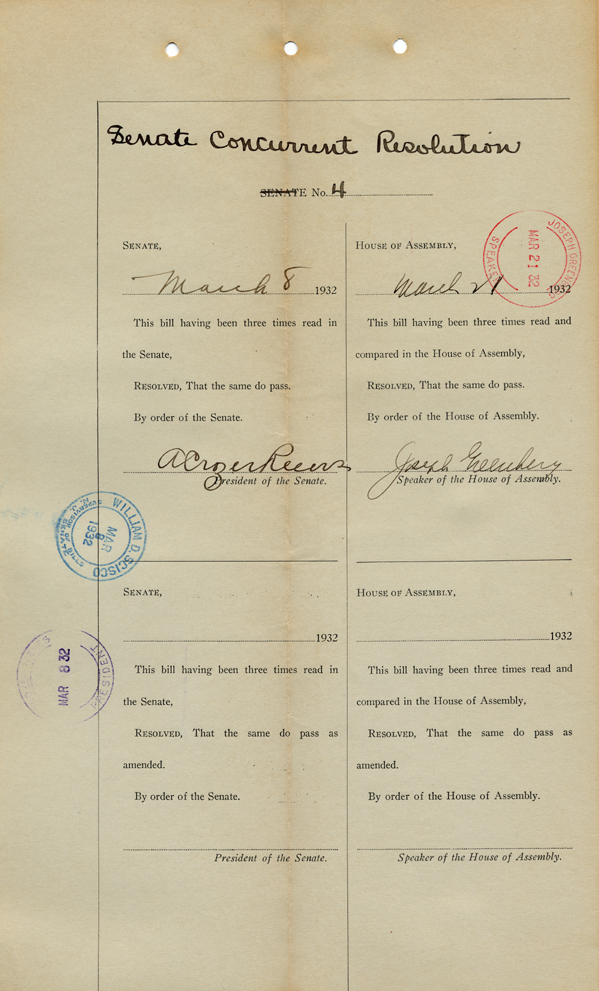
SENATE CONCURRENT RESOLUTION No. 4
SENATE,
March 8, 1932
This bill having been three times read in the Senate,
RESOLVED, That the same do pass.
By order of the Senate.
A. Crozer Reeves, President of the Senate
HOUSE OF ASSEMBLY,
March 21, 1932
This bill having been three times read and compared in the House of Assembly,
RESOLVED, That the same do pass.
By order of the House of Assembly.
Joseph Greenberg, Speaker of the House of Assembly
Section 1. The eighteenth article of amendment to the Constitution of the United States is hereby repealed.
Section 2. The transportation or importation into any State, Territory, or possession of the United States for delivery or use therein of intoxicating liquors, in violation of the laws thereof, is hereby prohibited.
Section 3. This article shall be inoperative unless it shall have been ratified as an amendment to the Constitution by conventions in the several States, as provided in the Constitution, within seven years from the date of the submission hereof to the States by the Congress.
Ratified by Required Number of States, 5 December 1933.
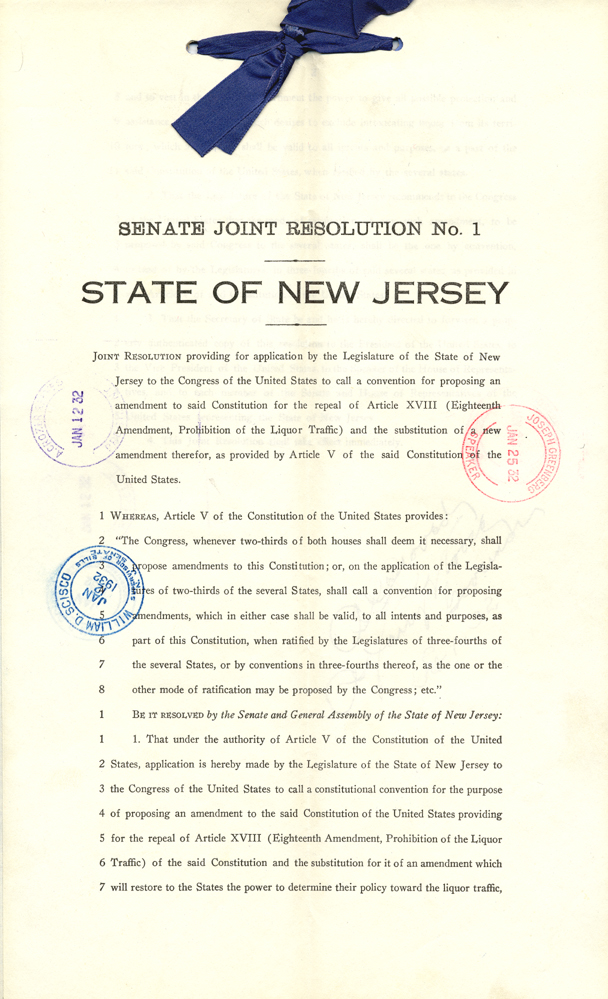
Senate Joint Resolution No. 1
State of New Jersey
JOINT RESOLUTION providing for application by the Legislature of the State of New Jersey to the Congress of the United States to call a convention for proposing an amendment to said Constitution for the repeal of Article XVIII (Eighteenth Amendment, Prohibition of the Liquor Traffic) and the substitution of a new amendment therefor, as provided by Article V of the said Constitution of the United States.
WHEREAS, Article V of the Constitution of the United States provides:
“The Congress, whenever two-thirds of both houses shall deem it necessary, shall propose amendments to this Constitution; or, on the application of the Legislatures of two-thirds of the several States, shall call a convention for proposing amendments, which in either case shall be valid, to all intents and purposes, as part of this Constitution, when ratified by the Legislatures of three-fourths of the several States, or by conventions in three-fourths thereof, as the one or the other mode of ratification may be proposed by the Congress; etc.”
BE IT RESOLVED by the Senate and General Assembly of the State of New Jersey:
1. That under the authority of Article V of the Constitution of the United States, application is hereby made by the Legislature of the State of New Jersey to the Congress of the United States to call a constitutional convention for the purpose of proposing an amendment to the said Constitution of the United States providing for the repeal of Article XVIII (Eighteenth Amendment, Prohibition of the Liquor Traffic) of the said Constitution and the substitution for it of an amendment which will restore to the States the power to determine their policy toward the liquor traffic,
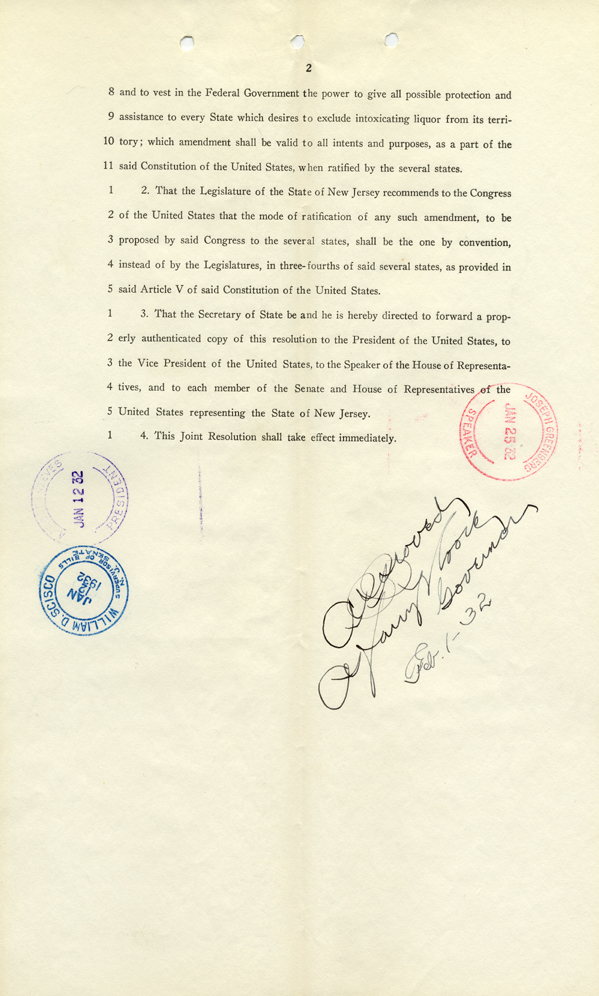
and to vest in the Federal Government the power to give all possible protection and assistance to every State which desires to exclude intoxicating liquor from its territory; which amendment shall be valid to all intents and purposes, as a part of the said Constitution of the United States, when ratified by the several states.
2. That the Legislature of the State of New Jersey recommends to the Congress of the United States that the mode of ratification of any such amendment, to be proposed by said Congress to the several states, shall be the one by convention, instead of by the Legislatures, in three-fourths of said several states, as provided in said Article V of said Constitution of the United States.
3. That the Secretary of State be and he is hereby directed to forward a properly authenticated copy of this resolution to the President of the United States, to the Vice President of the United States, to the Speaker of the House of Representatives, and to each member of the Senate and House of Representatives of the United States representing the State of New Jersey.
4. This Joint Resolution shall take effect immediately.
Approved /s/ A. Harry Moore
Governor
Feb. 1 [19]32
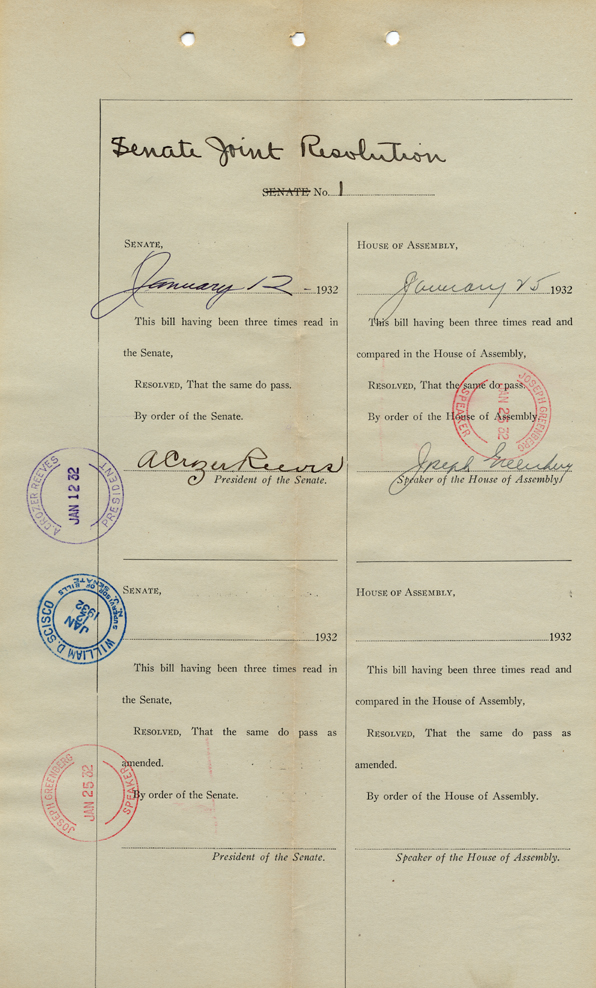
Senate Joint Resolution No. 1
SENATE,
January 12, 1932
This bill having been three times read in the
Senate,
RESOLVED, that the same do pass.
By order of the Senate.
/s/ A. Crozer Reeves,
President of the Senate
HOUSE OF ASSEMBLY,
January 25, 1932
This bill having been three times read and
compared in the House of Assembly,
RESOLVED, that the same do pass.
By order of the House of Assembly.
/s/ Joseph Greenberg,
Speaker of the House of Assembly
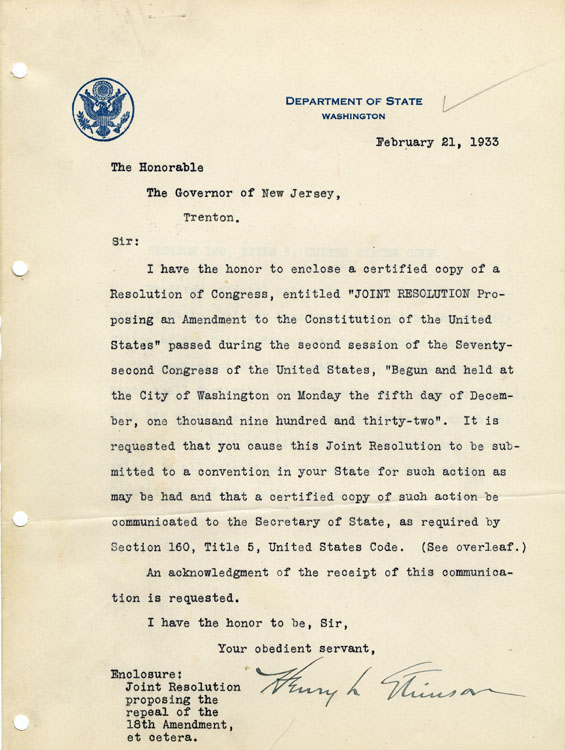
Department of State
Washington
February 21, 1933
The Honorable
The Governor of New Jersey,
Trenton,
Sir:
I have the honor to enclose a certified copy of a Resolution of Congress, entitled "JOINT RESOLUTION Proposing an Amendment to the Constitution of the United States" passed during the second session of the Seventy-second Congress of the United States, "Begun and held at the City of Washington on Monday the fifth day of December, one thousand nine hundred and thirty-two." it is requested that you cause this Joint Resolution to be submitted to a convention in your State for such action as may be had and that a certified copy of such action be communicated to the Secretary of State, as required by Section 160, Title 5, United States Code. (See overleaf.)
An acknowledgement of the receipt of this communication is requested.
I have the honor to be, Sir,
Your obedient servant,
Henry L. Stimson
Enclosure:
Joint Resolution proposing the repeal of the 18th Amendment, et cetera.
Section 160, Title 5, United States Code
Whenever official notice is received at the Department of State that any amendment proposed to the Constitution of the United States has been adopted, according to the provisions of the Constitution, the Secretary of State shall forthwith cause the amendment to be published, with his certificate, specifying the States by which the same may have been adopted, and that the same has become valid, to all intents and purposes, as a part of the Constitution of the United States.
No. 659
United States of America
Department of State
To all to whom these presents shall come, Greeting:
I certify that the copy hereto attached is a true copy of a Resolution of Congress entitled "JOINT RESOLUTION Proposing an Amendment to the Constitution of the United States" the original of which is on file in this Department.
In testimony whereof, I, Henry Stimson, Secretary of State, have hereunto caused the Seal of the Department of State to be affixed and my name subscribed by the Acting Chief Clerk of the said Department, at the City of Washington, in the District of Columbia, this 21st day of February, 1933.
Henry L. Stimson,
Secretary of State.
By P.F. Allen,
Acting Chief Clerk.
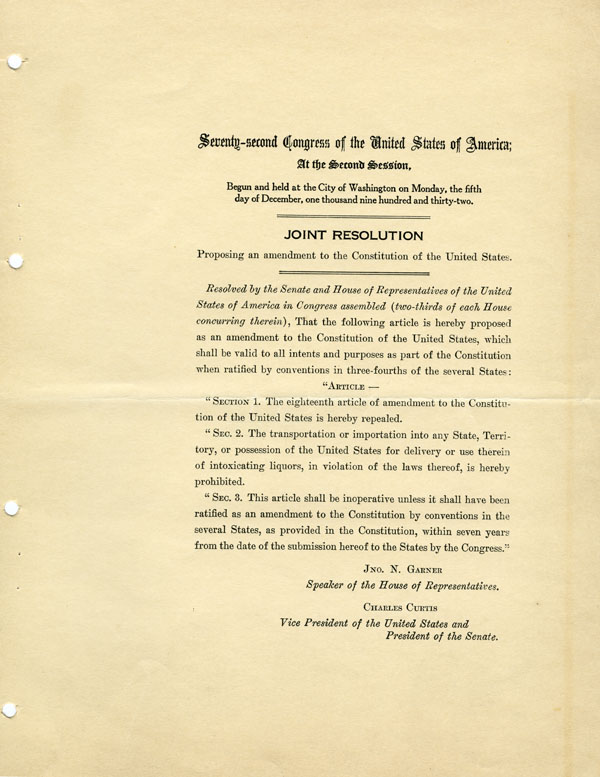
Seventy-second Congress of the United States of America;
At the Second Session,
Begun and held at the City of Washington on Monday, the fifth
day of December, one thousand nine hundred and thirty-two.
JOINT RESOLUTION
Proposing an amendment to the Constitution of the United States.
Resolved by the Senate and House of Representatives of the United States of America in Congress assembled (two-thirds of each House concurring therein), That the following article is hereby proposed as an amendment to the Constitution of the United States, which shall be valid to all intents and purposes as part of the Constitution when ratified by conventions in three-fourths of the several States:
"Article --
"Section 1. The eighteenth article of amendment to the Constitution of the United States is hereby repealed.
“Sec. 2. The transportation or importation into any State, Territory, or possession of the United States for delivery or use therein of intoxicating liquors, in violation of the laws thereof, is hereby prohibited.
"Sec. 3. This article shall be inoperative unless it shall have been ratified as an amendment to the Constitution by conventions in the several States, as provided in the Constitution, within seven years from the date of the submission hereof to the States by the Congress."
Jno. N. Garner
Speaker of the House of Representatives.
Charles Curtis
Vice President of the United States and President of the Senate.
I certify that this Join Resolution originated in the Senate.
Edwin P. Thayer
Secretary.
February 23, 1933
Ref HA.
Sir:
Acknowledgement is hereby made of the receipt of your letter of February 21st, enclosing a certified copy of a Resolution of Congress, entitled "JOINT RESOLUTION Proposing an Amendment to the Constitution of the United States" passed during the second session of the Seventy-second Congress of the United States, "Begun and held at the City of Washington on Monday the fifth day of December, one thousand nine hundred and thirty two."
Very truly yours,
Governor.
The Honorable
The Secretary of State,
Washington, D.C.
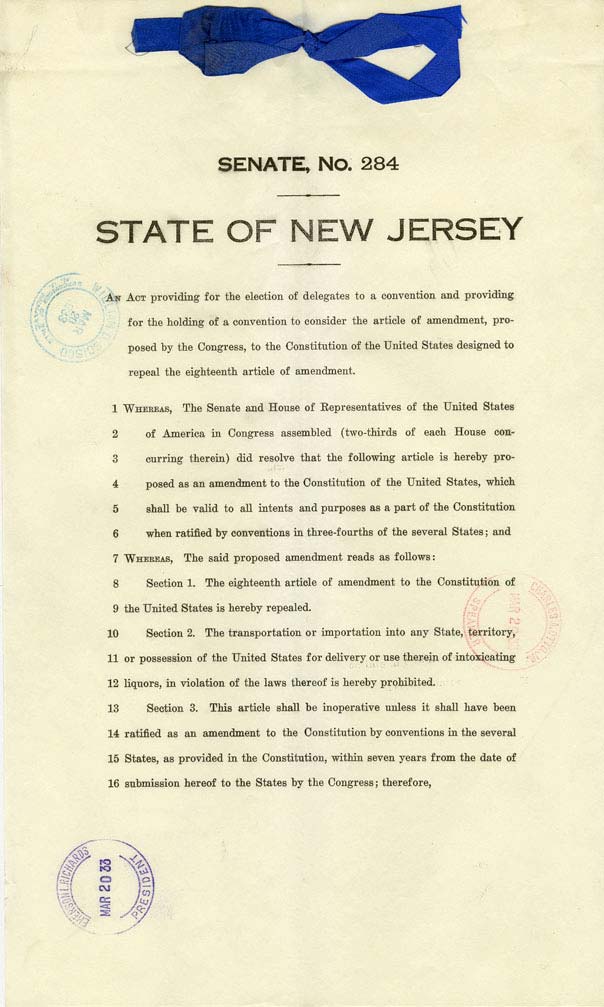
Senate, No. 284
STATE OF NEW JERSEY
An Act providing for the election of delegates to a convention and providing for the holding of a convention to consider the article of amendment, proposed by the Congress, to the Constitution of the United States designed to repeal the eighteenth article of amendment.
Whereas, The Senate and House of Representatives of the United States of America in Congress assembled (two‐thirds of each House concurring therein) did resolved that the following article is hereby proposed as an amendment to the Constitution of the United States, which shall be valid to all intents and purposes as a part of the Constitution when ratified by conventions in three‐fourths of the several States; and
Whereas, The said proposed amendment reads as follows:
Section 1. The eighteenth article of amendment to the Constitution of the United States is hereby repealed.
Section 2. The transportation or importation into any State, territory, or possession of the United States for delivery or use therein of intoxicating liquors, in violation of the laws thereof is hereby prohibited.
Section 3. This article shall be inoperative unless it shall have been ratified as an amendment to the Constitution by conventions in the several States, as provided in the Constitution, within seven years from the date of submission hereof to the States by the Congress; therefore,
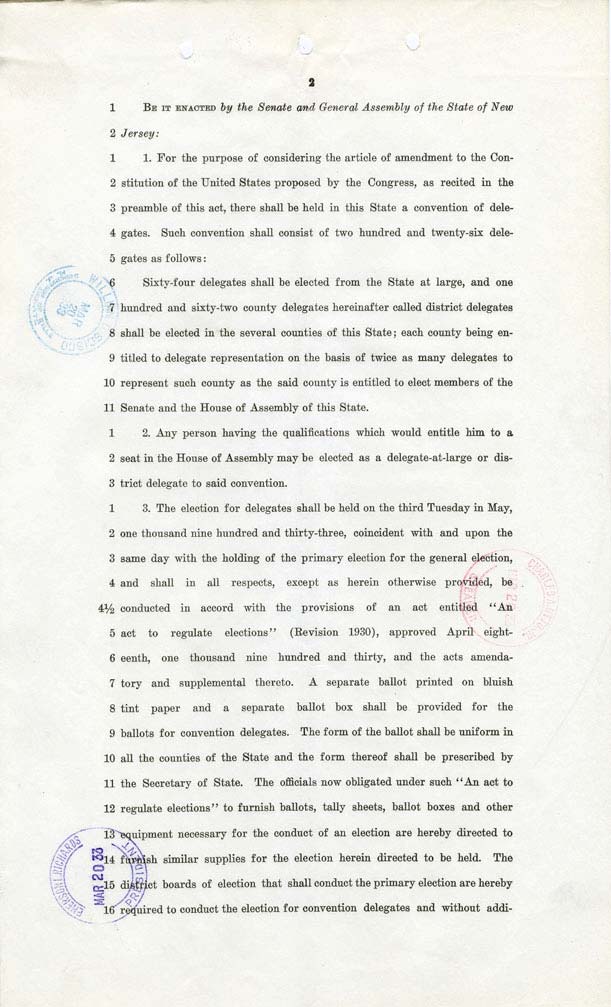
Be it enacted by the Senate and General Assembly of the State of New Jersey:
1. For the purpose of considering the article of amendment to the Constitution of the United States proposed by the Congress, as recited in the preamble of this act, there shall be held in this State a convention of delegates. Such convention shall consist of two hundred and twenty‐six delegates as follows:
Sixty‐four delegates shall be elected from the State at large, and one hundred and sixty‐two county delegates hereinafter called district delegates shall be elected in the several counties of this State; each county being entitled to delegate representation on the basis of twice as many delegates to represent such county as the said county is entitled to elect members of the Senate and the House of Assembly of this State.
2. Any person having the qualifications which would entitle him to a seat in the House of Assembly may be elected as a delegate‐at‐large or district delegate to said convention.
3. The election for delegates shall be held on the third Tuesday in May, one thousand nine hundred and thirty‐three, coincident with and upon the same day with the holding of the primary election for the general election, and shall in all respects, except as herein otherwise provided, be conducted in accord with the provision of an act entitled "An act to regulate elections" (Revision 1930), approved April eighteenth, on thousand nine hundred and thirty, and the acts amendatory and supplemental thereto. A separate ballot printed on bluish tint paper and a separate ballot box shall be
provided for the ballots for convention delegates. The form of the ballot shall be uniform in all the counties of the State and the form thereof shall be prescribed by the Secretary of State. The officials now obligated under such "An act to regulate elections" to furnish ballots, tally sheets, ballot boxes and other equipment necessary for the conduct of an election are hereby directed to furnish similar supplies for the election herein directed to be held. The district boards of election that shall conduct the primary election are hereby required to conduct the election for convention delegates and without addi‐
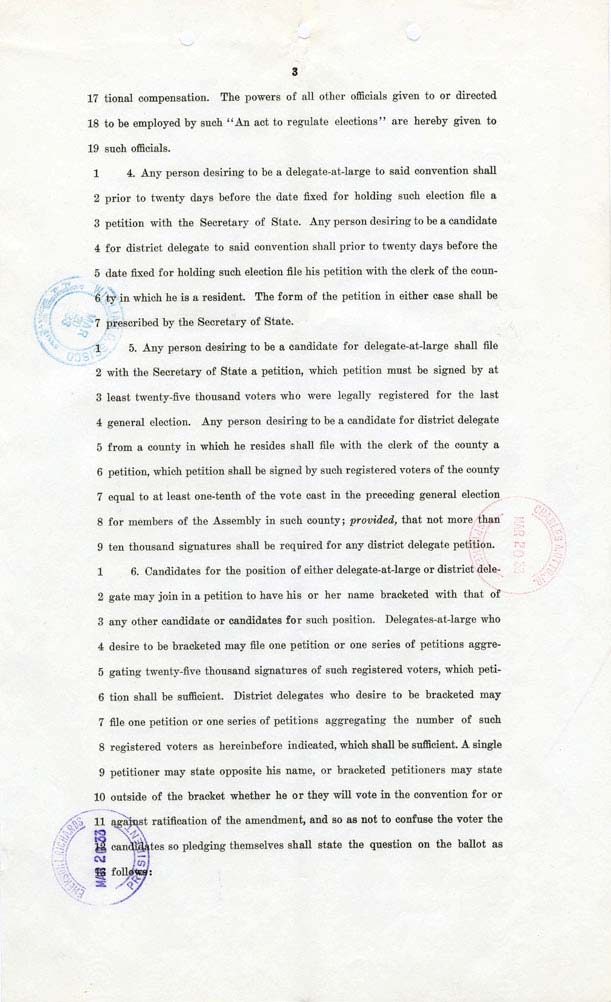
tional compensation. The powers of all other officials given to or directed to be employed by such "An act to regulate elections" are hereby given to such officials.
4. Any person desiring to be a delegate‐at‐large to said convention shall prior to twenty days before the date fixed for holding such election file a petition with the Secretary of State. Any person desiring to be a candidate for district delegate to said convention shall prior to twenty days before the date fixed for holding such election file his petition with the clerk of the county in which he is a resident. The form of the petition in either case shall be prescribed by the Secretary of State.
5. Any person desiring to be a candidate for delegate‐at‐large shall file with the Secretary of State a petition, which petition must be signed by at least twenty‐five thousand voters who were legally registered for the last general election. Any person desiring to be a candidate for district delegate from a county in which he resides shall file with the clerk of the county a petition, which petition shall be signed by such registered voters of the county equal to at least one‐tenth of the vote cast in the preceding general election for members of the Assembly in such county; provided, that not more than ten thousand signatures shall be required for any district delegate petition.
6. Candidates for the position of either delegate‐at‐large or district delegate may join in a petition to have his or her name bracketed with that of any other candidate or candidates for such position. Delegates‐at‐large who desire to be bracketed may file one petition or one series of petitions aggregating twenty‐five thousand signatures of such registered voters, which petition shall be sufficient. District delegates who desire to be bracketed may file one petition or one series of petitions aggregating the number of such registered voters as hereinbefore indicated, which shall be sufficient. A single petitioner may state opposite his name, or bracketed petitioners may state outside of the bracket whether he or they will vote in the convention for or against ratification of the amendment, and so as not to confuse the voter the candidates so pledging themselves shall state the question on the ballot as follows:
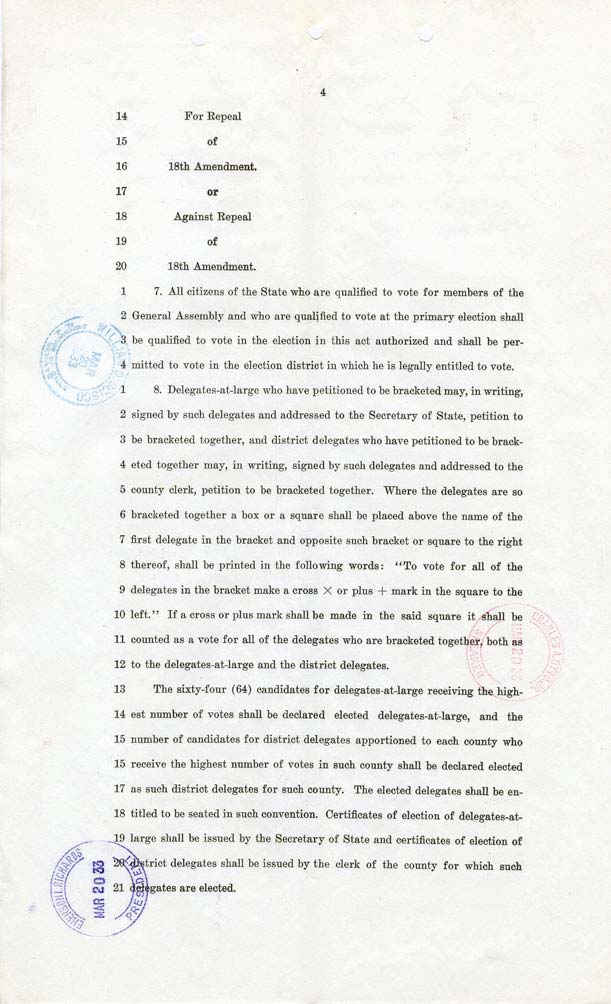
For Repeal of
18th Amendment.
or
Against Repeal
of
18th Amendment.
7. All citizens of the State who are qualified to vote for members of the General Assembly and who are qualified to vote at the primary election shall be qualified to vote in the election in this act authorized and shall be permitted to vote in the election district in which he is legally entitled to vote.
8. Delegates‐at‐large who have petitioned to be bracketed may, in writing, signed by such delegates and addressed to the Secretary of State, petition to be bracketed together, and district delegates who have petitioned to be bracketed together may, in writing, signed by such delegates and addressed to the county clerk, petition to be bracketed together. Where the delegates are so bracketed together a box or a square shall be placed above the name of the first delegate in the bracket and opposite such bracket or square to the right thereof, shall be printed in the following words: “To vote for all of the delegates in the bracket make a cross X or plus + mark in the square to the left.” If a cross or plus mark shall be made in the said square it shall be counted a vote for all of the delegates who are bracketed together, both as to the delegates‐at‐large and the district delegates.
The sixty‐four (64) candidates for delegates‐at‐large receiving the highest number of votes shall be declared elected delegates‐at‐large, and the number of candidates for district delegates apportioned to each county who receive the highest number of votes in such county shall be declared elected as such district delegates for such county. The elected delegates shall be entitled to be seated in such convention. Certificates of election of delegates‐at‐large shall be issued by the Secretary of State and certificates of election of district delegates shall be issued by the clerk of the county for which such delegates are elected.
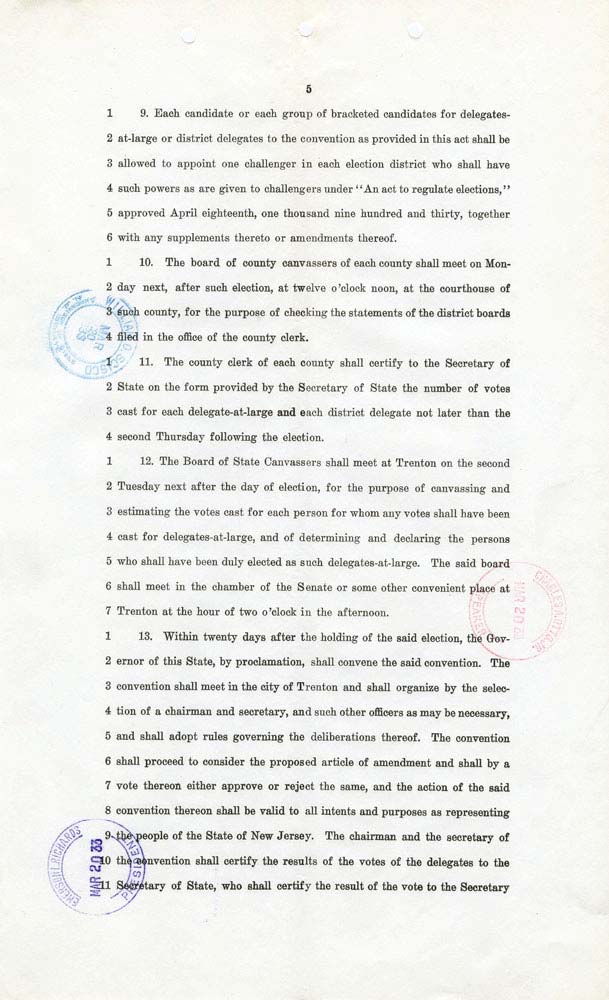
9. Each candidate or each group of bracketed candidates for delegates‐at‐large or district delegates to the convention as provided in this act shall be allowed to appoint one challenger in each election district who shall have such powers as are given to challengers under “An act to regulate elections,” approved April eighteenth, one thousand nine hundred and thirty, together with any supplements thereto or amendments thereof.
10. The board of county canvassers of each county shall meet on Monday next, after such election, at twelve o’clock noon, at the courthouse of such county, for the purpose of checking the statements of the district boards filed in the office of the county clerk.
11. The county clerk of each county shall certify to the Secretary of State on the form provided by the Secretary of State the number of votes cast for each delegate‐at‐large and each district delegate not later than the second Thursday following the election.
12. The Board of State Canvassers shall meet at Trenton on the second Tuesday next after the day of election, for the purpose of canvassing and estimating the votes cast for each person for whom any votes shall have been cast for delegates‐at‐large, and of determining and declaring the persons who shall have been duly elected as such delegates‐at‐large. The said board shall meet in the chamber of the Senate or some other convenient place at Trenton at the hour of two o’clock in the afternoon.
13. Within twenty days after the holding of the said election, the Governor of this State, by proclamation, shall convene the said convention. The convention shall meet in the city of Trenton and shall organize by the selection of a chairman and secretary, and such other officers as may be necessary, and shall adopt rules governing the deliberations thereof. The convention shall proceed to consider the proposed article of amendment and shall by a vote thereon either approve or reject the same, and the action for the said convention thereon either approve or reject the same, and the action of the said convention thereon shall be valid to all intents and purposed as representing the people of the State of New Jersey. The chairman and the secretary of the convention shall certify the results of the votes of the delegates to the Secretary of State, who shall certify the result of the vote to the Secretary
of State of the United States and to the Senate and the House of Representatives of the United States.
14. This act shall take effect immediately. Approved March 23, 1933
A. Harry Moore Governor
Senate No. 284
Senate,
March 20th 1933
This bill having been three times read in the Senate,
Resolved, That the same do pass. By order of the Senate.
/s/Emerson L. Richards,
President of the Senate.
House of Assembly,
March 20, 1933
This bill having been three times read and compared in the House of Assembly,
Resolved, That the same do pass.
By order of the House of the Assembly.
/s/Charles A. Otto, Jr.
Speaker of the House of Assembly.
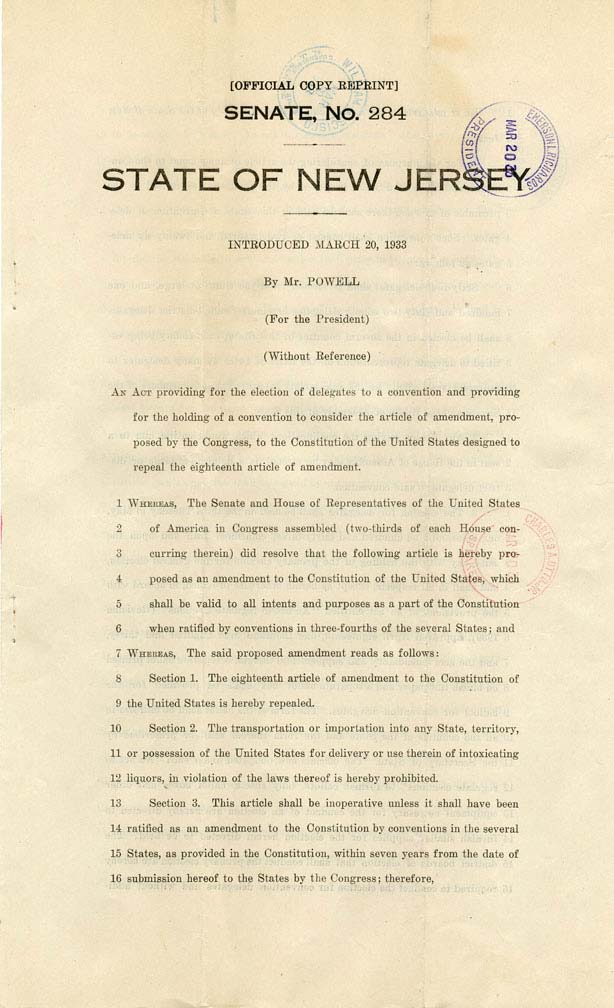
[Official Copy Reprint]
Senate, No. 284
STATE OF NEW JERSEY
Introduced March 20, 1933
By Mr. Powell
(For the President)
(Without Reference)
An Act providing for the election of delegates to a convention and providing for the holding of a convention to consider the article of amendment, proposed by the Congress, to the Constitution of the United States designed to repeal the eighteenth article of amendment.
Whereas, The Senate and House of Representatives of the United States of America in Congress assembled (two‐thirds of each House concurring therein) did resolved that the following article is hereby proposed as an amendment to the Constitution of the United States, which shall be valid to all intents and purposes as a part of the Constitution when ratified by conventions in three‐fourths of the several States; and
Whereas, The said proposed amendment reads as follows:
Section 1. The eighteenth article of amendment to the Constitution of the United States is hereby repealed.
Section 2. The transportation or importation into any State, territory, or possession of the United States for delivery or use therein of intoxicating liquors, in violation of the laws thereof is hereby prohibited.
Section 3. This article shall be inoperative unless it shall have been ratified as an amendment to the Constitution by conventions in the several States, as provided in the Constitution, within seven years from the date of submission hereof to the States by the Congress; therefore,
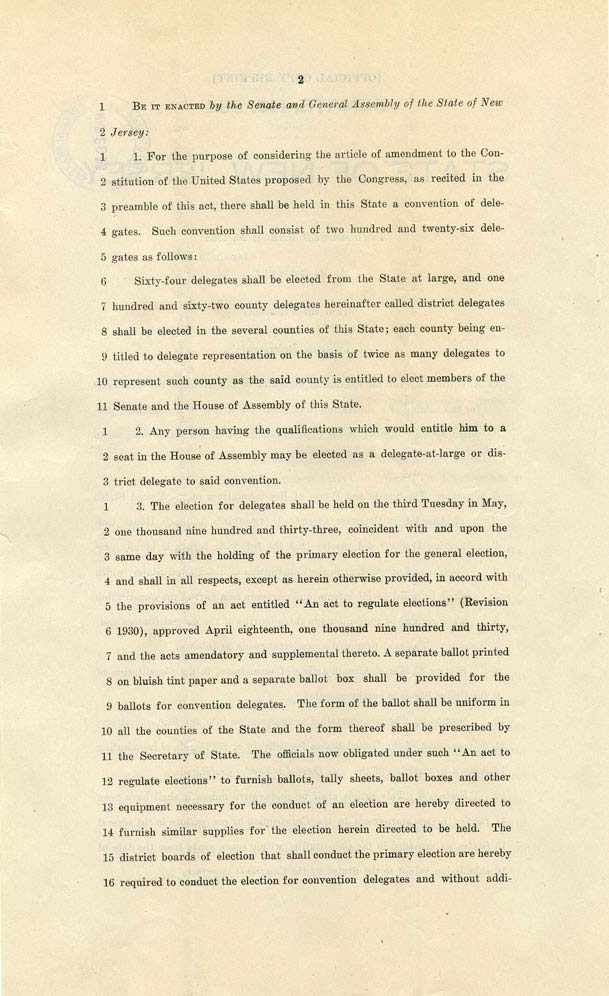
Be it enacted by the Senate and General Assembly of the State of New Jersey:
1. For the purpose of considering the article of amendment to the Constitution of the United States proposed by the Congress, as recited in the preamble of this act, there shall be held in this State a convention of delegates. Such convention shall consist of two hundred and twenty‐six delegates as follows:
Sixty‐four delegates shall be elected from the State at large, and one hundred and sixty‐two county delegates hereinafter called district delegates shall be elected in the several counties of this State; each county being entitled to delegate representation on the basis of twice as many delegates to represent such county as the said county is entitled to elect members of the Senate and the House of Assembly of this State.
2. Any person having the qualifications which would entitle him to a seat in the House of Assembly may be elected as a delegate‐at‐large or district delegate to said convention.
3. The election for delegates shall be held on the third Tuesday in May, one thousand nine hundred and thirty‐three, coincident with and upon the same day with the holding of the primary election for the general election, and shall in all respects, except as herein otherwise provided, in accord with the provision of an act entitled "An act to regulate elections" (Revision 1930), approved April eighteenth, on thousand nine hundred and thirty, and the acts amendatory and supplemental thereto. A separate ballot printed on bluish tint paper and a separate ballot box shall be provided for the ballots for convention delegates. The form of the ballot shall be uniform in all the counties of the State and the form thereof shall be prescribed by the Secretary of State. The officials now obligated under such "An act to regulate elections" to furnish ballots, tally sheets, ballot boxes and other equipment necessary for the conduct of an election are hereby directed to furnish similar supplies for the election herein directed to be held. The district boards of election that shall conduct the primary election are hereby required to conduct the election for convention delegates and without addi‐
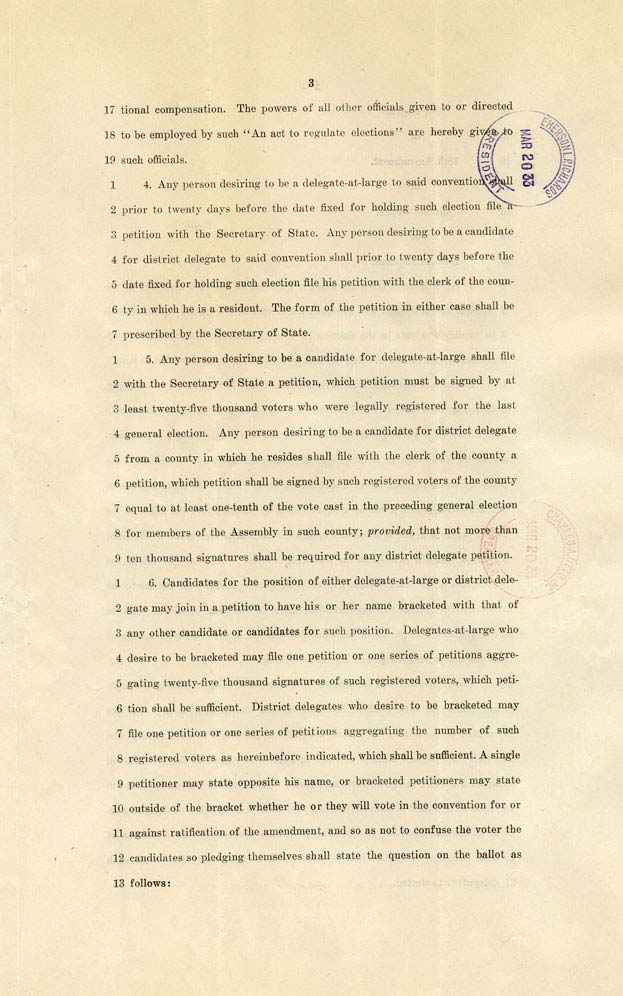
tional compensation. The powers of all other officials given to or directed to be employed by such "An act to regulate elections" are hereby given to such officials.
4. Any person desiring to be a delegate‐at‐large to said convention shall prior to twenty days before the date fixed for holding such election file a petition with the Secretary of State. Any person desiring to be a candidate for district delegate to said convention shall prior to twenty days before the date fixed for holding such election file his petition with the clerk of the county in which he is a resident. The form of the petition in either case shall be prescribed by the Secretary of State.
5. Any person desiring to be a candidate for delegate‐at‐large shall file with the Secretary of State a petition, which petition must be signed by at least twenty‐five thousand voters who were legally registered for the last general election. Any person desiring to be a candidate for district delegate from a county in which he resides shall file with the clerk of the county a petition, which petition shall be signed by such registered voters of the county equal to at least one‐tenth of the vote case in the preceding general election for members of the Assembly in such county; provided, that not more than ten thousand signatures shall be required for any district delegate petition.
6. Candidates for the position of either delegate‐at‐large or district delegate may join in a petition to have his or her name bracketed with that of any other candidate or candidates for such position. Delegates‐at‐large who desire to be bracketed may file one petition or one series of petitions aggregating twenty‐five thousand signatures of such registered voters, which petition shall be sufficient. District delegates who desire to be bracketed may file one petition or one series of petitions aggregating the number of such registered voters as hereinbefore indicated, which shall be sufficient. A single petitioner may state opposite his name, or bracketed petitioners may state outside of the bracket whether he or they will vote in the convention for or against ratification of the amendment, and so as not to confuse the voter the candidates so pledging themselves shall state the question on the ballot as follows:
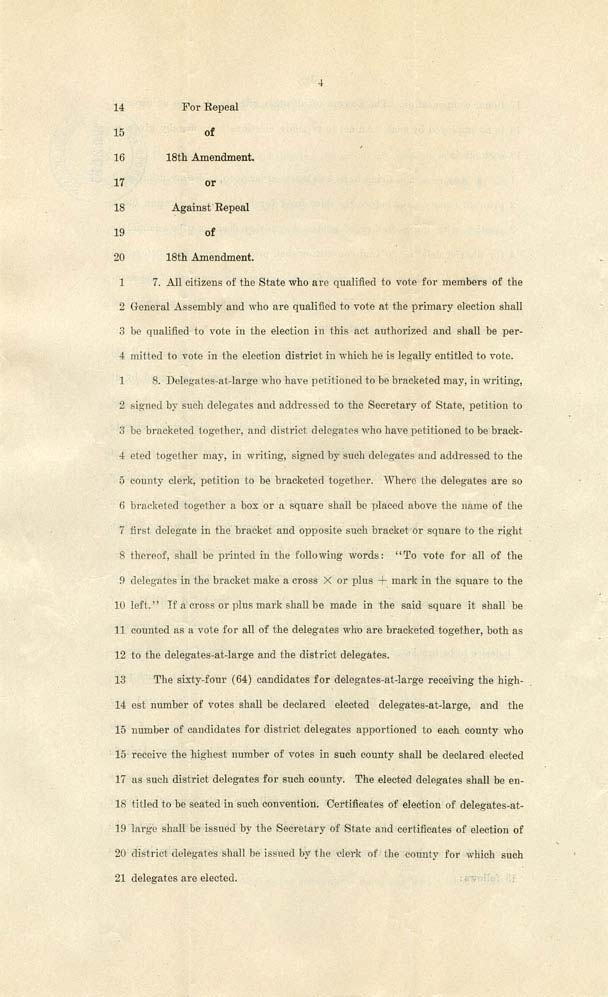
For Repeal
of
18th Amendment.
or
Against Repeal
of
18th Amendment.
7. All citizens of the State who are qualified to vote for members of the General Assembly and who are qualified to vote at the primary election shall be qualified to vote in the election in this act authorized and shall be permitted to vote in the election district in which he is legally entitled to vote.
8. Delegates‐at‐large who have petitioned to be bracketed may, in writing, signed by such delegates and addressed to the Secretary of State, petition to be bracketed together, and district delegates who have petitioned to be bracketed together may, in writing, signed by such delegates and addressed to the county clerk, petition to be bracketed together. Where the delegates are so bracketed together a box or a square shall be placed above the name of the first delegate in the bracket and opposite such bracket or square to the right thereof, shall be printed in the following words: “To vote for all of the delegates in the bracket make a cross X or plus + mark in the square to the left.” If a cross or plus mark shall be made in the said square it shall be counted a vote for all of the delegates who are bracketed together, both as to the delegates‐at‐large and the district delegates.
The sixty‐four (64) candidates for delegates‐at‐large receiving the highest number of votes shall be declared elected delegates‐at‐large, and the number of candidates for district delegates apportioned to each county who receive the highest number of votes in such county shall be declared elected as such district delegates for such county. The elected delegates shall be entitled to be seated in such convention. Certificates of election of delegates‐at‐large shall be issued by the Secretary of State and certificates of election of district delegates shall be issued by the clerk of the county for which such delegates are elected.
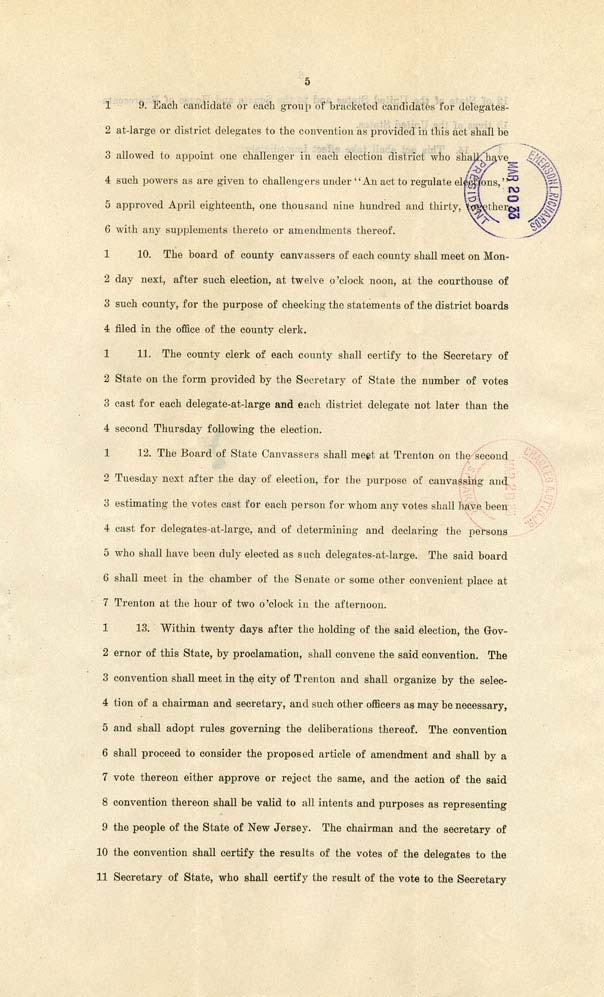
9. Each candidate or each group of bracketed candidates for delegates‐at‐large or district delegates to the convention as provided in this act shall be allowed to appoint one challenger in each election district who shall have such powers as are given to challengers under “An act to regulate elections,” approved April eighteenth, one thousand nine hundred and thirty, together with any supplements thereto or amendments thereof.
10. The board of county canvassers of each county shall meet on Monday next, after such election, at twelve o’clock noon, at the courthouse of such county, for the purpose of checking the statements of the district boards filed in the office of the county clerk.
11. The county clerk of each county shall certify to the Secretary of State on the form provided by the Secretary of State the number of votes cast for each delegate‐at‐large and each district delegate not later than the second Thursday following the election.
12. The Board of State Canvassers shall meet at Trenton on the second Tuesday next after the day of election, for the purpose of canvassing and estimating the votes cast for each person for whom any votes shall have been cast for delegates‐at‐large, and of determining and declaring the persons who shall have been duly elected as such delegates‐at‐large. The said board shall meet in the chamber of the Senate or some other convenient place at Trenton at the hour of two o’clock in the afternoon.
13. Within twenty days after the holding of the said election, the Governor of this State, by proclamation, shall convene the said convention. The convention shall meet in the city of Trenton and shall organize by the selection of a chairman and secretary, and such other officers as may be necessary, and shall adopt rules governing the deliberations thereof. The convention shall proceed to consider the proposed article of amendment and shall by a vote thereon either approve or reject the same, and the action for the said convention thereon either approve or reject the same, and the action of the said convention thereon shall be valid to all intents and purposed as representing the people of the State of New Jersey. The chairman and the secretary of the convention shall certify the results of the votes of the delegates to the Secretary of State, who shall certify the result of the vote to the Secretary
of State of the United States and to the Senate and the House of Representatives of the United States.
14. This act shall take effect immediately.
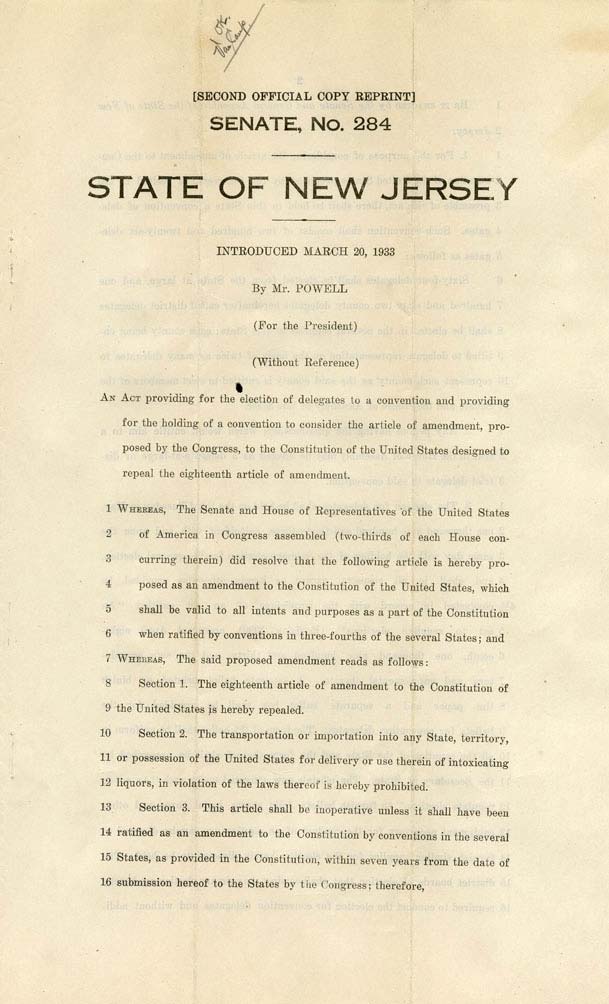
[Second Official Copy Reprint]
Senate, No. 284
STATE OF NEW JERSEY
Introduced March 20, 1933
By Mr. Powell
(For the President)
(Without Reference)
An Act providing for the election of delegates to a convention and providing for the holding of a convention to consider the article of amendment, proposed by the Congress, to the Constitution of the United States designed to repeal the eighteenth article of amendment.
Whereas, The Senate and House of Representatives of the United States of America in Congress assembled (two‐thirds of each House concurring therein) did resolved that the following article is hereby proposed as an amendment to the Constitution of the United States, which shall be valid to all intents and purposes as a part of the Constitution when ratified by conventions in three‐fourths of the several States; and
Whereas, The said proposed amendment reads as follows:
Section 1. The eighteenth article of amendment to the Constitution of the United States is hereby repealed.
Section 2. The transportation or importation into any State, territory, or possession of the United States for delivery or use therein of intoxicating liquors, in violation of the laws thereof is hereby prohibited.
Section 3. This article shall be inoperative unless it shall have been ratified as an amendment to the Constitution by conventions in the several States, as provided in the Constitution, within seven years from the date of submission hereof to the States by the Congress; therefore,
Be it enacted by the Senate and General Assembly of the State of New Jersey:
1. For the purpose of considering the article of amendment to the Constitution of the United States proposed by the Congress, as recited in the preamble of this act, there shall be held in this State a convention of delegates. Such convention shall consist of two hundred and twenty‐six delegates as follows:
Sixty‐four delegates shall be elected from the State at large, and one hundred and sixty‐two county delegates hereinafter called district delegates shall be elected in the several counties of this State; each county being entitled to delegate representation on the basis of twice as many delegates to represent such county as the said county is entitled to elect members of the Senate and the House of Assembly of this State.
2. Any person having the qualifications which would entitle him to a seat in the House of Assembly may be elected as a delegate‐at‐large or district delegate to said convention.
3. The election for delegates shall be held on the third Tuesday in May, one thousand nine hundred and thirty‐three, coincident with and upon the same day with the holding of the primary election for the general election, and shall in all respects, except as herein otherwise provided, in accord with the provision of an act entitled "An act to regulate elections" (Revision 1930), approved April eighteenth, on thousand nine hundred and thirty, and the acts amendatory and supplemental thereto. A separate ballot printed on bluish tint paper and a separate ballot box shall be provided for the ballots for convention delegates. The form of the ballot shall be uniform in all the counties of the State and the form thereof shall be prescribed by the Secretary of State. The officials now obligated under such "An act to regulate elections" to furnish ballots, tally sheets, ballot boxes and other equipment necessary for
the conduct of an election are hereby directed to furnish similar supplies for the election herein directed to be held. The district boards of election that shall conduct the primary election are hereby required to conduct the election for convention delegates and without addi‐
tional compensation. The powers of all other officials given to or directed to be employed by such "An act to regulate elections" are hereby given to such officials.
4. Any person desiring to be a delegate‐at‐large to said convention shall prior to twenty days before the date fixed for holding such election file a petition with the Secretary of State. Any person desiring to be a candidate for district delegate to said convention shall prior to twenty days before the date fixed for holding such election file his petition with the clerk of the county in which he is a resident. The form of the petition in either case shall be prescribed by the Secretary of State.
5. Any person desiring to be a candidate for delegate‐at‐large shall file with the Secretary of State a petition, which petition must be signed by at least twenty‐five thousand voters who were legally registered for the last general election. Any person desiring to be a candidate for district delegate from a county in which he resides shall file with the clerk of the county a petition, which petition shall be signed by such registered voters of the county equal to at least one‐tenth of the vote case in the preceding general election for members of the Assembly in such county; provided, that not more than ten thousand signatures shall be required for any district delegate petition.
6. Candidates for the position of either delegate‐at‐large or district delegate may join in a petition to have his or her name bracketed with that of any other candidate or candidates for such position. Delegates‐at‐large who desire to be bracketed may file one petition or one series of petitions aggregating twenty‐five thousand signatures of such registered voters, which petition shall be sufficient. District delegates who desire to be bracketed may file one petition or one series of petitions aggregating the number of such registered voters as hereinbefore indicated, which shall be sufficient. A single petitioner may state opposite his name, or bracketed petitioners may state outside of the bracket whether he or they will vote in the convention for or against ratification of the amendment, and so as not to confuse the voter the candidates so pledging themselves shall state the question on the ballot as follows:
For Repeal
of
18th Amendment.
or
Against Repeal
of
18th Amendment.
7. All citizens of the State who are qualified to vote for members of the General Assembly and who are qualified to vote at the primary election shall be qualified to vote in the election in this act authorized and shall be permitted to vote in the election district in which he is legally entitled to vote.
8. Delegates‐at‐large who have petitioned to be bracketed may, in writing, signed by such delegates and addressed to the Secretary of State, petition to be bracketed together, and district delegates who have petitioned to be bracketed together may, in writing, signed by such delegates and addressed to the county clerk, petition to be bracketed together. Where the delegates are so bracketed together a box or a square shall be placed above the name of the first delegate in the bracket and opposite such bracket or square to the right thereof, shall be printed in the following words: “To vote for all of the delegates in the bracket make a cross X or plus + mark in the square to the left.” If a cross or plus mark shall be made in the said square it shall be counted a vote for all of the delegates who are bracketed together, both as to the delegates‐at‐large and the district delegates.
The sixty‐four (64) candidates for delegates‐at‐large receiving the highest number of votes shall be declared elected delegates‐at‐large, and the number of candidates for district delegates apportioned to each county who receive the highest number of votes in such county shall be declared elected as such district delegates for such county. The elected delegates shall be entitled to be seated in such convention. Certificates of election of delegates‐at‐large shall be issued by the Secretary of State and certificates of election of district delegates shall be issued by the clerk of the county for which such delegates are elected.
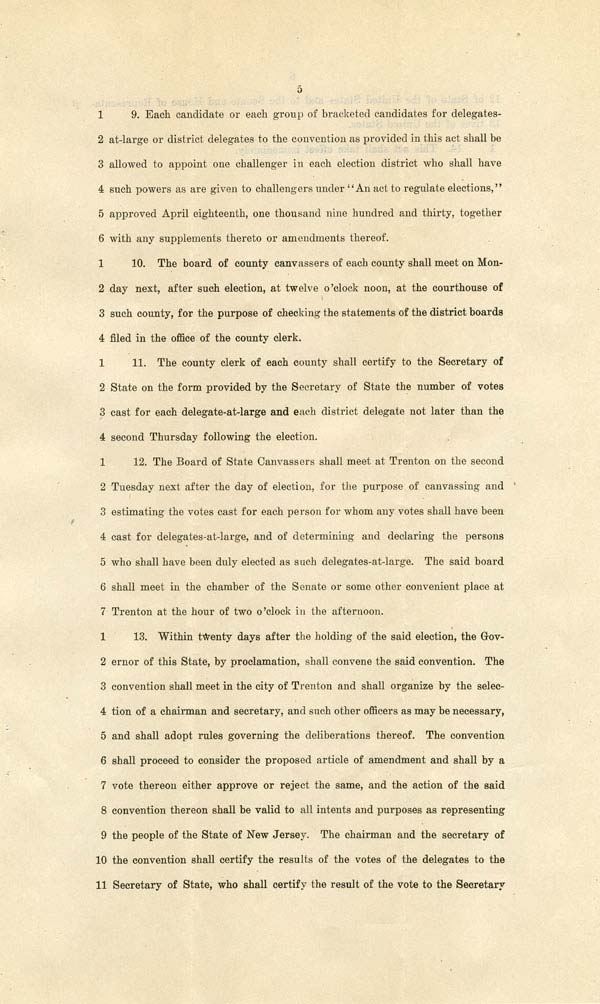
9. Each candidate or each group of bracketed candidates for delegates‐at‐large or district delegates to the convention as provided in this act shall be allowed to appoint one challenger in each election district who shall have such powers as are given to challengers under “An act to regulate elections,” approved April eighteenth, one thousand nine hundred and thirty, together with any supplements thereto or amendments thereof.
10. The board of county canvassers of each county shall meet on Monday next, after such election, at twelve o’clock noon, at the courthouse of such county, for the purpose of checking the statements of the district boards filed in the office of the county clerk.
11. The county clerk of each county shall certify to the Secretary of State on the form provided by the Secretary of State the number of votes cast for each delegate‐at‐large and each district delegate not later than the second Thursday following the election.
12. The Board of State Canvassers shall meet at Trenton on the second Tuesday next after the day of election, for the purpose of canvassing and estimating the votes cast for each person for whom any votes shall have been cast for delegates‐at‐large, and of determining and declaring the persons who shall have been duly elected as such delegates‐at‐large. The said board shall meet in the chamber of the Senate or some other convenient place at Trenton at the hour of two o’clock in the afternoon.
13. Within twenty days after the holding of the said election, the Governor of this State, by proclamation, shall convene the said convention. The convention shall meet in the city of Trenton and shall organize by the selection of a chairman and secretary, and such other officers as may be necessary, and shall adopt rules governing the deliberations thereof. The convention shall proceed to consider the proposed article of amendment and shall by a vote thereon either approve or reject the same, and the action for the said convention thereon either approve or reject the same, and the action of the said convention thereon shall be valid to all intents and purposed as representing the people of the State of New Jersey. The chairman and the secretary of the convention shall certify the results of the votes of the delegates to the Secretary of State, who shall certify the result of the vote to the Secretary
of State of the United States and to the Senate and the House of Representatives of the United States.
14. This act shall take effect immediately.
Chapter 73
Senate, No. 284
As Act providing for the election of delegates to a convention and providing for the holding of a convention to consider the article of amendment, proposed by the Congress, to the Constitution of the United States designed to repeal ht eighteenth amendment.
Filed March 2, 1933
Thomas A. Mathis, Secretary of State
I certify that this bill originated in the Senate
/s/ Oliver F. Van Camp
Secretary of the Senate
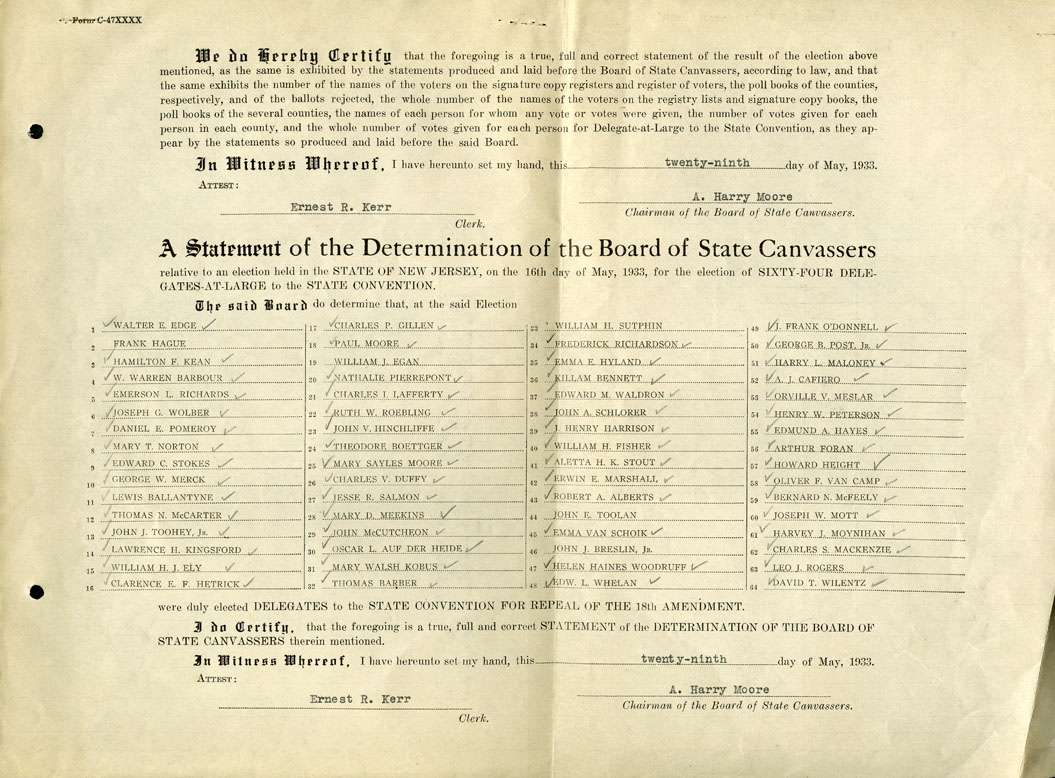
We do hereby Certify that the foregoing is a true, full and correct statement of the result of the election above mentioned, as the same is exhibited by the statements produced and laid before the Board of State Canvassers, according to law, and that the same exhibits the number of the names of the voters on the signature copy registers and register of voters, the poll books of the counties, respectively, and of the ballots rejected, the whole number of the names of the voters on the registry lists and signature copy books, the poll books of the several counties, the names of each person for whom any vote or votes were given, the number of votes given for each person in each county, and the whole number of votes given for each person for Delegate‐at-Large to the State Convention, as they appear by the statements so produced and laid before the said Board.
In Witness Whereof, I have hereunto set my hand, this twenty‐ninth day of May, 1933.
Attest:
Ernest R. Kerr
Clerk
A. Harry Moore
Chairman of the Board of State Canvassers.
A Statement of the Determination of the Board of State Canvassers relative to an election held in the STATE OF NEW JERSEY, on the 16th day of May, 1933, for the election of SIXTY‐FOUR DELEGATES‐AT‐LARGE to the STATE CONVENTION.
The said Board do determine that, at the said Election
1 Walter E. Edge
2 Frank Hague
3 Hamilton F. Kean
4 W. Warren Barbour
5 Emerson L. Richards
6 Joseph G. Wolber
7 Daniel E. Pomeroy
8 Mary T. Norton
9 Edward C. Stokes
10 George W. Merck
11 Lewis Ballantyne
12 Thomas N. McCarter
13 John J. Toohey, Jr.
14 Lawrence H. Kingsford
15 William H.J. Ely
16 Clarence E.F. Hetrick
17 Charles P. Gillen
18 Paul Moore
19 William J. Egan
20 Nathalie Pierrepont
21 Charles I. Lafferty
22 Ruth W. Roebling
23 John V. Hinchliffe
24 Theodore Boettger
25 Mary Sayles Moore
26 Charles V. Duffy
27 Jesse R. Salmon
28 Mary D. Meekins
29 John McCutcheon
30 Oscar L. Auf Der Heide
31 Mary Walsh Kobus
32 Thomas Barber
33 William H. Sutphin
34 Frederick Richardson
35 Emma E. Hyland
36 Killam Bennett
37 Edward M. Waldron
38 John A. Schlorer
39 J. Henry Harrison
40 William H. Fisher
41 Aletta H.K. Stout
42 Erwin E. Marshall
43 Robert A. Alberts
44 John E. Toolan
45 Emma Van Shoik
46 John J. Breslin, Jr.
47 Helen Haines Woodruff
48 Edward L. Whelan
49 J. Frank O’Donnell
50 George B. Post, Jr.
51 Harry L. Maloney
52 A.J. Cafiero
53 Orville V. Meslar
54 Henry W. Peterson
55 Edmund A. Hayes
56 Arthur Foran
57 Howard Height
58 Oliver F. Van Camp
59 Bernard N. McFeely
60 Joseph W. Mott
61 Harvey J. Moynihan
62 Charles S. Mackenzie
63 Leo J. Rogers
64 David T. Wilentz
were duly elected DELEGATES to the STATE CONVENTION FOR REPEAL OF THE 18th AMENDMENT.
I do Certify, that the foregoing is a true, full and correct STATEMENT of the DETERMINATION OF THE BOARD OF STATE CANVASSERS therein mentioned.
In Witness Whereof, I have hereunto set my hand, this twenty‐ninth day of May, 1933.
Attest:
Ernest R. Kerr
Clerk.
A. Harry Moore
Chairman of the Board of the State Canvassers.
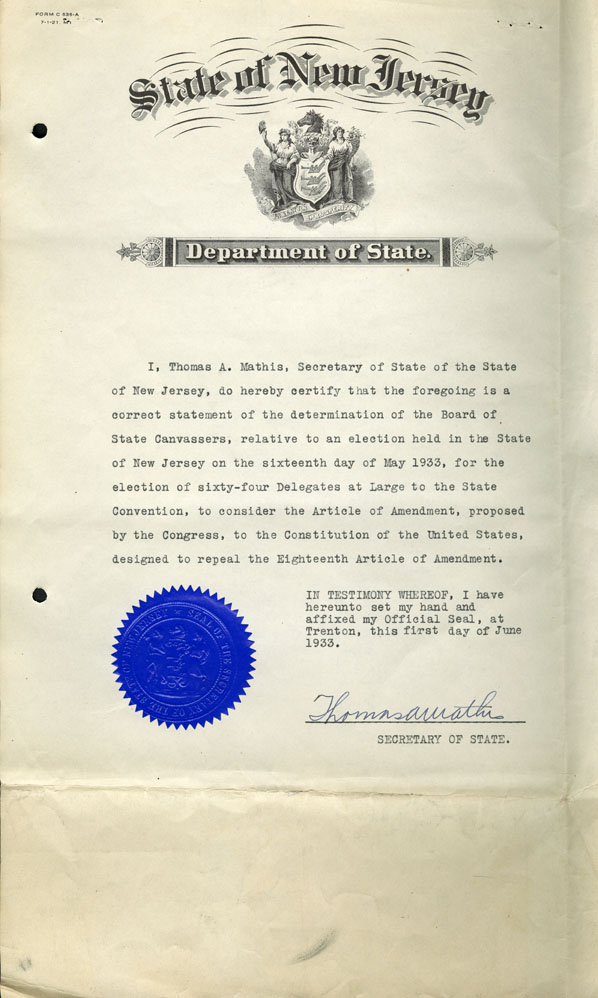
State of New Jersey
Department of State
I, Thomas A. Mathis, Secretary of State of the State of New Jersey, do hereby certify that the foregoing is a correct statemen of the determination of the Board of State Canvassers, relative to an election held in the State of New Jersey on the sixteenth day of May 1933, for the election of sixty-four Delegates at Large to the State Convention, to consider the Article of Amendment, proposed by the Congress, to the Constitution of the United States, designed to repeal the Eighteenth Article of Amendment.
IN TESTIMONY WHEREOF, I have hereunto set my hand and affixed my Official Seal, at Trenton, the first day of June 1933.
Thomas A. Mathis,
Secretary of State.
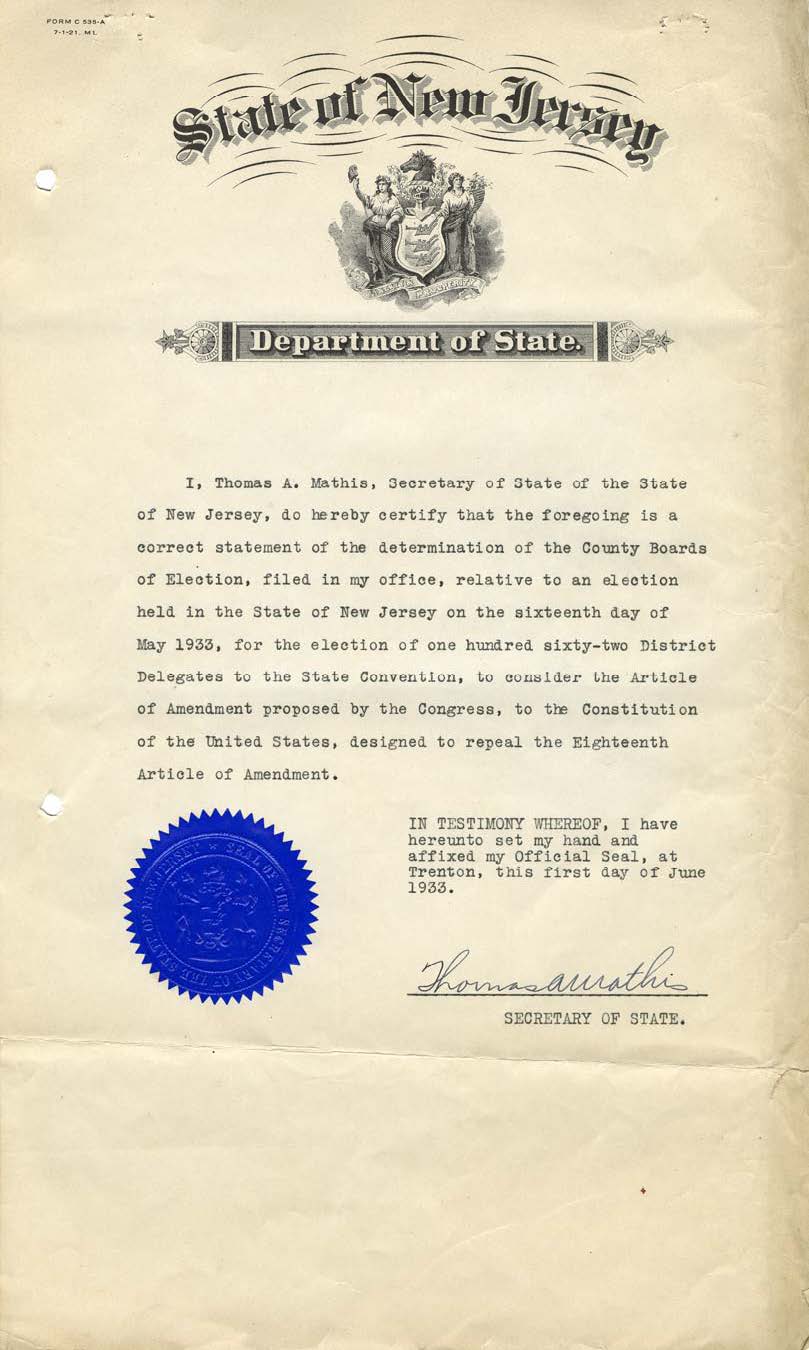
State of New Jersey
Department of State
I, Thomas A. Mathis, Secretary of State of the State of New Jersey, do hereby certify that the foregoing is a correct statement of the determination of the County Boards of Election, filed in my office, relative to an election held in the State of New Jersey on the sixteenth day of May 1933, for the election of one hundred sixty‐two District Delegates to the State Convention, to consider the Article of Amendment proposed by the Congress, to the Constitution of the United States, designed to repeal the Eighteenth Article of Amendment.
IN TESTIMONY WHEREOF, I have hereunto set my hand and affixed my Official Seal, at Trenton, this first day of June 1933.
Thomas A. Mathis
Secretary of State
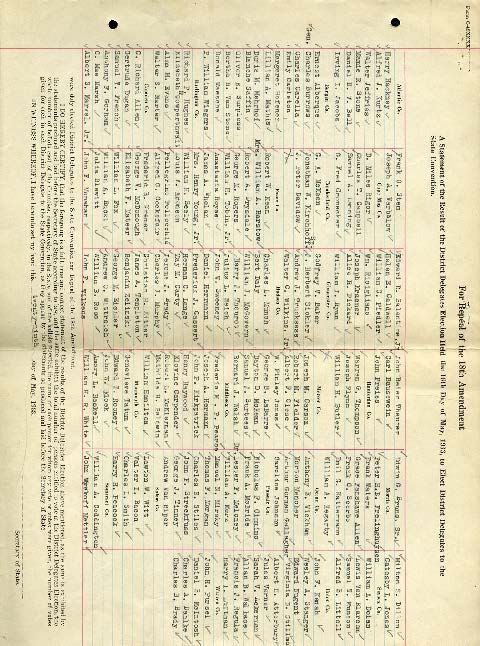
For Repeal of the 18th Amendment
A Statement of the Result of the District Delegates Election Held on the 16th Day of May, 1933, to Elect District Delegates to the State Convention.
Atlantic Co.
Harry Hackney
Alfred J. Kurtz
Walter Jeffries
Mamie R. Stone
Daniel H.V. Bell
Irving I. Jacobs
Bergen Co.
Ernest Alberque
Gen. Charles Burrows
Charles Carella
Emily Carleton
Margaret Hofener
Lillian A. Mathis
Doris M. Mehrhof
Blanche Saffin
Oliver B. Surpless
Bertha B. Van Stone
Donald Waesche
P. William Wiegers
Burlington Co.
Richard P. Hughes
Elizabeth R. Cowperthwait
Alma M. Evans
Walter S. Marter
Camden Co.
C. Richard Allen
Gertrude Dugan
Samuel T. French
Anthony F. Gorham
C. Mae Marsh
Albert S. Marvel, Jr.
Frank O. Stem
Joseph A. Varbalow
Cape May Co.
D. Miles Rigor
Charles T. Campbell
Samuel A. Lanning
G. Fred Cronecker
Cumberland Co.
G.A. McKeen
Jonathan W. Kirchhoff, Sr.
J. Peter Davidow
Essex Co.
Robert W. Kean
Mrs. William A. Barstow
Robert A. Drysdale
George M. Rogers
William H. Tobin, Jr.
Anastasia Royce
James A. Whelan
Mrs. Henry Young, Jr.
William H. Seely
Louis V. Aronson
Pelligrino Pellecchia
Alfred G. Cockefair
Frederic B. Kremer
George V. McDonough
Elizabeth F. Mateer
William L. Fox
William A. Rucki
Julia Blewitt
John F. Monahan
Edward D. Balentine, Jr.
Helen E. Caldwell
William C. Fielder
Wm. Ricigliano
Joseph Kraemer
Alice R. Pickard
William J. Ryan
Gloucester Co.
Godfrey V. Baker
J. Herbert Sickler
Andrew J. Trucksees
Walter C. Wilkins, Jr.
Hudson Co.
Charles L. Munch
Bert Daly
William J. McGovern
Harry J. Thourot
Julius L. Reich
John W. Sweeney
Daniel Herrmann
Frederick J. Gassert
Herman C. Lange
May M. Carty
Jerome J. Brady
Charles J. Murphy
Christian H. Ritter
James A. Templton
Benjamin Zelinski
George M. Eichler
Andrew O. Wittreich
William B. Ross
John F. Wilkens
John Beier Theurer
Carl Bausewein
John Preiss
Hunterdon Co.
Warren G. Thompson
Joseph Flynn
William H. Butler
Mercer Co.
Joseph M. Carson
Robert M. Fielder
Albert F. Giese
W. Finley Jones
George B. LaBarre
Dayton D. McKean
Samuel J. Surtees
Bernard J. Walsh
Middlesex Co.
Frederic M. P. Pearse
Joseph A. Hermann
John P. Kirkpatrick
Henry Haywood
Elovine Carpender
Robert L. McKiernan
Mathilda H. Baldwin
William Hamilton
Monmouth Co.
Genevieve Tatum
Edward T. Rooney
John W. Flock
Amory L. Haskell
William H.R. White
Edwin G. Bruns, Sr.
Morris Co.
Peter H. B. Frelinghuysen
Frank Waters
Grace Fanshawe Allen
Frank C. Scerbo
Emil G. Kattermann
William A. Hegarty
Ocean Co.
Anthony E. Wickham
Morton Mencher
Arthur Gorman Gallagher
Caroline Johnson
Passaic Co.
Nicholas F. Cimmino
Frank A. McBride
Dr. Lester F. Meloney
William A. Merz
Manuel N. Mirsky
Thomas F. Morgan
Charles E. Stiles
John F. Streckfuss
George J. Tinney
Andrew Van Riper
Salem Co.
Lawton W. Witt
Walter I. Bacon
Charles L. Smith
Harry H. Peacock
Somerset Co.
William A. Coddington
John Wyckoff Mettler
Milton S. Dillon
Catesby L. Jones
Sussex Co.
William A. Dolan
Lewis Van Blarcom
Samuel T. Munson
Alfred B. Littell
Union Co.
John F. Kenah
Wesley A. Stanger
Edward Nugent
Virginia B. Stillman
Albert H. Atterbury
Jules Verner
Sarah V. Ackerman
Allan B. Wallace
Francis J. Regula
Harry I. Luftman
Warren Co.
John H. Pursel
Daniel B. McIntosh
Charles A. Dahlke
Charles B. Brady
were duly elected District Delegates to the State Convention for Repeal of the 18th Amendment.
I DO HEREBY CERTIFY, that the foregoing is a full, true and correct statement of the results of the District Delegates Election above mentioned as the same is exhibited by the statement produced and laid before the Secretary of State according to law, and the same exhibits the total number of persons entitled to vote at the Dstrict Delegates Election, the whole number of ballots cast of the Counties, respectively, in the State, and of the ballots rejected, the name of each person for whom any vote or votes were given, the number of votes given for each in each District Delegate to the State Convention, as they appear by the statements so produced and laid before the Secretary of State.
IN WITNESS WHEREOF, I have hereunto set my hand this twenty‐ninth day of May, 1933.
Against Repeal of the 18th Amendment
A Statement of the Result of the District Delegates Election Held the 16th Day of May, 1933, to Elect District Delegates to the State Convention
Atlantic Co.
Bergen Co.
Burlington Co.
Camden Co.
Cape May Co.
Cumberland Co.
Samuel Iredell
Essex Co.
Gloucester Co.
Hudson Co.
Hunterdon Co.
W. Egbert Thomas
Mercer Co.
Middlesex Co.
Monmouth Co.
Morris Co.
Ocean Co.
Passaic Co.
Salem Co.
Somerset Co.
Sussex Co.
Union Co.
Warren Co.
were duly elected District Delegates to the State Convention for Repeal of the 18th Amendment.
I DO HEREBY CERTIFY, that the foregoing is a full, true and correct statement of the results of the District Delegates Election above mentioned as the same is exhibited by the statement produced and laid before the Secretary of State according to law, and the same exhibits the total number of persons entitled to vote at the Dstrict Delegates Election, the whole number of ballots cast of the Counties, respectively, in the State, and of the ballots rejected, the name of each person for whom any vote or votes were given, the number of votes given for each in each District Delegate to the State Convention, as they appear by the statements so produced and laid before the Secretary of State.
IN WITNESS WHEREOF, I have hereunto set my hand this twenty‐ninth day of May, 1933.
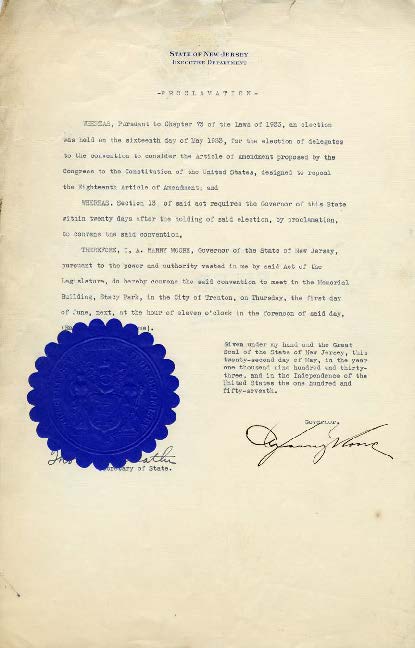
State of New Jersey
Executive Department
-P R O C L A M A T I O N –
WHEREAS, Pursuant to Chapter 73 of the Laws of 1933, an election was held on the sixteenth day of May 1933, for the election of delegates to the convention to consider the Article of Amendment proposed by the Congress to the Constitution of the United States, designed to repeal the Eighteenth Article of Amendment; and
WHEREAS, Section 13 of said act requires the Governor of this State within twenty days after the holding of said election, by proclamation, to convene the said convention,
THEREFORE, I, A. HARRY MOORE, Governor of the State of New Jersey, pursuant to the power and authority vested in me by said Act of the Legislature, do hereby convene the said convention to meet in the Memorial Building, Stacy Park, in the City of Trenton, on Thursday, the first day of June, next, at the hour of eleven o’clock in the forenoon of said day, (Eastern Standard Time).
Given under my hand and the Great Seal of the State of New Jersey, this twenty-second day of May, in the year one thousand nine hundred and thirty-three, and in the Independence of the United States the one hundred and fifty-seventh.
Governor,
/s/ A. Harry Moore
/s/ Thomas A. Mathis,
Secretary of State.
CONVENTION TO RATIFY THE TWENTY‐FIRST AMENDMENT TO THE CONSTITUTION OF THE UNITED STATES, DESIGNED TO REPEAL THE EIGHTEENTH ARTICLE OF AMENDMENT TO THE CONSTITUTION OF THE UNITED STATES, HELD PURSUANT TO CHAPTER SEVENTY‐THREE OF THE LAWS OF ONE THOUSAND NINE HUNDRED AND THIRTY‐THREE.
Memorial Building,
Stacy Park,
Trenton, NJ,
June 1, 1933.
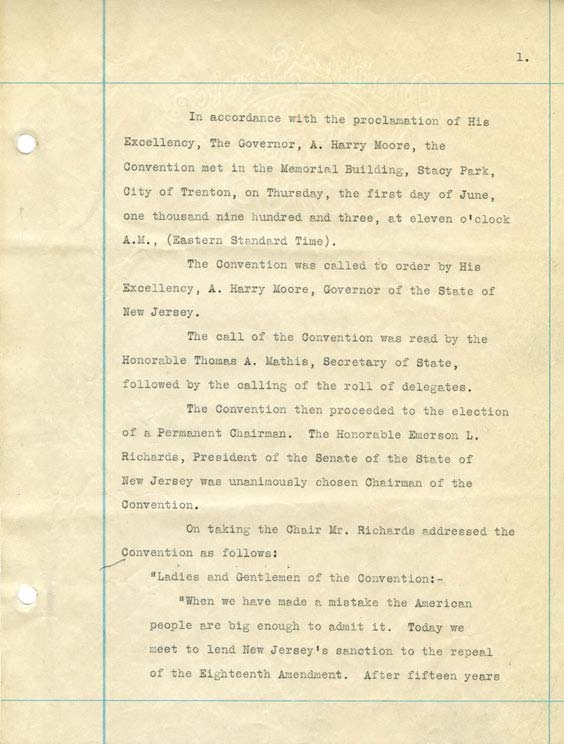
In accordance with the proclamation of His Excellency, The Governor, A. Harry Moore, the Convention met in the Memorial Building, Stacy Park, City of Trenton, on Thursday, the first day of June, one thousand nine hundred and [thirty] three, at eleven o’clock A.M., (Eastern Standard Time).
The Convention was called to order by His Excellency, A. Harry Moore, Governor of the State of New Jersey.
The call of the Convention was read by the Honorable Thomas A. Mathis, Secretary of State, followed by the calling of the roll of delegates.
The Convention then proceeded to the election of a Permanent Chairman. The Honorable Emerson L. Richards, President of the Senate of the State of New Jersey was unanimously chosen Chairman of the Convention.
On taking the Chair Mr. Richards addressed the Convention as follows: “Ladies and Gentlemen of the Convention: —
When we have made a mistake the American people are big enough to admit it. Today we meet to lend New Jersey’s sanction to the repeal of the Eighteenth Amendment. After fifteen years
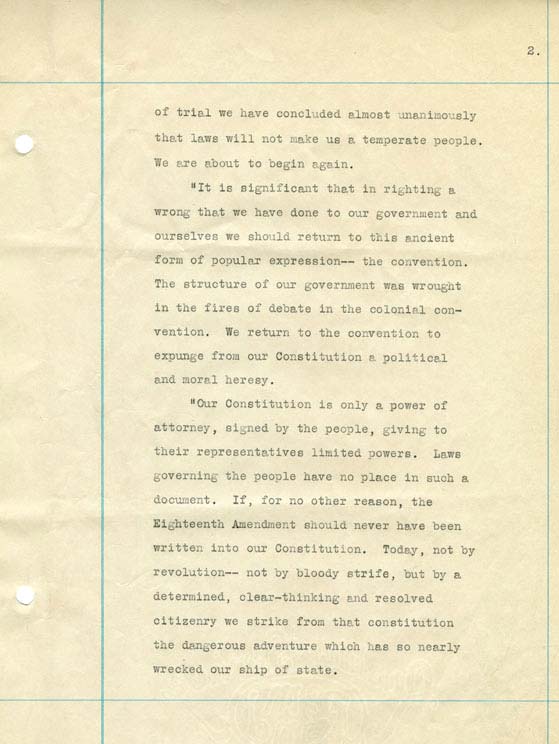
of trial we have concluded almost unanimously that laws will not make us a temperate people. We are about to begin again.
“It is significant that in righting a wrong that we have done to our government and ourselves we should return to this ancient form of popular expression‐‐ the convention. The structure of our government was wrought in the fires of debate in the colonial convention. We return to the convention to expunge from our Constitution a political and moral heresy.
“Our Constitution is only a power of attorney, signed by the people, giving to their representatives limited powers. Laws governing the people have no place in such a document. If, for no other reason, the Eighteenth Amendment should never have been written into our Constitution. Today, not by revolution‐‐ not by bloody strife, but by a determined, clear‐ thinking and resolved citizenry we strike from that constitution the dangerous adventure which has so nearly wrecked our ship of state.
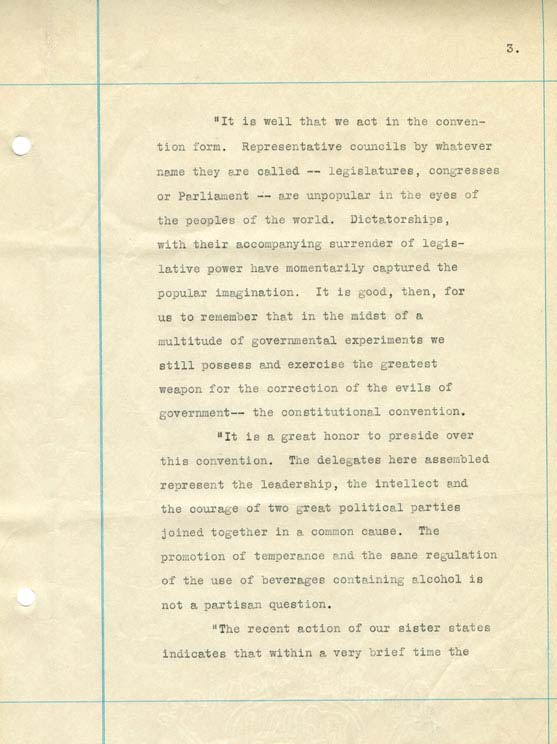
“It is well that we act in the convention form. Representative councils by whatever name they are called ‐‐ legislatures, congresses or Parliament ‐‐ are unpopular in the eyes of the peoples of the world. Dictatorships, with their accompanying surrender of legislative power have momentarily captured the popular imagination. It is good, then, for us to remember that in the midst of a multitude of governmental experiments we still possess and exercise the greatest weapon for the correction of the evils of government‐‐ the constitutional convention.
“It is a great honor to preside over this convention. The delegates here assembled represent the leadership, the intellect and the courage of two great political parties joined together in a common cause. The promotion of temperance and the sane regulation of the use of beverages containing alcohol is not a partisan question.
“The recent action of our sister states indicates that within a very brief time the
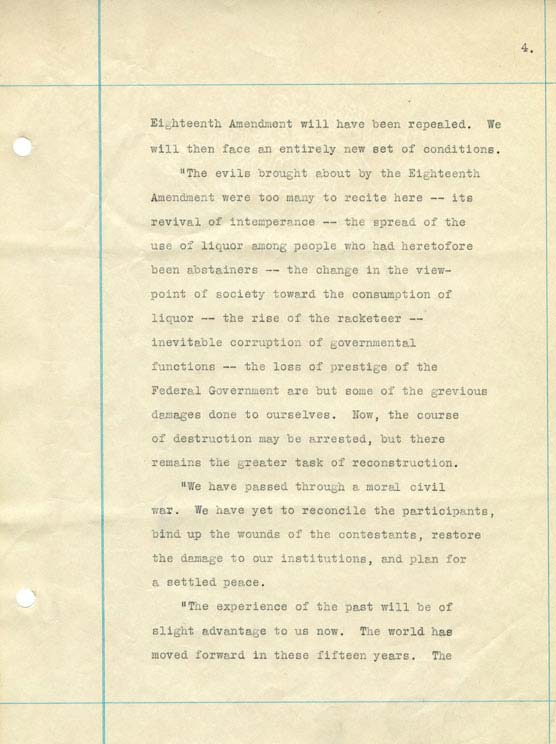
Eighteenth Amendment will have then been repealed. We will then face an entirely new set of conditions.
“The evils brought about by the Eighteenth Amendment were too many to recite here ‐‐ its revival of intemperance ‐‐ the spread of the use of liquor among people who had heretofore been abstainers ‐‐ the change in the viewpoint of society toward the consumption of liquor ‐‐ the rise of the racketeer ‐‐ inevitable corruption of governmental functions ‐‐ the loss of prestige of the Federal Government are but some of the grevious [sic] damages done to ourselves. Now, the course of destruction may be arrested, but there remains the greater task of reconstruction.
“We have passed through a moral civil war. We have yet to reconcile the participants, bind up the wounds of the contestants, restore the damage to our institutions, and plan for a settled peace.
“The experience of the past will be of slight advantage to us now. The world has moved forward in these fifteen years. The
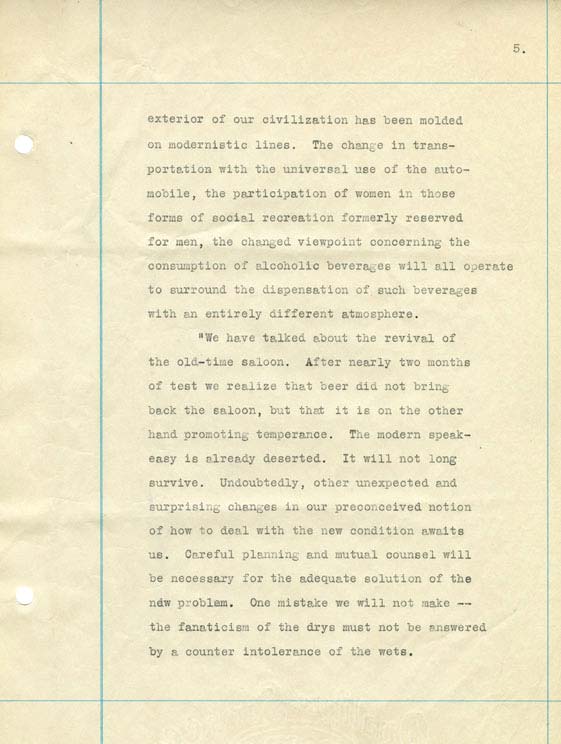
exterior of our civilization has been molded on modernistic lines. The change in transportation with the universal use of the automobile, the participation of women in those forms of social recreation formerly reserved for men, the changed viewpoint concerning the consumption of alcoholic beverages will all operate to surround the dispensation of such beverages with an entirely different atmosphere.
“We have talked about the revival of the old‐time saloon. After nearly two months of test we realize that beer did not bring back the saloon, but that it is on the other hand promoting temperance. The modern speakeasy is already deserted. It will not long survive. Undoubtedly, other unexpected and surprising changes in our preconceived notion of how to deal with the new condition awaits us. Careful planning and mutual counsel will be necessary for the adequate solution of the new problem. One mistake we will not make ‐‐ the fanaticism of the drys must not be answered by a counter intolerance of the wets.
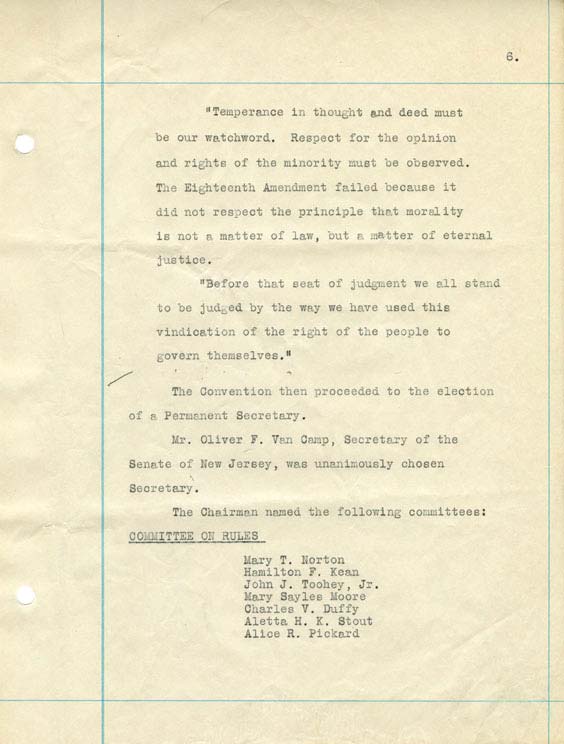
“Temperance in thought and deed must be our watchword. Respect for the opinion and rights of the minority must be observed. The Eighteenth Amendment failed because it did not respect the principle that morality is not a matter of law, but a matter of eternal justice.
“Before that seat of judgment we all stand to be judged by the way we have used this vindication of the right of the people to govern themselves.”
The Convention then proceeded to the election of a Permanent Secretary.
Mr. Oliver F. Van Camp, Secretary of the Senate of New Jersey, was unanimously chosen Secretary.
The Chairman named the following committees:
COMMITTEE ON RULES
Mary T. Norton
Hamilton F. Kean
John J. Toohey, Jr.
Mary Sayles Moore
Charles V. Duffy
Aletta H. K. Stout
Alice R. Pickard
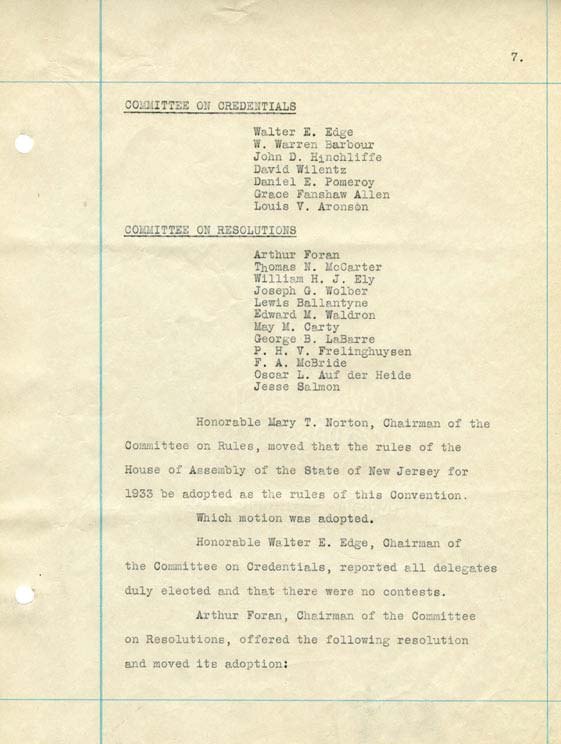
COMMITTEE ON CREDENTIALS
Walter E. Edge
W. Warren Barbour
John D. Hinchliffe
David Wilentz
Daniel E. Pomeroy
Grace Fanshaw Allen
Louis V. Aronson
COMMITTEE ON RESOLUTIONS
Arthur Foran
Thomas N. McCarter
William H. J. Ely
Joseph G. Wolber
Lewis Ballantyne
Edward M. Waldron
May M. Carty
George B. LaBarre
P. H. V. Frelinghuysen
F. A. McBride
Oscar L. Auf der Heide
Jesse Salmon
Honorable Mary T. Norton, Chairman of the Committee on Rules, moved that the rules of the House of Assembly of the State of New Jersey for 1933 be adopted as the rules of this Convention.
Which motion was adopted.
Honorable Walter E. Edge, Chairman of the Committee on Credentials, reported all delegates duly elected and that there were no contests.
Arthur Foran, Chairman of the Committee on Resolutions, offered the following resolution and moved its adoption:
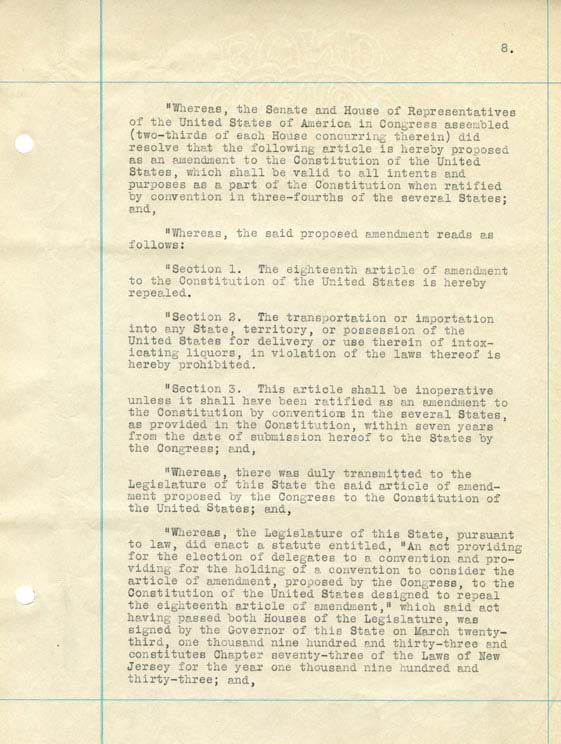
“Whereas, the Senate and House of Representatives of the United States of America in Congress assembled (two‐thirds of each House concurring therein) did resolve that the following article is hereby proposed as an amendment to the Constitution of the United States, which shall be valid to all intents and purposes as a part of the Constitution when ratified by convention in three‐fourths of the several States; and,
“Whereas, the said proposed amendment reads as follows:
“Section 1. The eighteenth article of amendment to the Constitution of the United States is hereby repealed.
“Section 2. The transportation or importation into any State, territory, or possession of the United States for delivery or use therein of intoxicating liquors, in violation of the laws thereof is hereby prohibited.
“Section 3. This article shall be inoperative unless it shall have been ratified as an amendment to the Constitution by convention in the several States, as provided in the Constitution, within seven years from the date of submission hereof to the States by the Congress; and,
“Whereas, there was duly transmitted to the Legislature of this State the said article of amendment proposed by the Congress to the Constitution of the United States; and,
“Whereas, the Legislature of this State, pursuant to law, did enact a statute entitled, “An act providing for the election of delegates to a convention and providing for the holding of a convention to consider the article of amendment, proposed by the Congress, to the Constitution of the United States designed to repeal the eighteenth article of amendment,” which said act having passed both Houses of the Legislature, was signed by the Governor of this State on March twenty‐third, one thousand nine hundred and thirty‐three and constitutes Chapter seventy‐three of the Laws of New Jersey for the year one thousand nine hundred and thirty‐three; and,
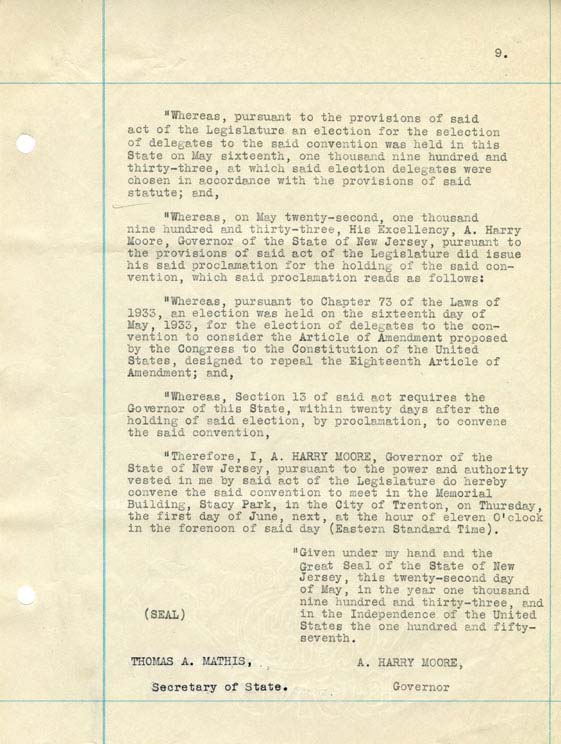
“Whereas, pursuant to the provisions of said act of the Legislature an election for the selection of delegates to the said convention was held in this State on May sixteenth, one thousand nine hundred and thirty‐three, at which said election delegates were chosen in accordance with the provisions of said statute; and,
“Whereas, on May twenty‐second, one thousand nine hundred and thirty‐three, His Excellency, A. Harry Moore, Governor of the State of New Jersey, pursuant to the provisions of said act of the Legislature did issue his said proclamation for the holding of the said convention, which said proclamation reads as follows:
“Whereas, pursuant to Chapter 73 of the Laws of 1933, an election was held on the sixteenth day of May, 1933, for the election of delegates to the convention to consider the Article of Amendment proposed by the Congress to the Constitution of the United States, designed to repeal the Eighteenth Article of Amendment; and,
“Whereas, Section 13 of said act requires the Governor of this State, within twenty days after the holding of said election, by proclamation, to convene the said convention,
“Therefore, I, A. HARRY MOORE, Governor of the State of New Jersey, pursuant to the power and authority vested in me by said act of the Legislature do hereby convene the said convention to meet in the Memorial Building, Stacy Park, in the City of Trenton, on Thursday, the first day of June, next, at the hour of eleven O’clock in the forenoon of said day (Eastern Standard Time).
“Given under my hand and the Great Seal of the State of New Jersey, this twenty‐second day of May, in the year one thousand nine hundred and thirty‐three, and in the Independence of the United States the one hundred and fifty‐seventh.
THOMAS A. MATHIS,
Secretary of State
A. HARRY MOORE,
Governor
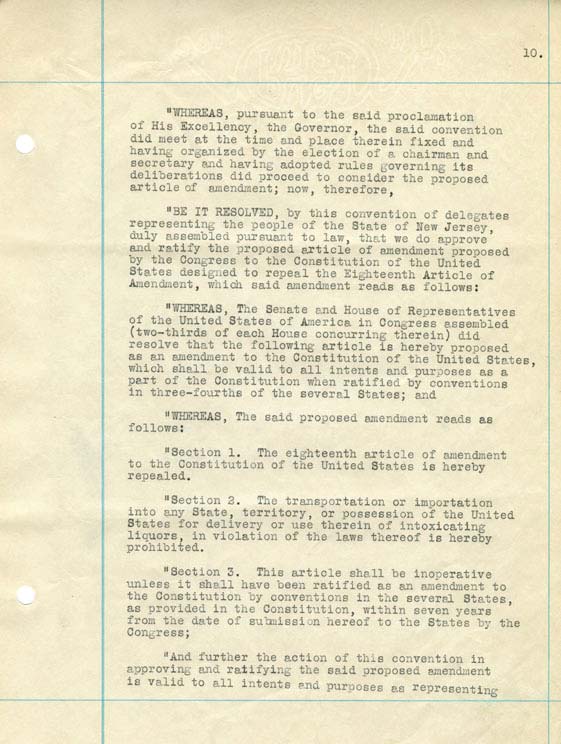
“Whereas, pursuant to the said proclamation of His Excellency, the Governor, the said convention did meet at the time and place therein fixed and having organized by the election of a chairman and secretary and having adopted rules governing its deliberations did proceed to consider the proposed article of amendment; now, therefore,
“BE IT RESOLVED, by this convention of delegates representing the people of the State of New Jersey, duly assembled pursuant to law, that we do approve and ratify the proposed article of amendment proposed by the Congress to the Constitution of the United States designed to repeal the Eighteenth Article of Amendment, which said amendment reads as follows:
“WHEREAS, The Senate and House of Representatives of the United States of America in Congress assembled (two‐thirds of each House concurring therein) did resolve that the following article is hereby proposed as an amendment to the Constitution of the United States, which shall be valid to all intents and purposes as a part of the Constitution when ratified by conventions in three‐fourths of the several States; and
“WHEREAS, The said proposed amendment reads as follows:
“Section 1. The eighteenth article of amendment to the Constitution of the United States is hereby repealed.
“Section 2. The transportation or importation into any State, territory, or possession of the United States for delivery or use therein of intoxicating liquors, in violation of the laws thereof is hereby prohibited.
“Section 3. This article shall be inoperative unless it shall have been ratified as an amendment to the Constitution by conventions in the several States, as provided in the Constitution, within seven years from the date of submission hereof to the States by the Congress;
“And further the action of this convention in approving and ratifying the said proposed amendment is valid to all intents and purposes as representing
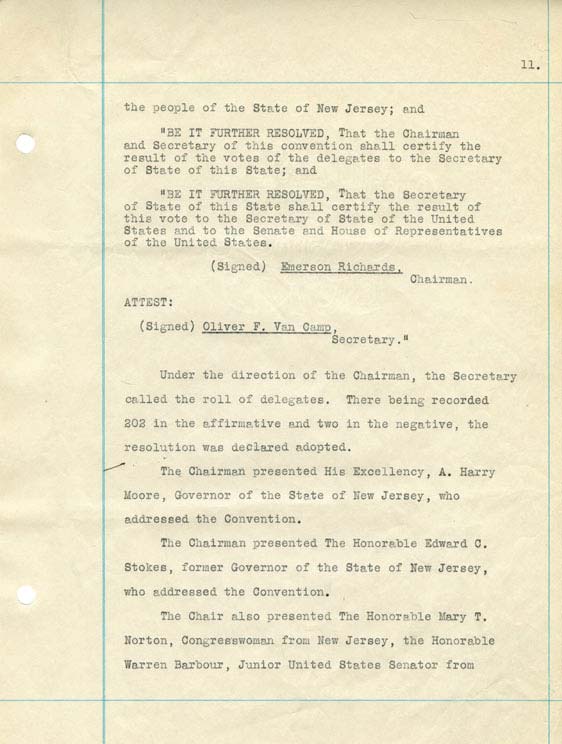
the people of the State of New Jersey; and
“BE IT FURTHER RESOLVED, That the Chairman and Secretary of this convention shall certify the result of the votes of the delegates to the Secretary of State of this State; and
“BE IT FURTHER RESOLVED, That the Secretary of State of this State shall certify the result of this vote to the Secretary of State of the United States and to the Senate and House of Representatives of the United States.
(Signed) Emerson Richards,
Chairman
ATTEST:
(Signed) Oliver F. Van Camp,
Secretary.”
Under the direction of the Chairman, the Secretary called the roll of delegates. There being recorded 202 in the affirmative and two in the negative, the resolution was declared adopted.
The Chairman presented His Excellency, A. Harry Moore, Governor of the State of New Jersey, who addressed the Convention.
The Chairman presented The Honorable Edward C. Stokes, former Governor of the State of New Jersey, who addressed the Convention.
The Chair also presented The Honorable Mary T. Norton, Congresswoman from New Jersey, the Honorable Warren Barbour, Junior United States Senator from
New Jersey, the Honorable Hamilton F. Kean, Senior United States Senator from New Jersey, and the Honorable Walter E. Edge, former Governor of the State of New Jersey, former United States Senator from New Jersey, and former United States Ambassador to France, who addressed the Convention.
On motion of Arthur Foran, one of the delegates to the Convention, the Convention adjourned sine die.
/s/ Oliver F. Van Camp
Oliver F. Van Camp, Secretary.
* * * *
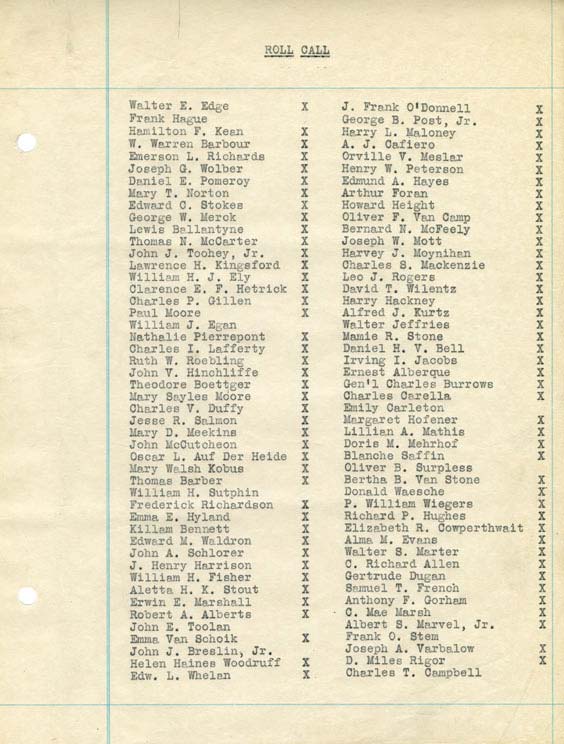
ROLL CALL
| Hamilton F. Kean | X | Henry L. Maloney | X |
| W. Warren Barbour | X | A.J. Cafiero | X |
| Emerson L. Richards | X | Orville V. Meslar | X |
| Joseph G. Wolber | X | Henry W. Peterson | X |
| Daniel E. Pomeroy | X | Edmund A. Hayes | X |
| Mary T. Norton | X | Arthur Foran | X |
| Edward C. Stokes | X | Howard Height | X |
| George W. Merck | X | Oliver F. Van Camp | X |
| Lewis Ballantyne | X | Bernard N. McFeely | X |
| Thomas N. McCarter | X | Joseph W. Mott | X |
| John J. Toohey, Jr. | X | Harvey J. Moynihan | X |
| Lawrence H. Kingsford | X | Charles S. Mackenzie | X |
| William H.J. Ely | X | Leo J. Rogers | X |
| Clarence E. F. Hetrick | X | David T. Wilentz | X |
| Charles P. Gillen | X | Harry Hackney | X |
| Paul Moore | X | Alfred J. Kurtz | X |
| William J. Egan | Walter Jeffries | X | |
| Nathalie Pierrepont | X | Mamie R. Stone | X |
| Charles I. Lafferty | X | Daniel H.V. Bell | X |
| Ruth W. Roebling | X | Irving I. Jacobs | X |
| John V. Hinchliffe | X | Ernest Alberque | X |
| Theodore Boettger | X | Gen’l Charles Burrows | X |
| Mary Sayles Moore | X | Charles Carella | X |
| Charles V. Duffy | X | Emily Carleton | |
| Jesse R. Salmon | X | Margaret Hofener | X |
| Mary D. Meekins | X | Lillian A. Mathis | X |
| John McCutcheon | X | Doris M. Mehrhof | X |
| Oscar L. Auf Der Heide | X | Blanche Saffin | X |
| Mary Walsh Kobus | X | Oliver B. Surpless | |
| Thomas Barber | X | Bertha B. Van Stone | X |
| William H. Sutphin | Donald Waesche | X | |
| Frederick Richardson | X | P. William Wiegers | X |
| Emma E. Hyland | X | Richard P. Hughes | X |
| Killam Bennett | X | Elizabeth R. Cowperthwait | X |
| Edward M. Waldron | X | Alma M. Evans | X |
| John A. Schlorer | X | Walter S. Marter | X |
| J. Henry Harrison | X | C. Richard Allen | X |
| William H. Fisher | X | Gertrude Dugan | X |
| Aletta H. K. Stout | X | Samuel T. French | X |
| Erwin E. Marshall | X | Anthony F. Gorham | X |
| Robert A. Alberts | X | C. Mae Marsh | X |
| John E. Toolan | Albert S. Marvel, Jr. | X | |
| Emma Van Schoik | X | Frank O. Stem | |
| John J. Breslin, Jr. | Joseph A. Varbalow | X | |
| Helen Haines Woodruff | X | D. Miles Rigor | X |
| Edw. L. Whelan | X | Charles T. Campbell |
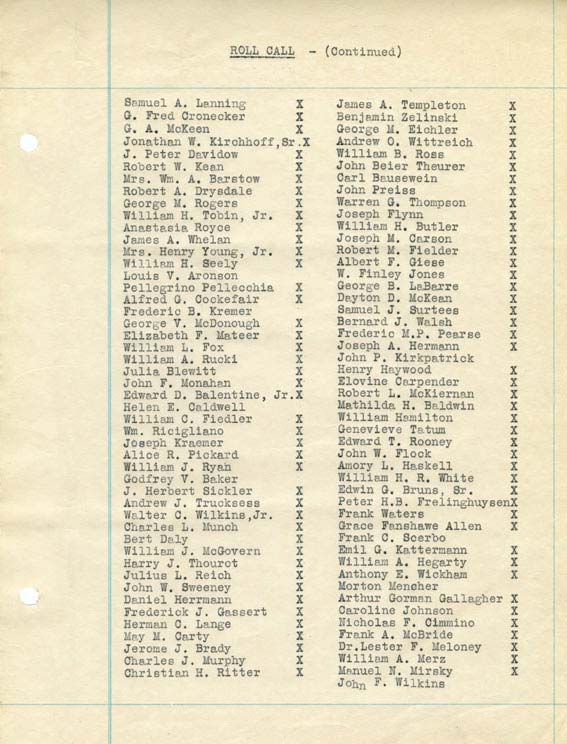
ROLL CALL – (Continued)
| Samuel A. Lanning | X | James A. Templeton | X |
| G. Fred Cronecker | X | Benjamin Zelinksi | X |
| G.A. McKeen | X | George M. Eichler | X |
| Jonathan W. Kirchhoff, Sr. | X | Andrew O. Wittreich | X |
| J. Peter Davidow | X | William B. Ross | X |
| Robert W. Kean | X | John Beier Theurer | X |
| Mrs. Wm. A. Barstow | X | Carl Bausewein | X |
| Robert A. Drysdale | X | John Preiss | X |
| George M. Robers | X | Warren G. Thompson | X |
| William H. Tobin, Jr. | X | Joseph Flynn | X |
| Anastasia Royce | X | William H. Butler | X |
| James A. Whelan | X | Joseph M. Carson | X |
| Mrs. Henry Young, Jr. | X | Robert M. Fielder | X |
| William H. Seely | X | Albert F. Giese | X |
| Louis Aronson | W. Finley Jones | X | |
| Pellegrino Pellecchia | X | George B. LaBarre | X |
| Alfred G. Cockefair | X | Dayton D. McKean | X |
| Frederic B. Kremer | Samuel J. Surtees | X | |
| George V. McDonough | X | Bernard J. Walsh | X |
| Elizabeth F. Mateer | X | Frederic M.P. Pearse | X |
| William L. Fox | X | Joseph A. Hermann | X |
| William A. Rucki | X | John P. Kirkpatrick | |
| Julia Blewitt | X | Henry Haywood | X |
| John F. Monhan | X | Elovine Carpender | X |
| Edward D. Balentine, Jr. | X | Robert L. McKiernan | X |
| Helen E. Caldwell | Mathilda H. Baldwin | X | |
| William C. Fiedler | X | William Hamilton | X |
| Wm. Ricigliano | X | Genevieve Tatum | X |
| Joseph Kraemer | X | Edward T. Rooney | X |
| Alice R. Pickard | X | John W. Flock | X |
| William J. Ryan | X | Amory L. Haskell | X |
| Godfrey V. Baker | William H.R. White | X | |
| J. Herbert Sickler | X | Edwin G. Bruns, Sr. | X |
| Andrew J. Trucksess | X | Peter H.B. Frelinghuysen | X |
| Walter C. Wilkins, Jr. | X | Frank Waters | X |
| Charles L. Munch | X | Grace Fanshawe Allen | X |
| Bert Daly | X | Frank C. Scerbo | |
| William J. McGovern | X | Emil G. Kattermann | X |
| Henry J. Thourot | X | William A. Hegarty | X |
| Julius L. Reich | X | Anthony E. Wickham | X |
| John W. Sweeney | X | Morton Mencher | |
| Daniel Herrmann | X | Arthur Gorman Gallagher | X |
| Frederick J. Gassert | X | Caroline Johnson | X |
| Herman C. Lange | X | Nicholas F. Cimmino | X |
| May M. Carty | X | Frank A. McBride | X |
| Jerome J. Brady | X | Dr. Lester F. Meloney | X |
| Charles J. Murphy | X | William A. Merz | X |
| Christian H. Ritter | X | Manuel N. Mirsky | X |
| John F. Wilkins |
ROLL CALL – (Continued)
| Thomas F. Morgan | |
| Charles E. Stiles | X |
| John F. Streckfuss | X |
| George J. Tinney | X |
| Andrew Van Riper | |
| Lawton W. Witt | X |
| Walter I. Bacon | X |
| Charles L. Smith | X |
| Harry H. Peacock | X |
| William A. Coddington | X |
| John Wyckoff Mettler | X |
| Milton S. Dillon | X |
| Catesby L. Jones | X |
| William A. Dolan | |
| Lewis Van Blarcom | X |
| Samuel T. Munson | X |
| Alfred B. Littell | X |
| John F. Kenah | X |
| Wesley A. Stanger | X |
| Edward Nugent | X |
| Virginia B. Stillman | X |
| Albert H. Atterbury | X |
| Jules Verner | X |
| Sarah V. Ackerman | X |
| Allan B. Wallace | X |
| Francis J. Regula | X |
| Harry I. Luftman | X |
| John H. Pursel | X |
| Daniel B. McIntosh | X |
| Charles A. Dahlke | X |
| Charles B. Brady | X |
| Samuel Iredell | X |
| W. Egbert Thomas | X |
TO ADOPT RESOLUTION
| Aye | Nay | Aye | Nay | ||
|---|---|---|---|---|---|
| Walter E. Edge | X | J. Frank O’Donnell | X | ||
| Frank Hague | George B. Post, Jr. | X | |||
| Hamilton F. Kean | X | Henry L. Maloney | X | ||
| W. Warren Barbour | X | A.J. Cafiero | X | ||
| Emerson L. Richards | X | Orville V. Meslar | X | ||
| Joseph G. Wolber | X | Henry W. Peterson | X | ||
| Daniel E. Pomeroy | X | Edmund A. Hayes | X | ||
| Mary T. Norton | X | Arthur Foran | X | ||
| Edward C. Stokes | X | Howard Height | X | ||
| George W. Merck | X | Oliver F. Van Camp | X | ||
| Lewis Ballantyne | X | Bernard N. McFeely | X | ||
| Thomas N. McCarter | X | Joseph W. Mott | X | ||
| John J. Toohey, Jr. | X | Harvey J. Moynihan | X | ||
| Lawrence H. Kingsford | X | Charles S. Mackenzie | X | ||
| William H.J. Ely | X | Leo J. Rogers | X | ||
| Clarence E. F. Hetrick | X | David T. Wilentz | X | ||
| Charles P. Gillen | X | Harry Hackney | X | ||
| Paul Moore | X | Alfred J. Kurtz | X | ||
| William J. Egan | Walter Jeffries | X | |||
| Nathalie Pierrepont | X | Mamie R. Stone | X | ||
| Charles I. Lafferty | X | Daniel H.V. Bell | X | ||
| Ruth W. Roebling | X | Irving I. Jacobs | X | ||
| John V. Hinchliffe | X | Ernest Alberque | X | ||
| Theodore Boettger | X | Gen’l Charles Burrows | X | ||
| Mary Sayles Moore | X | Charles Carella | X | ||
| Charles V. Duffy | X | Emily Carleton | |||
| Jesse R. Salmon | X | Margaret Hofener | X | ||
| Mary D. Meekins | X | Lillian A. Mathis | X | ||
| John McCutcheon | X | Doris M. Mehrhof | X | ||
| Oscar L. Auf Der Heide | X | Blanche Saffin | X | ||
| Mary Walsh Kobus | X | Oliver B. Surpless | |||
| Thomas Barber | X | Bertha B. Van Stone | X | ||
| William H. Sutphin | Donald Waesche | X | |||
| Frederick Richardson | X | P. William Wiegers | X | ||
| Emma E. Hyland | X | Richard P. Hughes | X | ||
| Killam Bennett | X | Elizabeth R. Cowperthwait | X | ||
| Edward M. Waldron | X | Alma M. Evans | X | ||
| John A. Schlorer | X | Walter S. Marter | X | ||
| J. Henry Harrison | X | C. Richard Allen | X | ||
| William H. Fisher | X | Gertrude Dugan | X | ||
| Aletta H. K. Stout | X | Samuel T. French | X | ||
| Erwin E. Marshall | X | Anthony F. Gorham | X | ||
| Robert A. Alberts | X | C. Mae Marsh | X | ||
| John E. Toolan | Albert S. Marvel, Jr. | X | |||
| Emma Van Schoik | X | Frank O. Stem | |||
| John J. Breslin, Jr. | Joseph A. Varbalow | X | |||
| Helen Haines Woodruff | X | D. Miles Rigor | X | ||
| Edw. L. Whelan | X | Charles T. Campbell | |||
| Alfred G. Cockefair | X | W. Finley Jones | X | ||
| Frederic B. Kremer | George B. LaBarre | X | |||
| George V. McDonough | X | Dayton D. McKean | X | ||
| Elizabeth F. Mateer | X | Samuel J. Surtees | X | ||
| William L. Fox | X | Bernard J. Walsh | X | ||
| William A. Ricki | X | Frederic M.P. Pearse | X | ||
| Julia Blewitt | X | Joseph A. Hermann | X | ||
| John F. Monhan | X | John P. Kirkpatrick | |||
| Edward D. Balentine, Jr. | X | Henry Haywood | X | ||
| Helen E. Caldwell | X | Elovine Carpender | X | ||
| William C. Fiedler | X | Robert L. McKiernan | X | ||
| Wm. Ricigliano | X | Mathilda H. Baldwin | X | ||
| Joseph Kraemer | X | William Hamilton | X | ||
| Alice R. Pickard | X | Genevieve Tatum | X | ||
| William J. Ryan | X | Edward T. Rooney | X | ||
| Godfrey V. Baker | John W. Flock | X | |||
| J. Herbert Sickler | X | Amory L. Haskell | X | ||
| Andrew J. Trucksess | X | William H.R. White | X | ||
| Walter C. Wilkins, Jr. | X | Edwin G. Bruns, Sr. | X | ||
| Charles L. Munch | X | Peter H.B. Frelinghuysen | X | ||
| Bert Daly | X | Frank Waters | X | ||
| William J. McGovern | X | Grace Fanshawe Allen | X | ||
| Henry J. Thourot | X | Frank C. Scerbo | |||
| Julius L. Reich | X | Emil G. Kattermann | X | ||
| John W. Sweeney | X | William A. Hegarty | X | ||
| Daniel Herrmann | X | Anthony E. Wickham | X | ||
| Frederick J. Gassert | X | Morton Mencher | |||
| Herman C. Lange | X | Arthur Gorman Gallagher | X | ||
| May M. Carty | X | Caroline Johnson | X | ||
| Jerome J. Brady | X | Nicholas F. Cimmino | X | ||
| Charles J. Murphy | X | Frank A. McBride | X |
TO ADOPT RESOLUTION
| Aye | Nay | ||
|---|---|---|---|
| Dr. Lester F. Meloney | X | ||
| William A. Merz | X | ||
| Manuel N. Mirsky | X | ||
| Thomas F. Morgan | X | ||
| Charles E. Stiles | X | ||
| John F. Streckfuss | |||
| George J. Tinney | X | ||
| Andrew Van Riper | |||
| Lawton W. Witt | X | ||
| Walter I. Bacon | X | ||
| Charles L. Smith | X | ||
| Harry H. Peacock | X | ||
| William A. Coddington | X | ||
| John Wyckoff Mettler | X | ||
| Milton S. Dillon | X | ||
| Catesby L. Jones | X | ||
| William A. Dolan | |||
| Lewis Van Blarcom | X | ||
| Samuel T. Munson | X | ||
| Alfred B. Littell | X | ||
| John F. Kenah | X | ||
| Wesley A. Stanger | X | ||
| Edward Nugent | X | ||
| Virginia B. Stillman | X | ||
| Albert H. Atterbury | X | ||
| Jules Verner | X | ||
| Sarah V. Ackerman | X | ||
| Allan B. Wallace | X | ||
| Francis J. Regula | X | ||
| Harry I. Luftman | X | ||
| John H. Pursel | X | ||
| Daniel B. McIntosh | X | ||
| Charles A. Dahlke | X | ||
| Charles B. Brady | X | ||
| Samuel Iredell | X | ||
| W. Egbert Thomas | X |
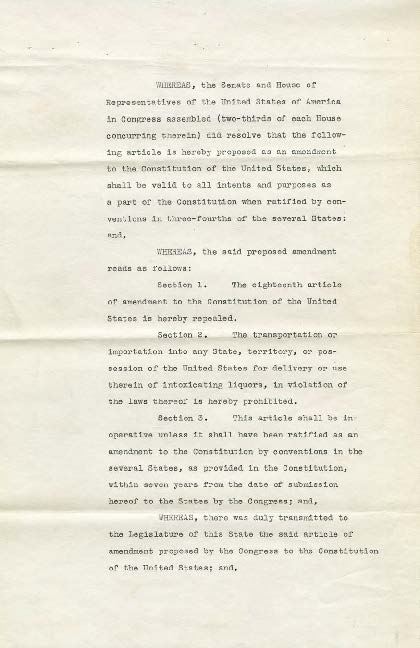
WHEREAS, the Senate and House of Representatives of the United States of America in Congress assembled (two‐thirds of each House concurring therein) did resolve that the following article is hereby proposed as an amendment to the Constitution of the United States, which shall be valid to all intents and purposes as a part of the Constitution when ratified by conventions in three‐fourths of the several States: and,
WHEREAS, the said proposed amendment reads as follows:
Section 1. The eighteenth article of amendment to the Constitution of the United States is hereby repealed.
Section 2. The transportation or importation into any State, territory, or possession of the United States for delivery or use therein of intoxicating liquors, in violation of the laws thereof is hereby prohibited.
Section 3. This article shall be inoperative unless it shall have been ratified as an amendment to the Constitution by conventions in the several States, as provided in the Constitution, within seven years from the date of submission hereof to the States by the Congress; and,
WHEREAS, there was duly transmitted to the Legislature of this State the said article of amendment proposed by the Congress to the Constitution of the United States; and,
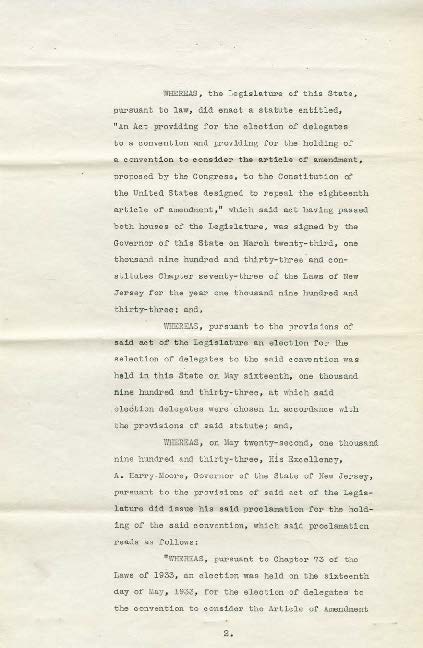
WHEREAS, the Legislature of this State, pursuant to law, did enact a statute entitled, “An Act providing for the election of delegates to a convention and providing for the holding of a convention to consider the article of amendment, proposed by the Congress, to the Constitution of the United States designed to repeal the eighteenth article of amendment,” which said act having passed both houses of the Legislature, was signed by the Governor of this State on March twenty‐third, one thousand nine hundred and thirty‐three and constitutes Chapter seventy‐three of the Laws of New Jersey for the year one thousand nine hundred and thirty‐three; and,
WHEREAS, pursuant to the provisions of said act of the Legislature an election for the selection of delegates to the said convention was held in this State on May sixteenth, one thousand nine hundred and thirty‐three, at which said election delegates were chosen in accordance with the provisions of said statute; and,
WHEREAS, on May twenty‐second, one thousand nine hundred and thirty‐three, His Excellency,
A. Harry Moore, Governor of the State of New Jersey, pursuant to the provisions of said act of the Legislature did issue his said proclamation for the holding of the said convention, which said proclamation reads as follows:
“WHEREAS, pursuant to Chapter 73 of the Laws of 1933, an election was held on the sixteenth day of May, 1933, for the election of delegates to the convention to consider the Article of Amendment
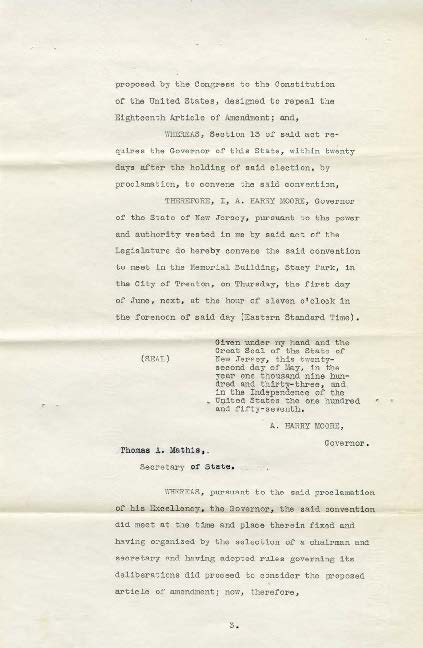
proposed by the Congress to the Constitution of the United States, designed to repeal the Eighteenth Article of Amendment; and,
WHEREAS, Section 13 of said act requires the Governor of this State, within twenty days after the holding of said election, by proclamation, to convene the said convention,
THEREFORE, I, A. HARRY MOORE, Governor of the State of New Jersey, pursuant to the power and authority vested in me by said act of the Legislature do hereby convene the said convention to meet in the Memorial Building, Stacy Park, in the City of Trenton, on Thursday, the first day of June, next, at the hour of eleven o’clock in the forenoon of said day (Eastern Standard Time).
Given under my hand and the Great Seal of the State of New Jersey, this twenty‐second day of May, in the year one thousand nine hundred and thirty‐three, and in the Independence of the United States the one hundred and fifty‐seventh.
A. HARRY MOORE,
Governor.
Thomas A. Mathis,
Secretary of State.
WHEREAS, pursuant to the said proclamation of his Excellency, the Governor, the said convention did meet at the time and place therein fixed and having organized by the selection of a chairman and secretary and having adopted rules governing its deliberations did proceed to consider the proposed article of amendment; now, therefore,
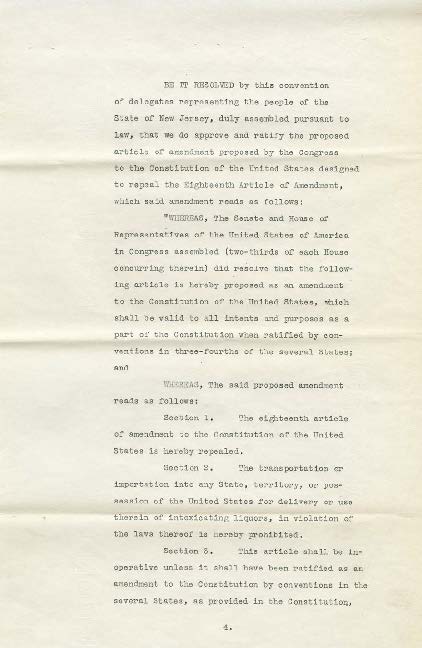
BE IT RESOLVED by this convention of delegates representing the people of the State of New Jersey, duly assembled pursuant to law, that we do approve and ratify the proposed article of amendment proposed by the Congress to the Constitution of the United States designed to repeal the Eighteenth Article of Amendment, which said amendment reads as follows:
“WHEREAS, The Senate and House of Representatives of the United States of America in Congress assembled (two‐thirds of each House concurring therein) did resolve that the following article is hereby proposed as an amendment to the Constitution of the United States, which shall be valid to all intents and purposes as a part of the Constitution when ratified by conventions in three‐fourths of the several States; and
WHEREAS, The said proposed amendment reads as follows:
Section 1. The eighteenth article of amendment to the Constitution of the United States is hereby repealed.
Section 2. The transportation or importation into any State, territory, or possession of the United States for delivery or use therein of intoxicating liquors, in violation of the laws thereof is hereby prohibited.
Section 3. This article shall be inoperative unless it shall have been ratified as an amendment to the Constitution by conventions in the several States, as provided in the Constitution,
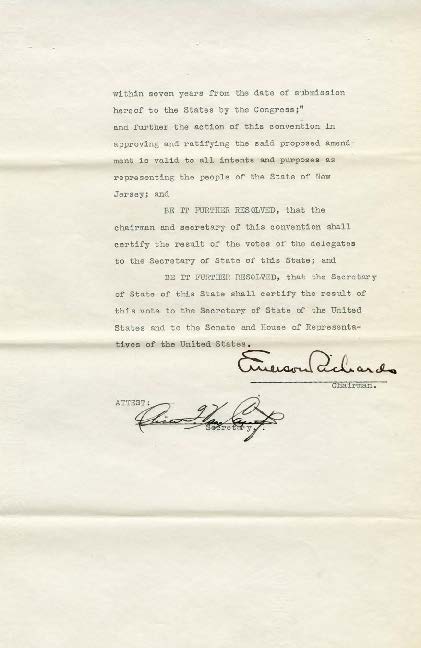
within seven years from the date of submission hereof to the States by the Congress;” and further the action of this convention in approving and ratifying the said proposed amendment is valid to all intents and purposes as representing the people of the State of New Jersey; and
BE IT FURTHER RESOLVED, that the chairman and secretary of this convention shall certify the result of the votes of the delegates to the Secretary of State of this State; and
BE IT FURTHER RESOLVED, that the Secretary of State of this State shall certify the result of this vote to the Secretary of State of the United States and to the Senate and House of Representatives of the United States.
/s/ Emerson Richards
Chairman.
ATTEST:
/s/ Oliver F. Van Camp
Secretary.
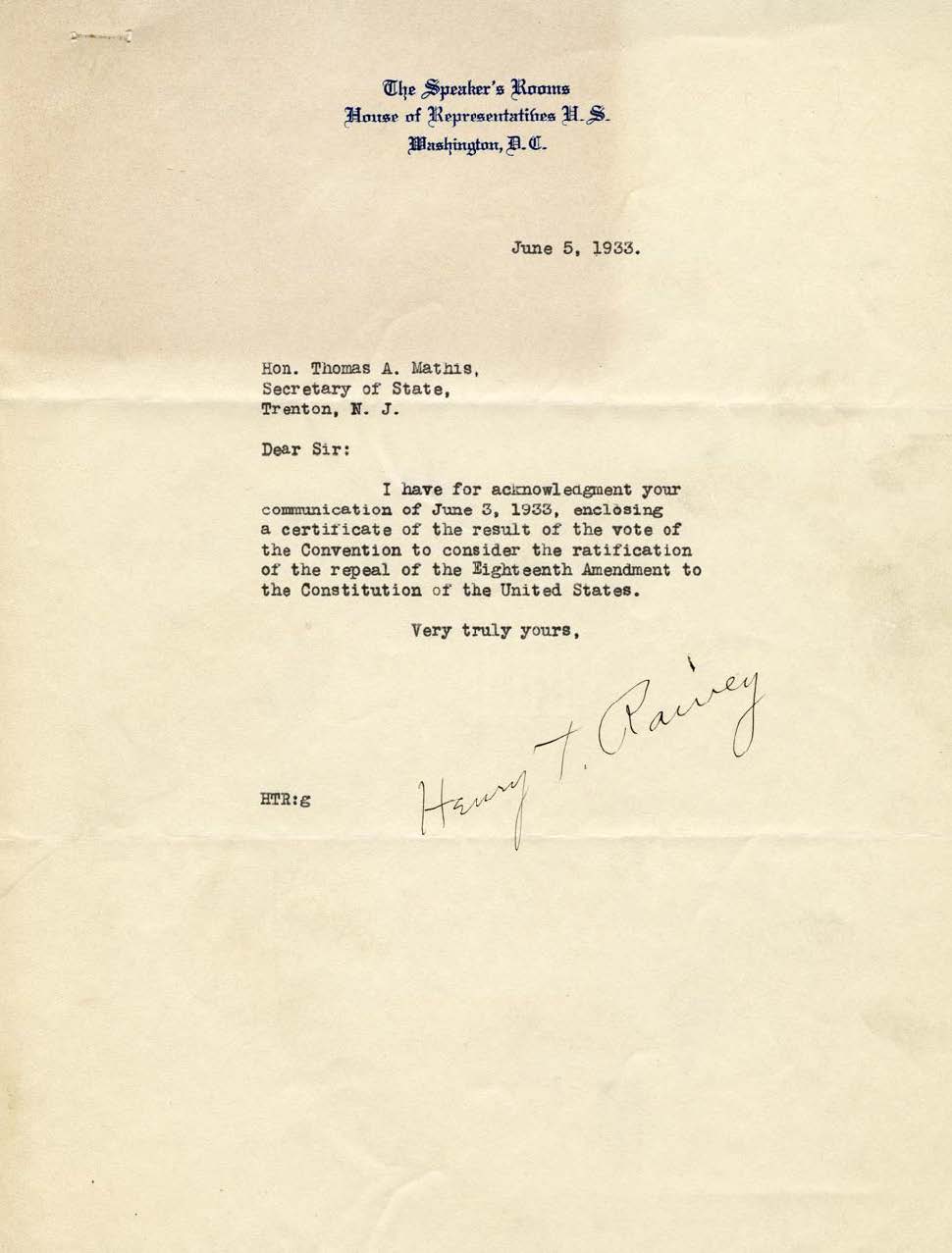
The Speaker’s Rooms
House of Representatives U.S.
Washington, D.C.
June 5, 1933
Hon. Thomas A. Mathis,
Secretary of State,
Trenton, N.J.
Dear Sir:
I have for acknowledgement your communication of June 3, 1933, enclosing a certificate of the result of the vote of the Convention to consider the ratification of the repeal of the Eighteenth Amendment to the Constitution of the United States.
Very truly yours,
/s/ Henry T. Rainey
HTR:g
Section 1. No person shall be elected to the office of the President more than twice, and no person who has held the office of President, or acted as President, for more than two years of a term to which some other person was elected President shall be elected to the office of the President more than once. But this Article shall not apply to any person holding the office of President when this Article was proposed by the Congress, and shall not prevent any person who may be holding the office of President, or acting as President, during the term within which this Article becomes operative from holding the office of President or acting as President during the remainder of such term.
Section 2. This article shall be inoperative unless it shall have been ratified as an amendment to the Constitution by the legislatures of three-fourths of the several States within seven years from the date of its submission to the States by the Congress.
Ratified by Required Number of States, 27 February 1951.
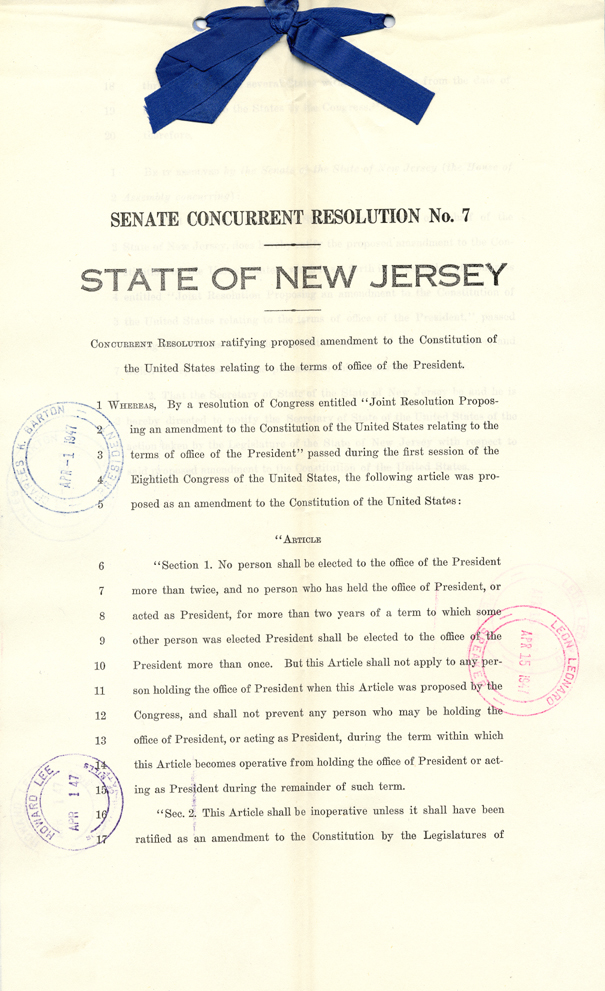
Senate Concurrent Resolution No. 7
State of New Jersey
CONCURRENT RESOLUTION ratifying proposed amendment to the Constitution of the United States relating to the terms of office of the President.
WHEREAS, By a resolution of Congress entitled “Joint Resolution proposing an amendment to the Constitution of the United States relating to the terms of office of the President” passed during the first session of the Eightieth Congress of the United States, the following article was proposed as an amendment to the Constitution of the United States:
“ARTICLE
“Section 1. No person shall be elected to the office of the President more than twice, and no person who has held the office of President, or acted as President, for more than two years of a term to which some other person was elected President shall be elected to the office of the President more than once. But this Article shall not apply to any person holding the office of President when this Article was proposed by the Congress, and shall not prevent any person who may be holding the office of President, or acting as President, during the term within which this Article becomes operative from holding the office of President or acting as President during the remainder of such term.
“Sec. 2. This Article shall be inoperative unless it shall have been ratified as an amendment to the Constitution by the Legislatures of
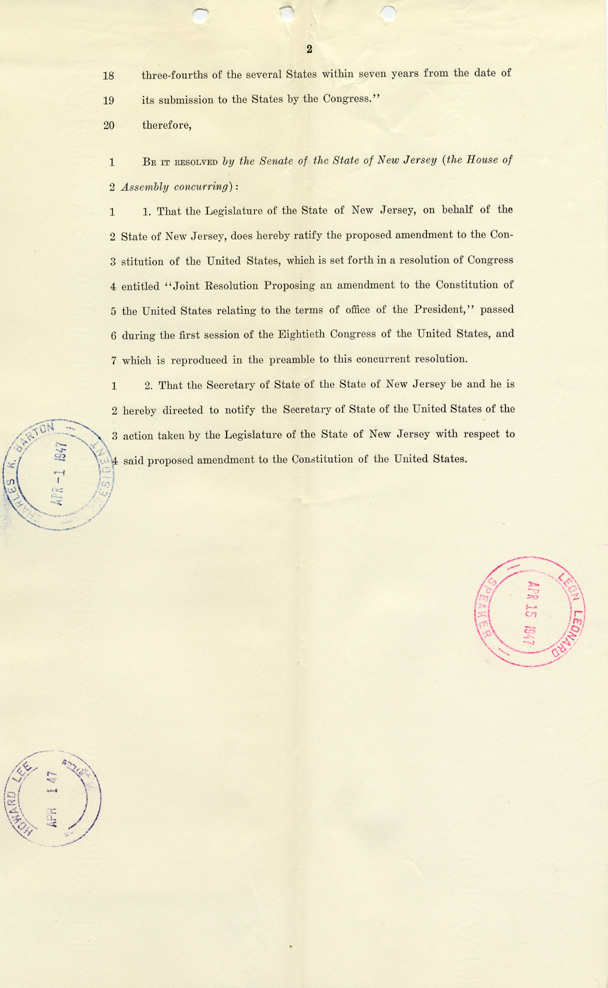
three-fourths of the several States within seven years from the date of its submission to the States by the Congress.”
therefore,
BE IT RESOLVED by the Senate of the State of New Jersey (the House of Assembly concurring):
1. That the Legislature of the State of New Jersey, on behalf of the State of New Jersey, does hereby ratify the proposed amendment to the Constitution of the United States, which is set forth in a resolution of Congress entitled “Joint Resolution Proposing an amendment to the Constitution of the United States relating to the terms of office of the President,” passed during the first session of the Eightieth Congress of the United States, and which is reproduced in the preamble to this concurrent resolution.
2. That the Secretary of State of the State of New Jersey be and he is hereby directed to notify the Secretary of State of the United States of the action taken by the Legislature of the State of New Jersey with respect to said proposed amendment to the Constitution of the United States.
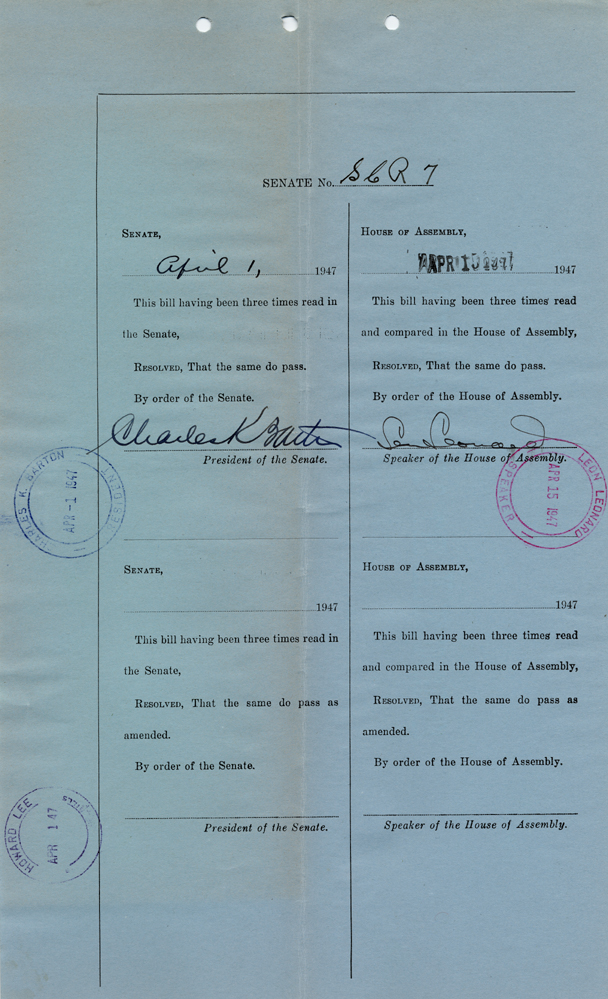
SENATE No. S.C.R. 7
SENATE,
April 1, 1947
This bill having been three times read in the Senate,
RESOLVED, That the same do pass.
By order of the Senate.
Charles K. Barton, President of the Senate
HOUSE OF ASSEMBLY,
April 15, 1947
This bill having been three times read and compared in the House of Assembly,
RESOLVED, That the same do pass.
By order of the House of Assembly.
Leon Leonard, Speaker of the House of Assembly
Section 1. The District constituting the seat of Government of the United States shall appoint in such manner as the Congress may direct:
A number of electors of President and Vice President equal to the whole number of Senators and Representatives in Congress to which the District would be entitled if it were a State, but in no event more than the least populous State; they shall be in addition to those appointed by the States, but they shall be considered, for the purposes of the election of President and Vice President, to be electors appointed by a State; and they shall meet in the District and perform such duties as provided by the twelfth article of amendment.
Section 2. The Congress shall have power to enforce this article by appropriate legislation.
Ratified by Required Number of States, 29 March 1961.
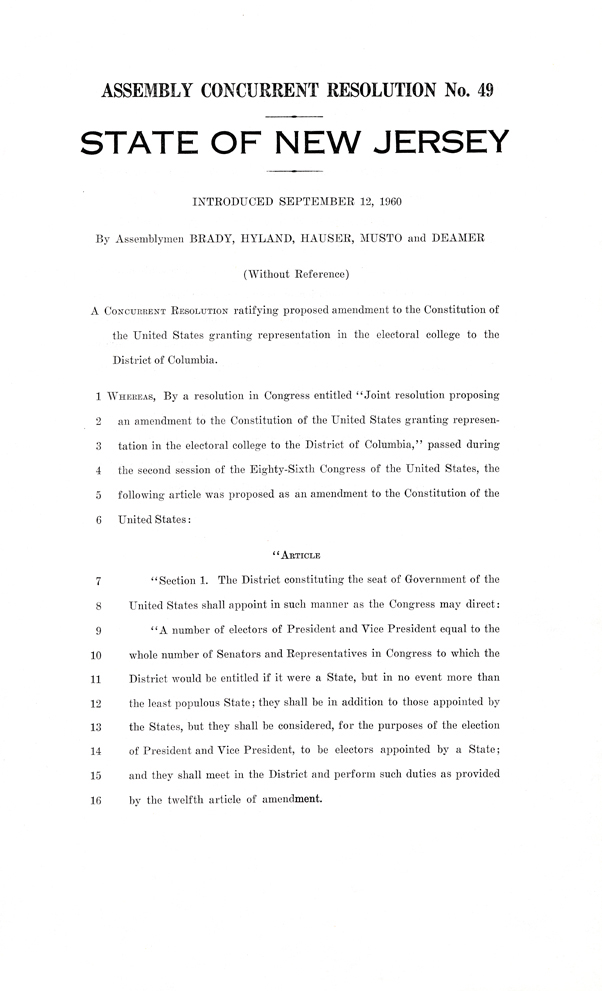
ACR 49, resolving to ratify the 23rd Amendment, was passed by the General Assembly on 12 September 1960 and by the Senate on 19 December 1960. The signed original was not found amongst the filings of the Secretary of State. The image and transcription included here are taken from the copy of the printed resolution found in the Governor's Counsel's Office bill file.
Assembly Concurrent Resolution No. 49
State of New Jersey
INTRODUCED SEPTEMBER 12, 1960
By Assemblymen BRADY, HYLAND, HAUSER, MUSTO and DEAMER
(Without Reference)
A CONCURRENT RESOLUTION ratifying proposed amendment to the Constitution of the United States granting representation in the electoral college to the District of Columbia.
WHEREAS, By a resolution in Congress entitled “Joint resolution proposing an amendment to the Constitution of the United States granting representation in the electoral college to the District of Columbia,” passed during the second session of the Eighty-Sixth Congress of the United States, the following article was proposed as an amendment to the Constitution of the United States:
“ARTICLE
“Section 1. The District constituting the seat of Government of the United States shall appoint in such manner as the Congress may direct:
“A number of electors of President and Vice President equal to the whole number of Senators and Representatives in Congress to which the District would be entitled if it were a State, but in no event more than the least populous State; they shall be in addition to those appointed by the States, but they shall be considered, for the purposes of the election of President and Vice President, to be electors appointed by a State; and they shall meet in the District and perform such duties as provided by the twelfth article of amendment.
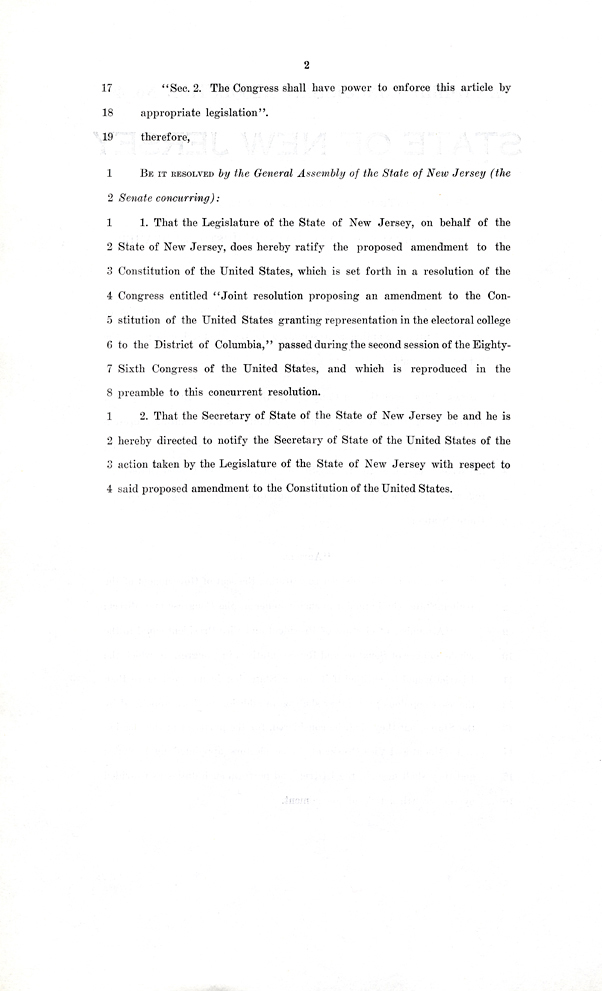
“Sec. 2. The Congress shall have power to enforce this article by appropriate legislation”.
therefore,
BE IT RESOLVED by the General Assembly of the State of New Jersey (the Senate concurring):
1. That the Legislature of the State of New Jersey, on behalf of the State of New Jersey, does hereby ratify the proposed amendment to the Constitution of the United States, which is set forth in a resolution of the Congress entitled “Joint resolution proposing an amendment to the Constitution of the United States granting representation in the electoral college to the District of Columbia,” passed during the second session of the Eighty-Sixth Congress of the United States, and which is reproduced in the preamble to this concurrent resolution.
2. That the Secretary of State of the State of New Jersey be and he is hereby directed to notify the Secretary of State of the United States of the action taken by the Legislature of the State of New Jersey with respect to said proposed amendment to the Constitution of the United States.
Section 1. The right of citizens of the United States to vote in any primary or other election for President or Vice President, for electors for President or Vice President, or for Senator or Representative in Congress, shall not be denied or abridged by the United States or any State by reason of failure to pay any poll tax or other tax.
Section 2. The Congress shall have power to enforce this Article by appropriate legislation.
Ratified by Required Number of States, 23 January 1964.
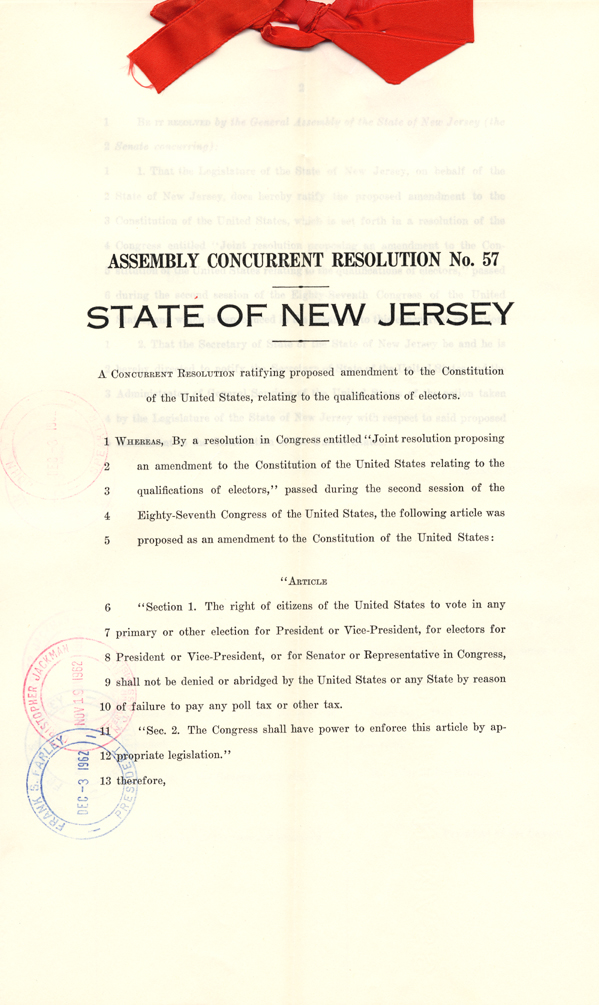
Assembly Concurrent Resolution No. 57
State of New Jersey
A CONCURRENT RESOLUTION ratifying proposed amendment to the Constitution of the United States, relating to the qualifications of electors.
WHEREAS, By a resolution in Congress entitled “Joint resolution proposing an amendment to the Constitution of the United States relating to the qualifications of electors,” passed during the second session of the Eighty-Seventh Congress of the United States, the following article was proposed as an amendment to the Constitution of the United States:
“ARTICLE
“Section 1. The right of citizens of the United States to vote in any primary or other election for President or Vice-President, for electors for President or Vice-President, or for Senator or Representative in Congress, shall not be denied or abridged by the United States or any State by reason of failure to pay any poll tax or other tax.
“Sec. 2. The Congress shall have power to enforce this article by appropriate legislation.”
therefore,
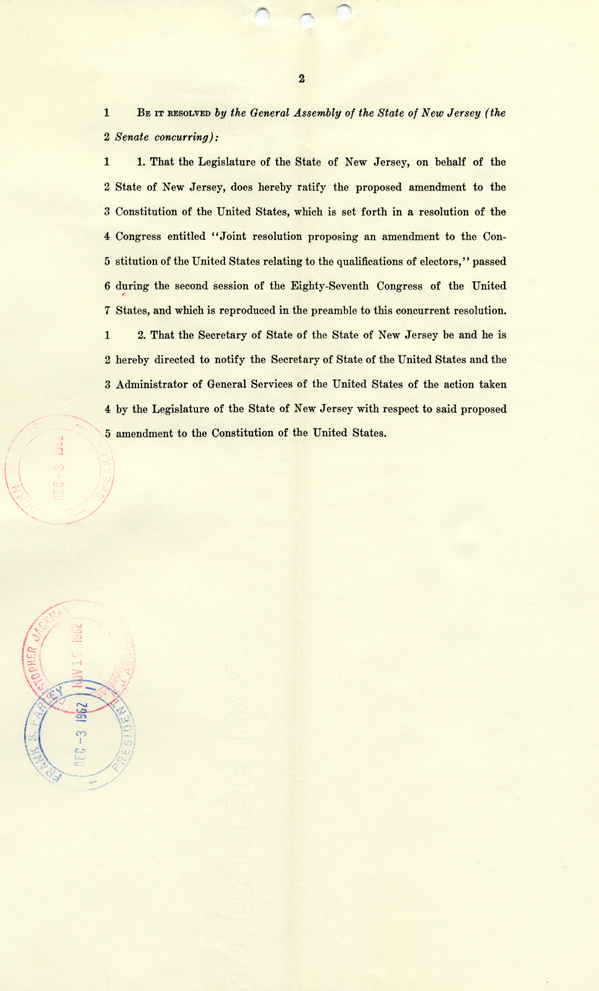
BE IT RESOLVED by the General Assembly of the State of New Jersey (the Senate concurring):
1. That the Legislature of the State of New Jersey, on behalf of the State of New Jersey, does hereby ratify the proposed amendment to the Constitution of the United States, which is set forth in a resolution of the Congress entitled “Joint resolution proposing an amendment to the Constitution of the United States relating to the qualifications of electors,” passed during the second session of the Eighty-Seventh Congress of the United States, and which is reproduced in the preamble to this concurrent resolution.
2. That the Secretary of State of the State of New Jersey be and he is hereby directed to notify the Secretary of State of the United States and the Administrator of General Services of the United States of the action taken by the Legislature of the State of New Jersey with respect to said proposed amendment to the Constitution of the United States.
GENERAL ASSEMBLY No. A.C.R. 57
GENERAL ASSEMBLY,
December 3, 1962.
This bill having been three times read in the General Assembly,
RESOLVED, That the same do pass.
By order of the General Assembly.
John W. Davis, Speaker of the General Assembly
SENATE,
December 3, 1962.
This bill having been three times read and compared in the Senate,
RESOLVED, That the same do pass.
By order of the Senate.
F. S. Farley, President of the Senate
Section 1. In case of the removal of the President from office or of his death or resignation, the Vice President shall become President.
Section 2. Whenever there is a vacancy in the office of the Vice President, the President shall nominate a Vice President who shall take office upon confirmation by a majority vote of both Houses of Congress.
Section 3. Whenever the President transmits to the President pro tempore of the Senate and the Speaker of the House of Representatives his written declaration that he is unable to discharge the powers and duties of his office, and until he transmits to them a written declaration to the contrary, such powers and duties shall be discharged by the Vice President as Acting President.
Section 4. Whenever the Vice President and a majority of either the principal officers of the executive departments or of such other body as Congress may by law provide, transmit to the President pro tempore of the Senate and the Speaker of the House of Representatives their written declaration that the President is unable to discharge the powers and duties of his office, the Vice President shall immediately assume the powers and duties of the office as Acting President.
Thereafter, when the President transmits to the President pro tempore of the Senate and the Speaker of the House of Representatives his written declaration that no inability exists, he shall resume the powers and duties of his office unless the Vice President and a majority of either the principal officers of the executive department or of such other body as Congress may by law provide, transmit within four days to the President pro tempore of the Senate and the Speaker of the House of Representatives their written declaration that the President is unable to discharge the powers and duties of his office. Thereupon Congress shall decide the issue, assembling within forty-eight hours for that purpose if not in session. If the Congress, within twenty-one days after receipt of the latter written declaration, or, if Congress is not in session, within twentyone days after Congress is required to assemble, determines by two-thirds vote of both Houses that the President is unable to discharge the powers and duties of his office, the Vice President shall continue to discharge the same as Acting President; otherwise, the President shall resume the powers and duties of his office.
Ratified by Required Number of States, 10 February 1967.
Assembly Concurrent Resolution No. 55
State of New Jersey
A CONCURRENT RESOLUTION ratifying proposed amendment to the Constitution of the United States providing for Presidential succession and inability.
WHEREAS, By a resolution of the Congress of the United States, entitled “Joint resolution proposing an amendment to the Constitution of the United States relating to succession to the Presidency and Vice-Presidency and to cases where the President is unable to discharge the powers and duties of his office,” passed by the Congress at the first session of the Eighty-Ninth Congress, the following article was proposed as an amendment to the Constitution of the United States:
“ARTICLE —
“Section 1. In case of the removal of the President from office or of his death or resignation, the Vice President shall become President.
“Sec. 2. Whenever there is a vacancy in the office of the Vice President, the President shall nominate a Vice President who shall take office upon confirmation by a majority vote of both Houses of Congress.
“Sec. 3. Whenever the President transmits to the President pro tempore of the Senate and the Speaker of the House of Representatives
his written declaration that he is unable to discharge the powers and duties of his office, and until he transmits to them a written declaration to the contrary, such powers and duties shall be discharged by the Vice President as Acting President.
“Sec. 4. Whenever the Vice President and a majority of either the principal officers of the executive departments or of such other body as Congress may by law provide, transmit to the President pro tempore of the Senate and the Speaker of the House of Representatives their written declaration that the President is unable to discharge the powers and duties of his office, the Vice President shall immediately assume the powers and duties of the office as Acting President.
“Thereafter, when the President transmits to the President pro tempore of the Senate and the Speaker of the House of Representatives his written declaration that no inability exists, he shall resume the powers and duties of his office unless the Vice President and a majority of either the principal officers of the executive department or of such other body as Congress may by law provide, transmit within four days to the President pro tempore of the Senate and the Speaker of the House of Representatives their written declaration that the President is unable to discharge the powers and duties of his office. Thereupon Congress shall decide the issue, assembling within forty-eight hours for that purpose if not in session. If the Congress, within twenty-one days after receipt of the latter written declaration, or, if Congress is not in session, within twenty-one days after Congress is required to assemble, determines by two-thirds vote of both Houses that the President is unable to discharge the powers and duties of his office, the Vice President shall continue to discharge the same as Acting President; otherwise, the President shall resume the powers and duties of his office.”
therefore,
BE IT RESOLVED by the General Assembly of the State of New Jersey (the Senate concurring):
1. That the Legislature of the State of New Jersey, on behalf of the State of New Jersey, does hereby ratify the proposed amendment to the Constitution of the United States, which is set forth in a resolution of the Congress entitled “Joint resolution proposing an amendment to the Constitution of the United States relating to succession to the Presidency and Vice-Presidency and to cases where the President is unable to discharge the powers and duties of his office,” passed during the first session of the Eighty-Ninth Congress of the United States, and which is reproduced in the preamble to this concurrent resolution.
2. That the Secretary of State of the State of New Jersey be and he is hereby directed to notify the Secretary of State of the United States of the action taken by the Legislature of the State of New Jersey with respect to said proposed amendment to the Constitution of the United States.
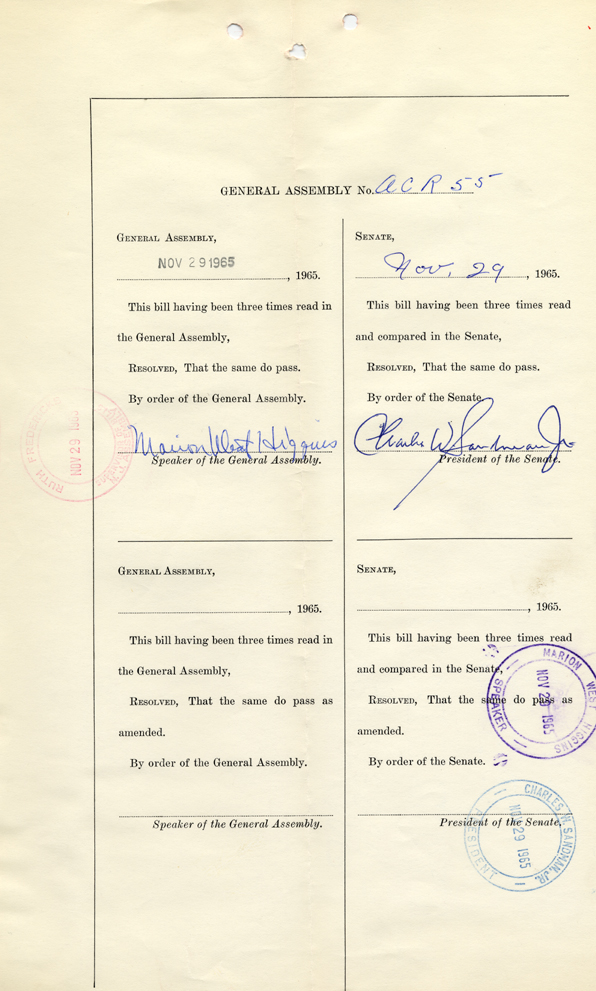
GENERAL ASSEMBLY No. A.C.R. 55
GENERAL ASSEMBLY,
November 29, 1965.
This bill having been three times read in the General Assembly,
RESOLVED, That the same do pass.
By order of the General Assembly.
Marion West Higgins,
Speaker of the General Assembly
SENATE,
November 29, 1965.
This bill having been three times read and compared in the Senate,
RESOLVED, That the same do pass.
By order of the Senate.
Charles W. Sandman, Jr.,
President of the Senate
Section 1. The right of citizens of the United States, who are eighteen years of age or older, to vote shall not be denied or abridged by the United States or by any State on account of age.
Section 2. The Congress shall have power to enforce this article by appropriate legislation.
Ratified by Required Number of States, 1 July 1971.
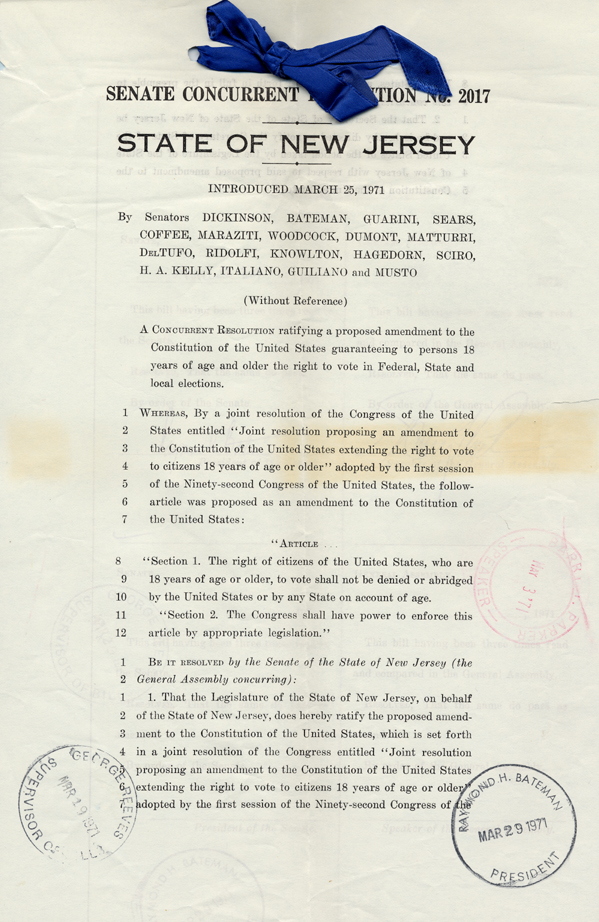
Senate Concurrent Resolution No. 2017
State of New Jersey
INTRODUCED MARCH 25, 1971
By Senators DICKINSON, BATEMAN, GUARINI, SEARS, COFFEE, MARAZITI, WOODCOCK, DUMONT, MATTURRI, DELTUFO, RIDOLFI, KNOWLTON, HAGEDORN, SCIRO, H.A. KELLY, ITALIANO, GUILIANO and MUSTO
(Without Reference)
A CONCURRENT RESOLUTION ratifying a proposed amendment to the Constitution of the United States guaranteeing to persons 18 years of age and older the right to vote in Federal, State and local elections.
WHEREAS, By a joint resolution of the Congress of the United States entitled “Joint resolution proposing an amendment to the Constitution of the United States extending the right to vote to citizens 18 years of age or older” adopted by the first session of the Ninety-second Congress of the United States, the following article was proposed as an amendment to the Constitution of the United States:
“ARTICLE
“Section 1. The right of citizens of the United States, who are 18 years of age or older, to vote shall not be denied or abridged by the United States or by any State on account of age.
“Sec. 2. The Congress shall have power to enforce this article by appropriate legislation.”
BE IT RESOLVED by the Senate of the State of New Jersey (the General Assembly concurring):
1. That the Legislature of the State of New Jersey, on behalf of the State of New Jersey, does hereby ratify the proposed amendment to the Constitution of the United States, which is set forth in a joint resolution of the Congress entitled “Joint resolution proposing an amendment to the Constitution of the United States extending the right to vote to citizens 18 years of age or older” adopted by the first session of the Ninety-second Congress of the
United States, and which is set forth in full in the preamble to this concurrent resolution.
2. That the Secretary of State of the State of New Jersey be and he is hereby directed to notify the Secretary of State of the United States of the action taken by the Legislature of the State of New Jersey with respect to said proposed amendment to the Constitution of the United States.
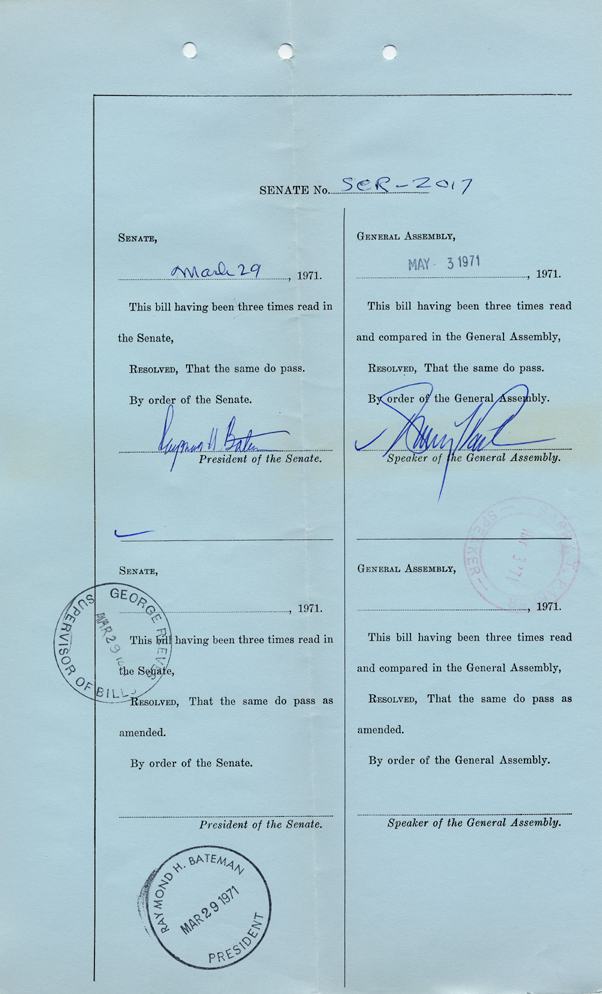
SENATE No. S.C.R. 2017
SENATE,
March 29, 1971.
This bill having been three times read in the Senate,
RESOLVED, That the same do pass.
By order of the Senate.
Raymond H. Bateman, President of the Senate
GENERAL ASSEMBLY,
May 3, 1971
This bill having been three times read and compared in the General Assembly,
RESOLVED, That the same do pass.
By order of the General Assembly.
George Reeves, Speaker of the General Assembly
No law, varying the compensation for the services of the Senators and Representatives, shall take effect, until an election of Representatives shall have intervened.
Ratified by Required Number of States, 7 May 1992.
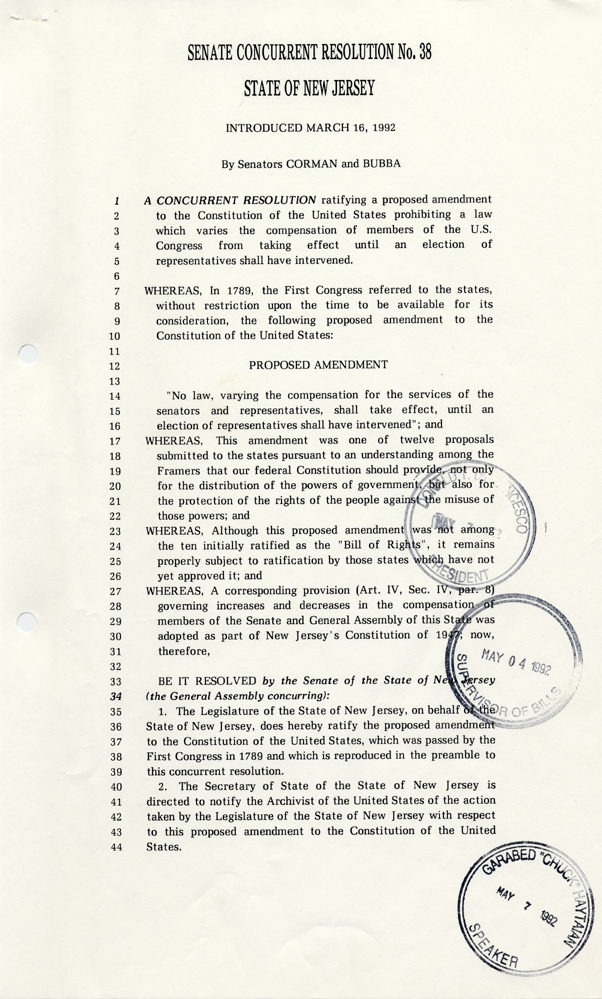
Senate Concurrent Resolution No. 38
State of New Jersey
INTRODUCED MARCH 16, 1992
By Senators CORMAN and BUBBA
A CONCURRENT RESOLUTION ratifying a proposed amendment to the Constitution of the United States prohibiting a law which varies the compensation of members of the U.S. Congress from taking effect until an election of representatives shall have intervened.
WHEREAS, in 1789, the First Congress referred to the states, without restriction upon the time to be available for its consideration, the following proposed amendment to the Constitution of the United States:
PROPOSED AMENDMENT
“No law, varying the compensation for the services of the senators and representatives, shall take effect, until an election of representatives shall have intervened”; and
WHEREAS, This amendment was one of twelve proposals submitted to the states pursuant to an understanding among the Framers that our federal Constitution should provide, not only for the distribution of the powers of government, but also for the protection of the rights of the people against the misuse of those powers; and
WHEREAS, Although this proposed amendment was not among the ten initially ratified as the “Bill of Rights”, it remains properly subject to ratification by those states which have not yet approved it; and
WHEREAS, A corresponding provision (Art. IV, Sec. IV, par. 8) governing increases and decreases in the compensation of members of the Senate and General Assembly of this State was adopted as part of New Jersey’s Constitution of 1947; now, therefore,
BE IT RESOLVED by the Senate of the State of New Jersey (the General Assembly concurring):
1. The Legislature of the State of New Jersey, on behalf of the State of New Jersey, does hereby ratify the proposed amendment to the Constitution of the United States, which was passed by the First Congress in 1789 and which is reproduced in the preamble to this concurrent resolution.
2. The Secretary of State of the State of New Jersey is directed to notify the Archivist of the United States of the action taken by the Legislature of the State of New Jersey with respect to this proposed amendment to the Constitution of the United States.
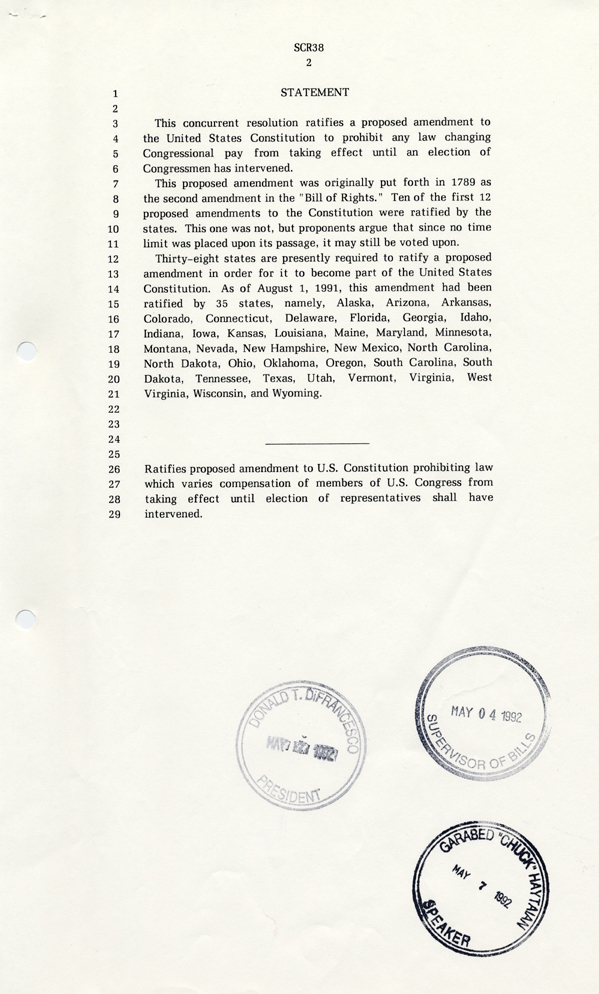
STATEMENT
This concurrent resolution ratifies a proposed amendment to the United States Constitution to prohibit any law changing Congressional pay from taking effect until an election of Congressmen has intervened.
This proposed amendment was originally put forth in 1789 as the second amendment in the “Bill of Rights.” Ten of the first 12 proposed amendments to the Constitution were ratified by the states. This one was not, but proponents argue that since no time limit was placed upon its passage, it may still be voted upon.
Thirty-eight states are presently required to ratify a proposed amendment in order for it to become part of the United States Constitution. As of August 1, 1991, this amendment had been ratified by 35 states, namely, Alaska, Arizona, Arkansas, Colorado, Connecticut, Delaware, Florida, Georgia, Idaho, Indiana, Iowa, Kansas, Louisiana, Maine, Maryland, Minnesota, Montana, Nevada, New Hampshire, New Mexico, North Carolina, North Dakota, Ohio, Oklahoma, Oregon, South Carolina, South Dakota, Tennessee, Texas, Utah, Vermont, Virginia, West Virginia, Wisconsin, and Wyoming.
Ratifies proposed amendment to U.S. Constitution prohibiting law which varies compensation of members of U.S. Congress from taking effect until election of representatives shall have intervened.
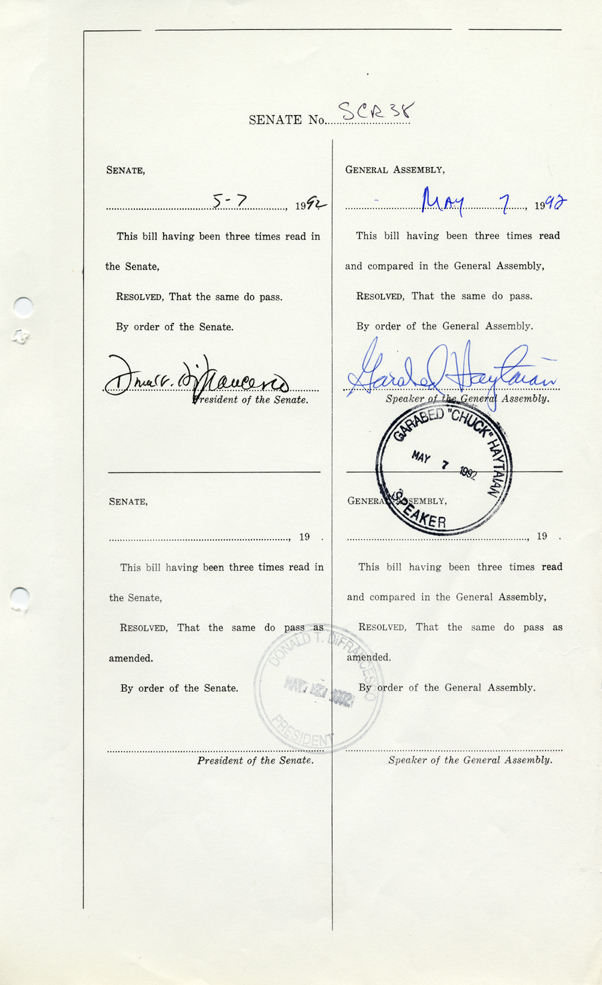
SENATE No. S.C.R. 38
SENATE,
May 7, 1992.
This bill having been three times read in the Senate,
RESOLVED, That the same do pass.
By order of the Senate.
Donald DiFrancisco, President of the Senate
GENERAL ASSEMBLY,
May 7, 1992.
This bill having been three times read and compared in the General Assembly,
RESOLVED, That the same do pass.
By order of the General Assembly.
Garabed Haytaian, Speaker of the General Assembly
Page Last Updated: 06/23/26

 Official Site of The State of New Jersey