
 |
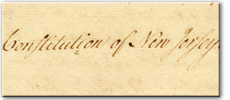
1776 State ConstitutionOn 2 July 1776, New Jersey became the fourth American colony to adopt a constitution declaring independence from Great Britain. It was composed in five days, and although the delegates considered it a temporary charter, it remained New Jersey's state constitution for sixty-eight years. |
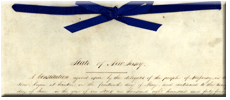 |
1844 State ConstitutionNew Jersey's second constitution shifted governmental power, which had been vested largely in the legislature under the State's first charter, to the executive branch. In addition to direct election of the governor by the voters, the 1844 State Constitution also provided for gubernatorial veto power and the appointment of most high-level officials by the governor. |
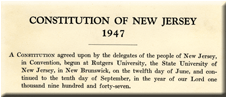 |
1947 State ConstitutionNew Jersey's current state constitution was drafted by a convention of delegates from each county, convened from 12 June to 10 September 1947. The new charter further strengthened the Office of the Governor and reorganized and unified the judicial system under the Supreme Court. |
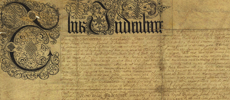 |
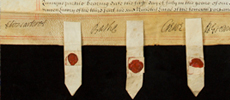
Release of James, Duke of York to John Lord Berkeley, and Sir George Carteret, June 24, 1664In March 1664, King Charles II of England granted his brother James, Duke of York, lands in the New World including Maine, Long Island, and territory between the Connecticut and Delaware Rivers. On June 24, 1664, James presented a valuable portion of this land to John, Lord Berkeley, and Sir George Carteret in recognition of their loyalty to the Crown during the English Civil War. Described by one of the Duke's followers as some of the "most improvabelest land" held by James, this new proprietary colony was called Nova Cesarea or New Jersey. In a very real sense, this document represents the birth certificate of New Jersey. |
 |
Dame Elizabeth Carteret’s 1682 ReleaseDame Elizabeth Carteret’s 1682 release resulted from her petition to the Duke of York to allow her to sell her half of the Province of New Jersey to the twelve future proprietors of East New Jersey, including William Penn. |
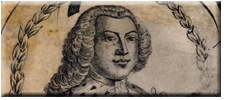 |
William Franklin Appointment, 1762William Franklin (ca. 1730/31-1813) was the thirteenth, and last, of New Jersey's royal governors. He was the natural son of Philadelphia printer and diplomat Benjamin Franklin, through whose influence William was appointed to the New Jersey governorship on 9 September 1762. |
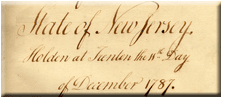 |
Convention MinutesOn December 18, 1787, New Jersey become the third state to ratify the United States Constitution. The minutes of the ratification convention document the quick work of the delegates. They required only six days to establish rules, review the document, and complete their deliberations. |
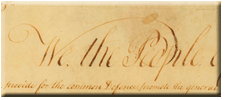 |
New Jersey's RatificationFollowing the unanimous approval of the federal constitution by New Jersey's ratification convention, the delegates directed their secretary to engross the ratification on vellum for signature. This document contains the full text of the constitution, the form of ratification, the original delegates’ signatures, and the convention secretary's attestation. |
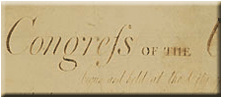 |
New Jersey's Bill of RightsOn November 20, 1789, New Jersey became the first state to ratify the Bill of Rights. Of the twelve proposed constitutional amendments, New Jersey approved eleven. Articles 3 through 12 became the 1st through 10th Amendments, guaranteeing fundamental rights and freedoms for all American citizens. |
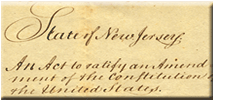 |
Constitutional AmendmentsSince its ratification in 1788, the United States Constitution has been amended twenty-seven times. New Jersey was the first state to ratify the first ten amendments, known as the Bill of Rights. In all, our state has ratified 26 of the 27 proposed amendments approved by the required three-fourths of the states. |
Page Last Updated: 07/20/26

 Official Site of The State of New Jersey