 Official Site of The State of New Jersey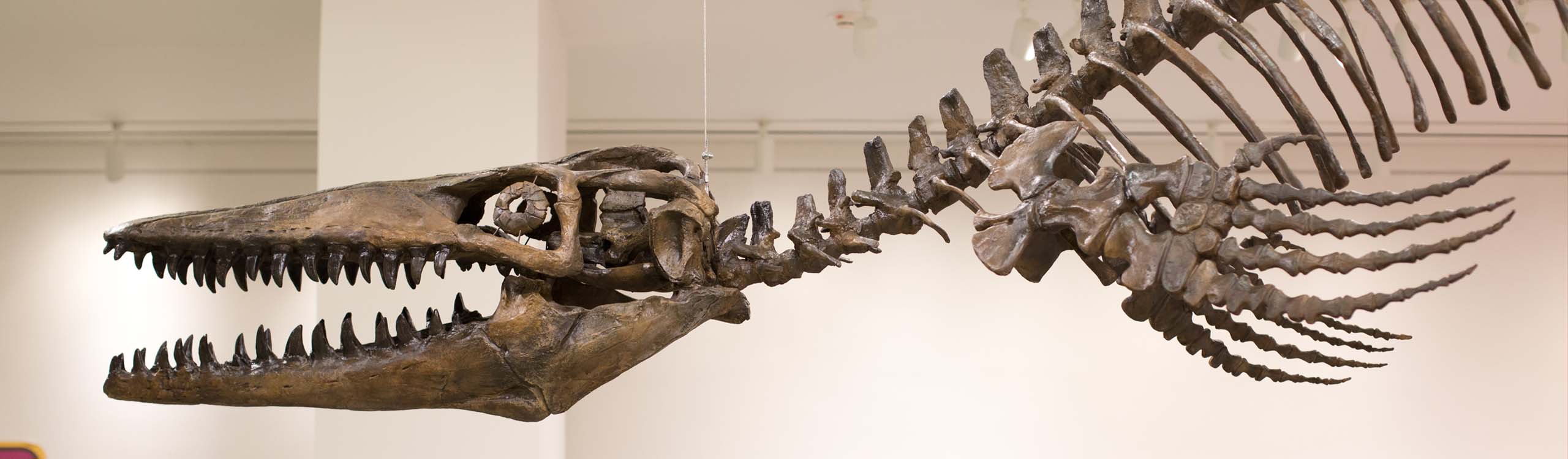
On view April 28, 2026 – January 10, 2027
In celebration of the United States Semiquincentennial and New Jersey’s 250th, the New Jersey State Archives, in collaboration with the New Jersey State Museum, presents “The Power of Change: Revolutionary Stories.” The exhibit highlights rarely seen foundational federal and state government documents. Visitors will also explore how revolutionary ideals, fought for by our founders, influenced the newly established government and continue to allow for reinterpretation and adaptation today.
Opening February 14, 2026
Polyester pants and platform shoes; pinball machines and Parliament Funkadelic; petroleum crises and presidential pandemonium. That’s right – the State Museum is going back to the Seventies for this upcoming exhibition. In 1976, Americans looked to heal the wounds wrought by the tumultuous 1960s and put aside their many differences in a widespread celebration of the nation’s 200th birthday. Drawing exclusively from the State Museum’s own collections, Spirit of ‘76: The Bicentennial showcases an assortment of never-before-exhibited artifacts and artworks produced fifty years ago as part of the energy and excitement of the Bicentennial. Highlights include masterpieces of porcelain by the Cybis studio of Trenton, silkscreen and lithographic prints by New Jersey-native Jacob Lawrence and other American artists from the Kent Bicentennial Portfolio and a handcrafted cotton album quilt made by a group of first-time fiber artists from Princeton. Can you dig it?
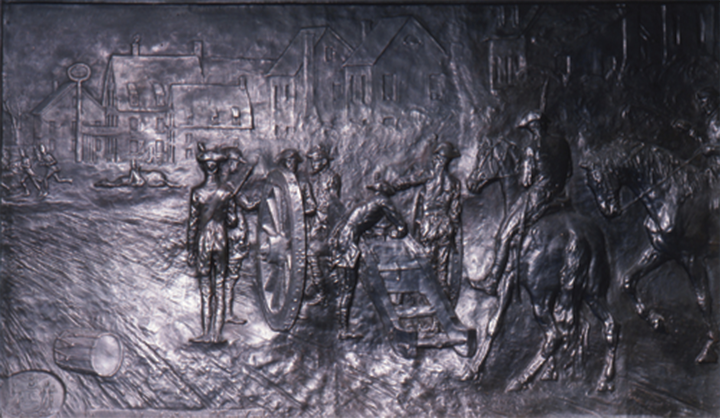
The Museum’s long-term exhibition, Remembering the Revolution, is centered around two monumental bronze tablets by the American artist Thomas Eakins (1844-1916), widely acknowledged as one of America’s most important artists. In 1892, Eakins was contracted to design historical tablets for what we know today at the Trenton Battle Monument (350 North Warren St., Trenton). The Monument, dedicated in 1893, marks the Continental Army’s artillery emplacement from the December 26, 1776 Battle of Trenton.
In 1968, the Corcoran Gallery of Art (Washington, DC), made a request to the NJ Department of Conservation and Economic Development to borrow the tablets for an exhibition on the sculpture of Thomas Eakins. However, during the work to temporarily remove the tablets from the Monument, it was discovered that they were beginning to be impacted by acid rain, bird droppings and other environmental issues. Due to the desire to protect the tablets from further damage, the conservators consulting on the project recommended that duplicate tables be cast for installation on the Monument. The Hirshhorn Foundation offered to pay for the duplicates, provided a second duplicate set could be cast for the collection of the Hirshhorn Museum (Washington, DC). The then-Director of the NJ State Museum Kenneth Prescott requested that the original bronzes be transferred to the State Museum’s collection.
Thomas Eakins’ bronze panels recounting the Battle of Trenton are among the finest examples of commemorative achievement. So too are the ceramics that master potter Isaac Broome made for the 1876 World’s Fair. The original ‘Eakins bronzes,’ and a changing selection of Revolutionary era-inspired/commemorative works from the State Museum Cultural History and Fine Art collections are on view in the exhibition, Remembering the Revolution, which illustrates how New Jersey has remembered the era through art and craft.
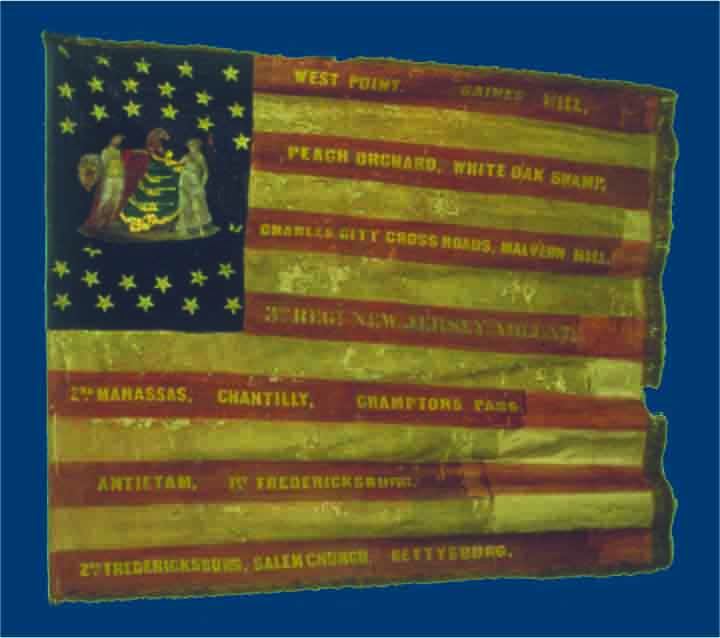 National Color with battle honors, 3rd Infantry Regiment, New Jersey Volunteers, 1861
Main Building - South Gallery, 1st floor
Get up close and personal with a rare collection of flags carried into battle by New Jersey’s Civil War soldiers and learn about our important role in the history of the War Between the States. New Jersey is one of the few states to actively display its Civil War flags, which were often returned to capital cities after the war.
The flags change periodically, allowing visitors to experience new examples from the collection.
On long-term view
Main Building - 2nd floor
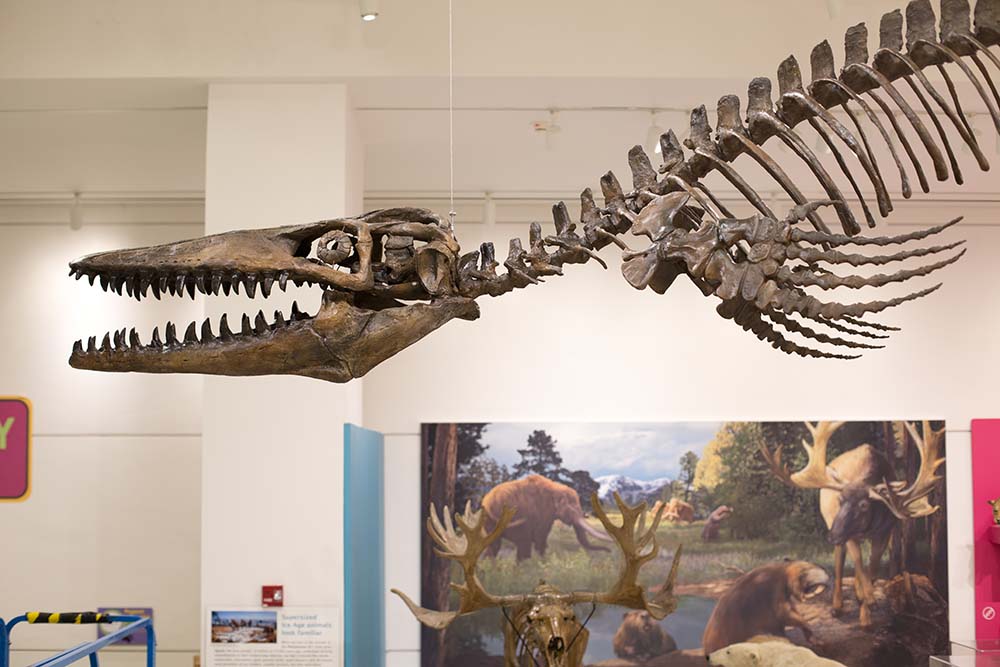
The exhibition presents unique fossil stories that offer intriguing clues about our ever-changing planet, how life on Earth has evolved and adapted… or gone extinct. Step back 3.5 billion years to explore the geology of New Jersey, the oldest fossils from the state and the progression of life here. Learn about the evolution of turtles, fish, mammals and birds. Meet New Jersey’s own Dryptosaurus, the world’s first known carnivorous dinosaur, reconstructed and displayed for the first time ever! Marvel at a life-sized cast of New Jersey’s state dinosaur, Hadrosaurus foulkii, and a Mosasaurus maximus – a 50-foot marine reptile discovered in southern New Jersey. These two specimens are on long-term view thanks to support from NJM Insurance Group and the New Jersey State Museum Foundation. The exhibition concludes with a look at Ice Age animals and their modern day relatives.
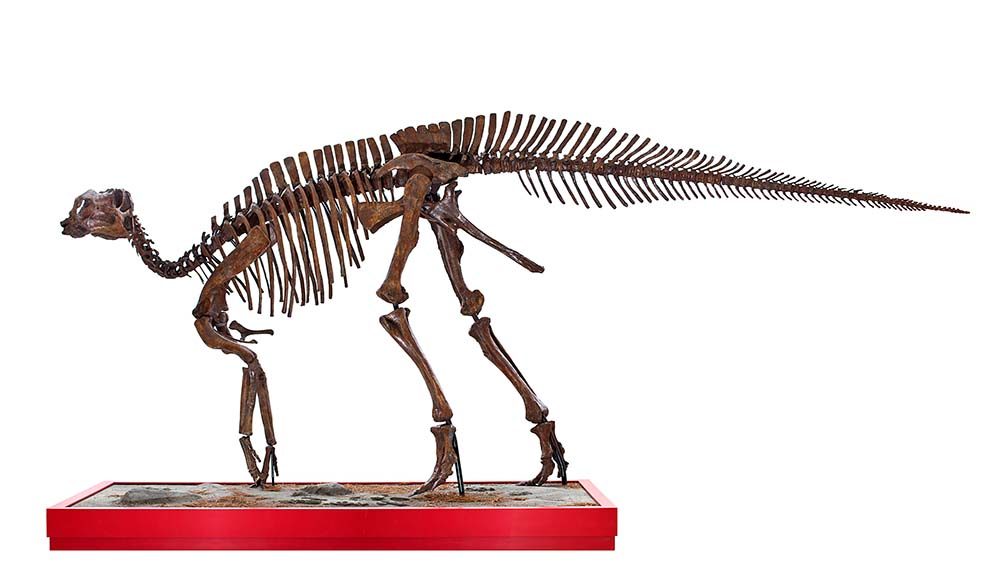
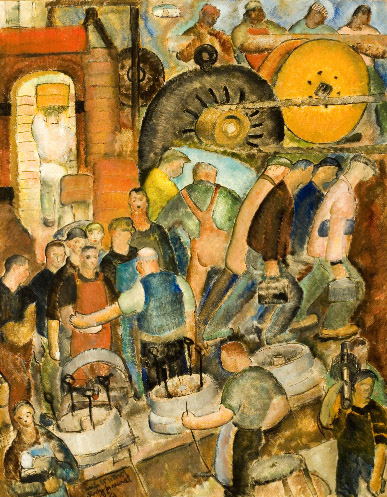
IMAGE CREDIT: Charles Ward (1900-62)
Study for Mural (1934) - oil on board
NJ State Museum Collection
Gift of the Friends of the New Jersey State Museum
FA1999.3
On Long-term View
Main Building - 2nd Floor Galleries
This installation highlights the diversity of voices and visions found in 19th through 21st century American art. The exhibition explores the sources of artists' inspiration and how these inspirations changed over time; how travel to Europe - and the art being made there - influenced American trends; the impact of immigrant artists bringing their own sensibilities to the US; and how world and US events (historical, political, cultural, etc.) impacted artists.
The exhibition allows visitors to see that art-making does not happen in a stylistic or ideological vacuum. Works created by academic, expressionist, folk, modernist and visionary artists will be shown together in a roughly chronological format to present the range, variety and complexity of America's fine art. In addition, important works by significant NJ artists will be highlighted within the context of American art.
The exhibition was made possible, in part, with support from the Friends of the New Jersey State Museum through the Lucille M. Paris Fund.
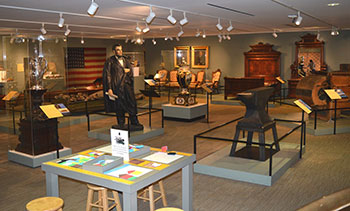
View of the Pretty Big Things gallery.
On Long-term View
Main Building - 3rd Floor
A 1,400-pound anvil made by Trenton's Fisher & Norris Eagle Anvil Works. An iron pot used to render whale blubber on the Jersey Shore. A hand-carved statue of the tallest American president. A "grandfather" clock made by the first African-American clockmaker. A grandiose Dutch immigrant wardrobe crafted in the 18th century.
What do these five historical artifacts have in common? They are all pretty big things. Using a non-traditional approach that eschews strict chronology, this educational exhibit consisting of compelling artifacts and hands-on activities for families takes visitors on an eclectic journey into unknown stories of New Jersey history using some of the "biggest" artifacts from the museum's Cultural History collection.
Do you know which American presidents have historical ties to our state? Can you name the symbols found on the Great Seal of the State of New Jersey? Did you ever wonder why New Jersey is called the Garden State? Do you know the difference between locally-made furniture types known as the linen press, the kast, and the chest-on-chest?
Can you name a New Jersey industry that was represented at the famous 1876 Centennial International Exposition in Philadelphia? Come to the State Museum in order to learn the answers to these big questions of New Jersey history and to celebrate the rich historic heritage of our state.
Pretty Big Things: Stories of New Jersey History is the long-term core exhibition for the New Jersey State Museum's Cultural History Bureau, a diverse collection of historical artifacts documenting the history of everyday life in New Jersey from colonial times through the present day.
The exhibition was made possible, in part, with support from the Friends of the New Jersey State Museum through the Lucille M. Paris Fund.
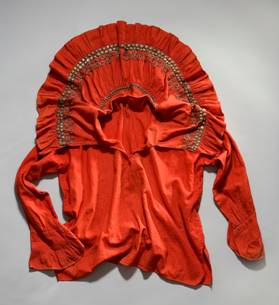
IMAGE CREDIT: Delaware Woman's Blouse with Silver Brooches (c.1810-80)
Cotton, cotton thread, silver and dye
Collected by anthropologist Frank G. Speck
from the daughter of Chief Wooden Buffalo
Gift of Frank G. Speck
AE 3202
On Long-term View
Main Building - Lower Level Gallery
This exhibition offers visitors a glimpse into the lives of the Delaware Indians over a two hundred year time span. From the 1740s to the 1890s, many of New Jersey's Indians moved out of the state ahead of the ever-expanding non-Indian population. Artist and chronicler of American Indians, George Catlin (1796-1872), noted as early as 1832 that the Delaware were among the most relocated Indians in the United States. This exhibition tells the story of these migrations.
In the late 1800s and into the 1900s, the Indians that remained in New Jersey survived by adapting to a market economy. They developed handcraft industries which produced items desired by non-Indian settlers. The Indians produced baskets and other woven items such as mats and brooms, as well as carved wooden pieces such as mortars and shovels.
The descendents of the Delaware Indians who left New Jersey, as well as those who stayed, continue to follow and adapt their cultural and religious traditions, thus preserving them for future generations and sharing them with all other cultures.
The objects on view, which date from the late 1700s to the early 1900s, include a woman's blouse with silver brooches, splint baskets, a wooden shovel, a leather pipe bag decorated with glass beads, children's moccasins and a child's basket.
The exhibition was made possible through funding support provided by PSEG Foundation, with additional generous support provided by the Friends of the New Jersey State Museum.
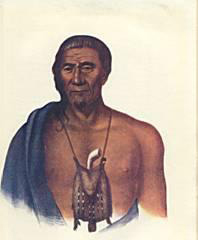
IMAGE CREDIT: After Gustavus Hesselius Tish-Co-Han
A Delaware Chief (c.1837-1844)
Hand-colored lithograph from "The McKenney-Hall Portrait Gallery of American Indians"
Published by J.T. Bowen, Philadelphia
New Jersey State Museum Collection
Museum Purchase
FA1980.49.17
On long-term view
Main Building - Lower Level
The exhibition provides a view of the seventeenth-century Dutch, Swedish and English competition to start colonies within what is today New Jersey and to develop a successful fur trade with the Indians who were living here.
The visitor is given the opportunity to view this exciting period of history through Native American and European objects produced during this fierce competition. The impact of the Europeans' arrival and eventual settlement on the lifestyle of the Indian inhabitants is also presented through early documents and historic maps and drawings. Artifacts on display include a rare dugout canoe along with examples of seventeenth-century Indian fishing equipment and domestic and personal items drawn from the Museum's extensive Native American archaeological collections. English- and Dutch-made seventeenth-century trade goods recovered from excavations at Indian sites include metal axes and hoes, glass beads, a rare brass kettle, gun parts, and white clay smoking pipes.
A selection of tools and ornaments the Indians made from broken brass kettles is also in the exhibition, along with a reconstruction of how wampum (small shell beads) was made by the Indians. Historic wampum beads are displayed and the importance of the beads in the fur trade is presented through historic accounts. The exhibition includes the earliest images of the Indians of the area drawn by European colonists and the earliest maps showing sites of Indian settlements in the seventeenth-century.
The exhibition was funded by the Friends of the New Jersey State Museum through a generous grant from the Estate of Paul Stillman, Wachovia Bank, Executor.
Page Last Updated: 05/15/26
 Subscribe to our Newsletter